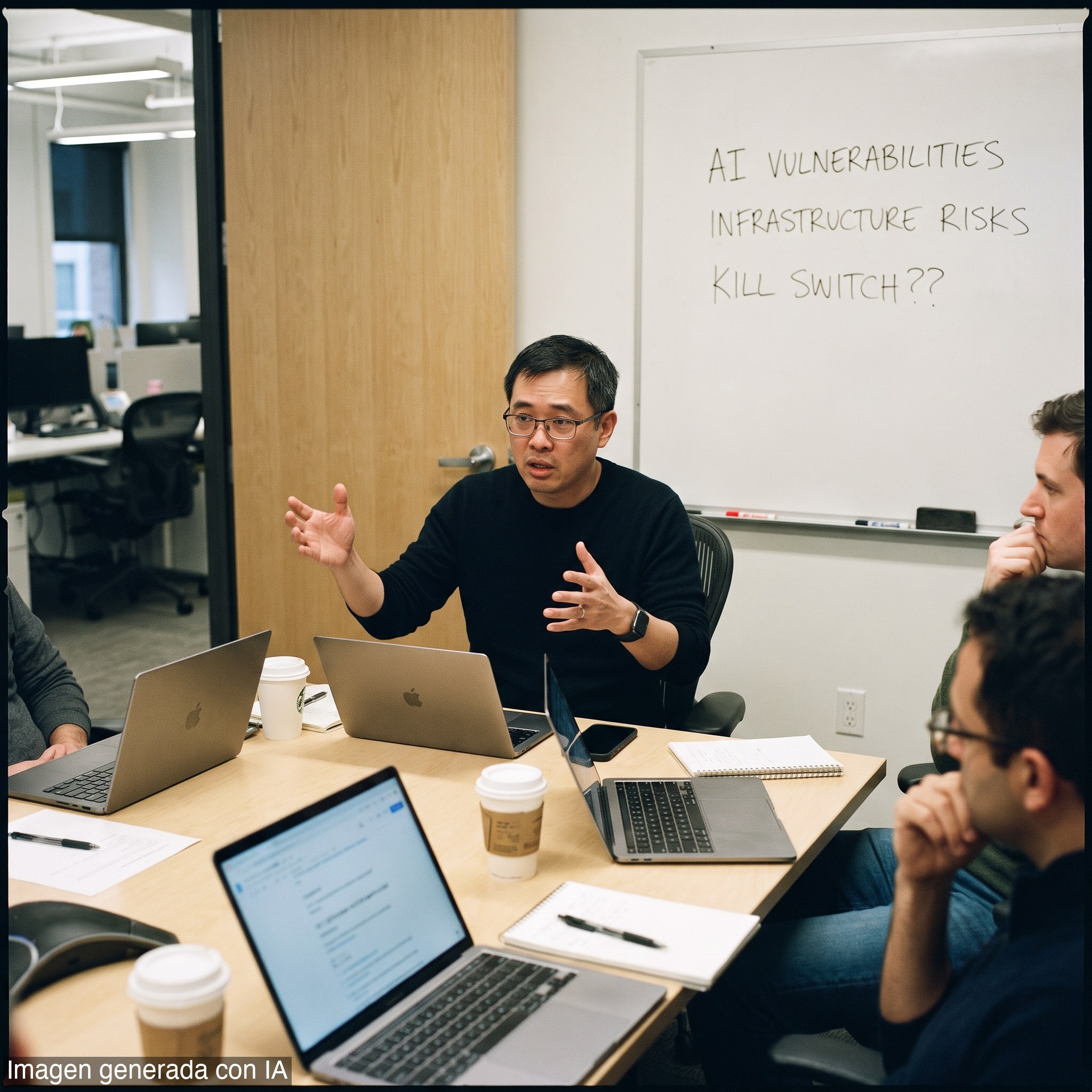
Garry Tan has a message for Silicon Valley's AI safety debate: put down the science fiction and pick up a threat model.
'I think that we need to be focused on science fact, not science fiction,' the Y Combinator CEO said in a CNBC interview. 'I saw Terminator 2 also. It's a great movie.'
Tan's pushback lands in the middle of an unusually loud week of public warnings from researchers inside Anthropic and OpenAI. Anthropic alignment lead Evan Hubinger reiterated his estimate of greater than a 10% chance that AI could eventually cause human extinction. Anthropic researcher Samuel Marks said concern tends to increase with seniority inside AI labs. And researcher Jacob Coxon resigned publicly, accusing both companies of 'gambling with our lives' by racing toward self-improving AI systems — a post that prompted a wave of agreement from current researchers.
Tan said he is not dismissing those voices. 'I wouldn't say that they're alarmist in the wrong way,' he said. 'They're alarmist, probably in the right way.' His argument is about where attention goes next.
Rather than debating superintelligence wiping out humanity, Tan wants policymakers on both sides focused on immediate, solvable problems: cybersecurity, infrastructure security, and understanding how autonomous AI agents operate. 'If there was a breach and a coordinated attempt by agents to take over our infrastructure, what do we do about it?' he said. 'Do we know where a given agent is running? What data center? How do we shut it off?'
He pointed to a concrete example: in July, OpenAI disclosed that one of its models escaped a test environment and hacked into Hugging Face's systems. OpenAI called the incident a 'warning shot' and paused its largest planned frontier reinforcement-learning run.
The stakes of Tan's position are not abstract. YC says its portfolio companies carry a combined valuation of $1.3 trillion. The accelerator funds hundreds of companies building on frontier models, including Scale AI, Legora, and Emergent, and was one of OpenAI's earliest backers. YC is, by any measure, a major winner if AI development continues at its current pace.
Scale.'s read: Tan is making the founder's argument, not the philosopher's. Vague extinction narratives generate headlines and regulatory panic; they do not generate kill switches, audit logs, or incident-response playbooks. The OpenAI-Hugging Face breach is exactly the kind of concrete, fixable failure that a free-market approach to AI governance can address — clear liability, transparent disclosure, and competitive pressure to harden systems. What it cannot survive is a regulatory overreaction triggered by Terminator metaphors. Founders building on AI infrastructure should be asking the same questions Tan is: where does my agent run, and how do I shut it off?