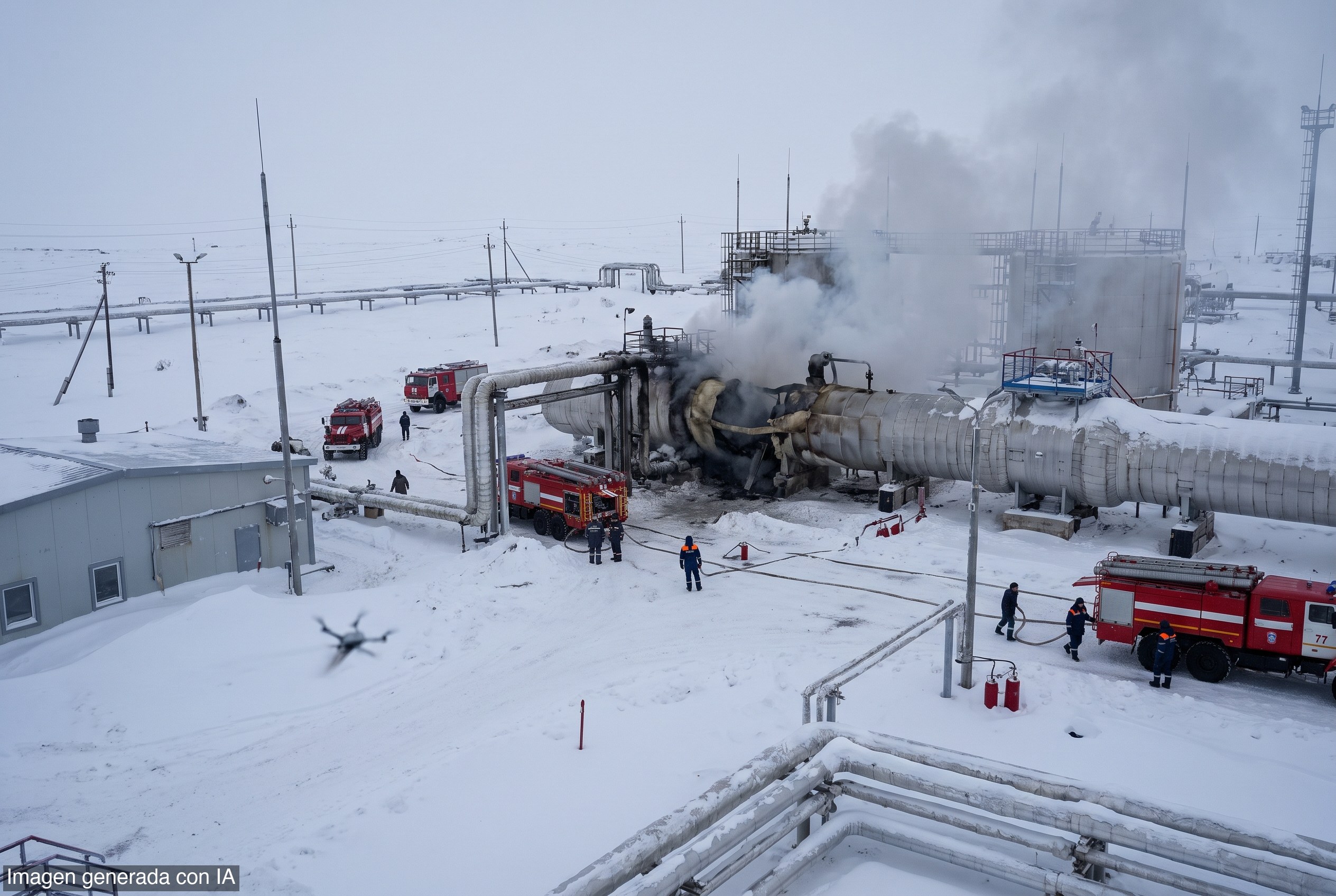
Ukraine's Special Operations Forces announced Wednesday that drones struck two Russian gas facilities in the Yamalo-Nenets Autonomous Okrug — a region deep in the Russian Arctic — flying nearly 2,000 miles to do it.
The targets were a major plant in Novy Urengoy, a gas-producing city, and a second facility roughly 60 miles south in the Purovsky district. Ukraine's SSO called it Kyiv's 'deepest defeat' of Russia since the full-scale invasion began in 2022. 'Until today, this was considered an absolutely safe rear for the aggressor,' the SSO said in a statement.
The hardware behind the record
Ukrainian drone manufacturer Fire Point confirmed its FP-1 one-way drones were used in the Novy Urengoy strike. 'FP-1 drones covered more than 3,200 km and set a new record for the range of destruction,' the company said.
That distance exceeds Fire Point's standard cited range of 2,600 km for the FP-1. The manufacturer had previously noted that a jet-launched, improved version of the drone can travel up to 2,110 miles. The FP-1 has a 20-foot wingspan, cruises at up to 111 mph, and carries an explosive warhead of up to 132 pounds.
Yamalo-Nenets governor Dmitry Artyukhov confirmed a drone attack caused a fire at an industrial facility, adding: 'Most importantly, there are no fatalities or injuries. The extent and nature of the damage are being determined.'
The SSO did not detail the extent of damage to the plants, which process raw materials and gas condensate.
A pattern of deeper strikes
Wednesday's operation follows a July strike against an oil facility in Omsk, Western Siberia — a 1,700-mile attack that Ukrainian President Volodymyr Zelenskyy said involved 'upgraded' Fire Point drones. Each successive operation has pushed the range envelope further, systematically targeting Russia's energy infrastructure as a core economic pillar.
Scale.'s read
For founders tracking defense-tech and dual-use hardware, the FP-1's performance is a case study in iterative product development under extreme pressure: a manufacturer that ships, tests in the field, upgrades, and ships again — compressing a development cycle that traditional defense contractors measure in years into months.
More broadly, the strategic logic is straightforward. Russia's energy revenues fund its war machine. Every gas condensate plant taken offline tightens the fiscal pressure on Moscow. Ukraine is not just fighting a ground war — it is running a long-range attrition campaign against an adversary's balance sheet, one drone at a time.