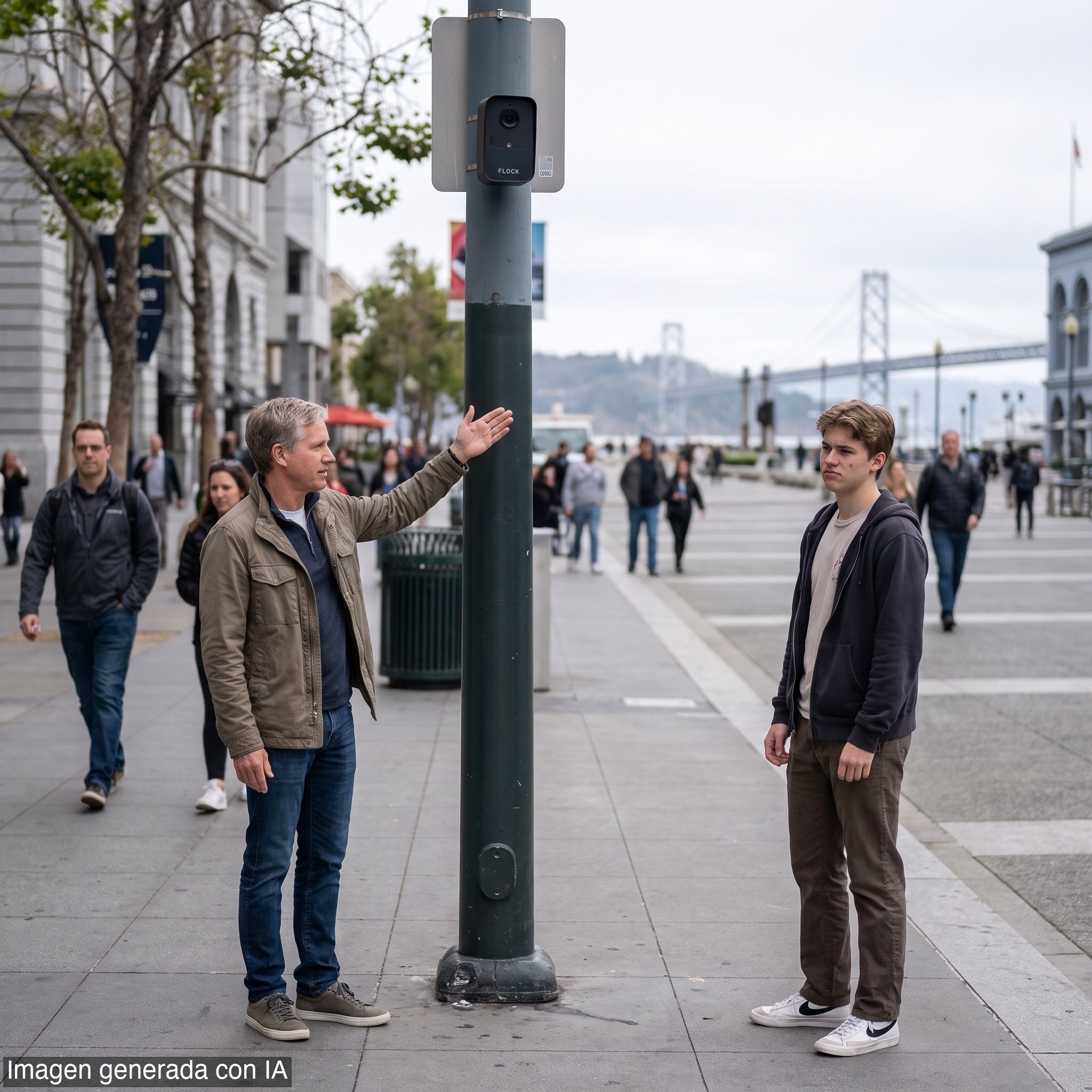
Chris Larsen, cofounder of Ripple, bankrolled San Francisco's push into automated surveillance. Now the backlash is showing up at his dinner table.
On a recent episode of the podcast 'On with Kara Swisher,' Larsen said his 19-year-old son has been calling him out over his support for Flock Safety, the Atlanta-based maker of automated license-plate readers used by law enforcement in thousands of communities across the US.
'He always gives me a hard time — 'I can't believe you're doing this surveillance thing? What are you doing?'' Larsen said, recounting his son's reaction.
When Larsen points to the crime-reduction numbers, his son doesn't move.
'I'd rather have the crime than the surveillance,' the son said, according to Larsen.
The numbers Larsen cites are real. Between fiscal years 2023 and 2025, reported thefts from vehicles in San Francisco declined by 79%, reaching the lowest level since 2017, according to city officials. Larsen donated $9.4 million to the San Francisco Police Department to support its Real-Time Investigations Center — a hub that uses automated license-plate readers, drones, cameras, and real-time video feeds — with Flock named specifically as part of the investment.
But the political ground under Flock is shifting fast. A Business Insider investigation found a dozen cases where people who had not committed a crime were wrongfully targeted by police using Flock's technology. Critics also point to instances of misidentified plates and officers using the system for personal surveillance, including tracking an ex-partner.
Flock has said its technology is a critical public safety tool and announced last month that it was tightening privacy and accountability safeguards in response to the backlash.
The 'DeFlock movement,' as Larsen called it, is already producing results for its side. The Florida Department of Transportation ordered the removal of automated license-plate readers from state highways. Denver and Tempe, Arizona, have deactivated their Flock cameras. Protesters gathered outside Larsen's home last month as part of a wave of national demonstrations.
'We're here for one very specific reason: to watch the man who feels entitled to watching all of us,' one protester said in a video of the demonstration.
Larsen acknowledged the shift. 'One to two years ago, there was much more support for tools like Flock cameras,' he said. He suggested San Francisco could revisit how long it stores Flock data — currently a year, versus the company's default of seven days — and praised the city's drone program for being 'incident based' rather than continuous patrol.
'This is going to be the issue of the day,' Larsen said. 'It's a trade-off, public safety and privacy, and just being able to not be seen. Where is that line?'
That question is exactly the one founders building in the security, proptech, and civic-tech space need to answer before they scale — not after the protesters show up outside.
The Flock story is a clean case study in what happens when a product's unit economics look great (crime down 79%) but the consent architecture lags behind adoption. Larsen's son isn't wrong that the trade-off is real. The founders who get this right will build the accountability layer in from day one — data retention limits, audit trails, clear use-case restrictions — rather than bolting it on when the 'DeFlock' crowd is already at the door.