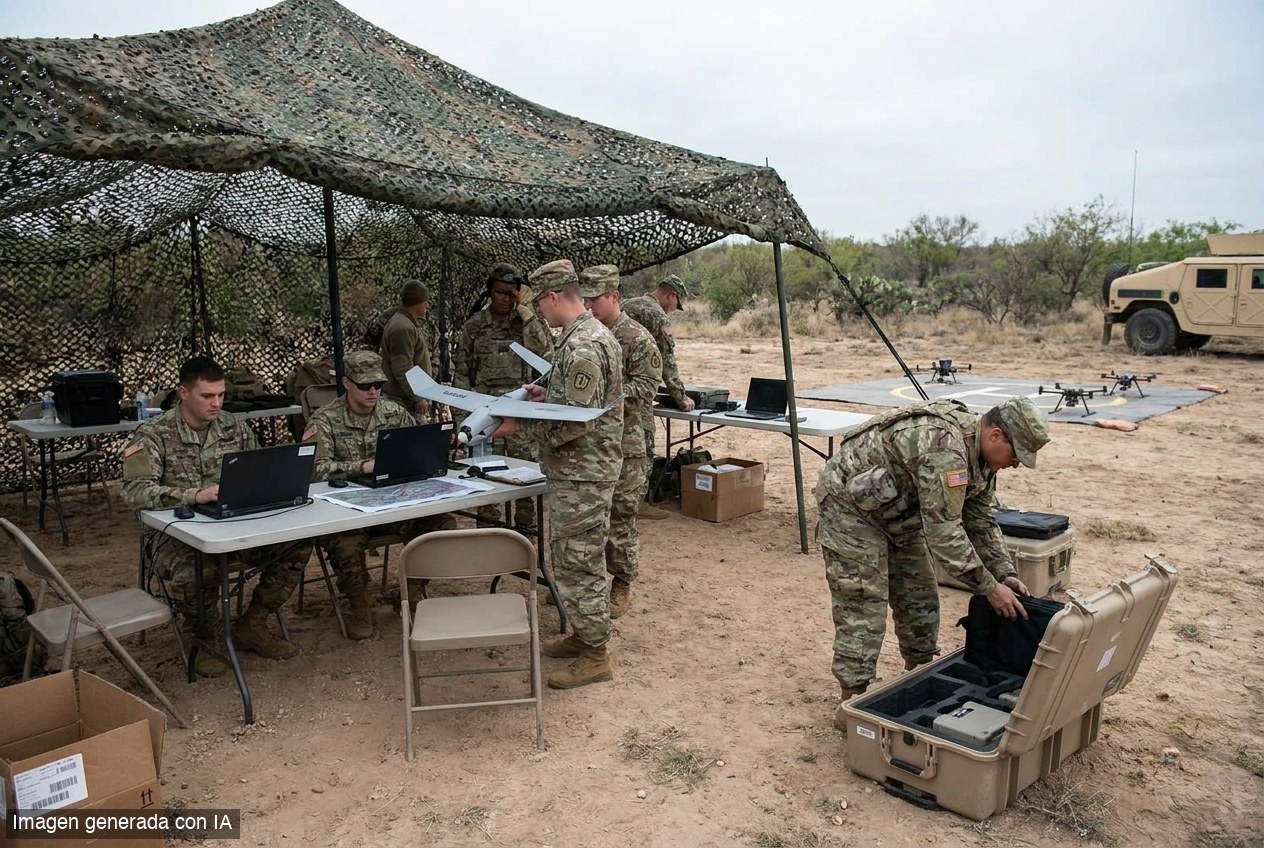
The US Army's experimental drone battalion was never meant to last — and officials want founders of the defense-tech world to understand why that's a feature, not a bug.
The 3rd Battalion of the 504th Parachute Infantry Regiment was stood up last fall inside the 173rd Airborne Brigade as the Unmanned Assault Battalion. Its mission: test uncrewed systems, develop battlefield tactics, and generate lessons the Army could apply at scale. Now it's returning to its airborne infantry role, and the Pentagon is pushing back on the narrative that the experiment failed.
'They were never flagged to be a permanent centralized drone unit,' Army Chief Technology Officer Alex Miller told reporters at a modernization media roundtable on Wednesday.
The timeline was baked in from day one. Miller said the plan called for the battalion to spend six to seven months testing uncrewed technologies before receiving its full infantry equipment set. After that, the Army would disseminate the takeaways across the service.
Why centralization kills scale
Miller's argument tracks with a logic any founder who has tried to bottle innovation inside a single team will recognize: centralize expertise and you slow the spread.
'If you centralize that in one place, what you lose is the ability to actually scale that learning and send that out to the rest of the Army,' he said.
He pointed to conversations with Ukrainian leadership as validation. 'It was less a drone corps and was more of one platoon per company, one company per battalion,' Miller said — which he noted already mirrors how the Army was structuring its tactical UAS platoons.
Assistant Secretary Brent Ingraham reinforced the point: 'While there was an experimental drone battalion, we are scaling that capability across the entire Army.'
The criticism didn't land quietly
When The Wall Street Journal first reported the phase-out last month, the Army said only that it was committed to 'drone dominance' without explaining the experiment's intended shelf life. That silence opened the door to concern. A group of US lawmakers wrote to Army leadership warning that 'eliminating this specialized drone unit will limit our ability to learn from allies, particularly the Ukrainian Armed Forces, and hinder our efforts to modernize drone warfare at the speed necessary to compete on the modern battlefield.'
The Army acknowledged it should have communicated the plan earlier. 'We're sort of combating this narrative that we set something new up, and then we killed that new thing,' Miller said. 'That's just not true.'
Going forward, the service says it will use a Combined Arms Services platform as a central repository for lessons from soldiers and units across the force.
The editorial read
The Army's playbook here is the right one: run a tight, time-boxed experiment, extract the signal, then distribute it rather than hoard it in a bureaucratic silo. A permanent drone corps would have been the government equivalent of a skunkworks that never ships to production.
The real lesson for defense-tech founders is that the customer — the warfighter — is already moving toward distributed, unit-level drone capability. Build for that architecture, not for a centralized procurement bottleneck that may never materialize.