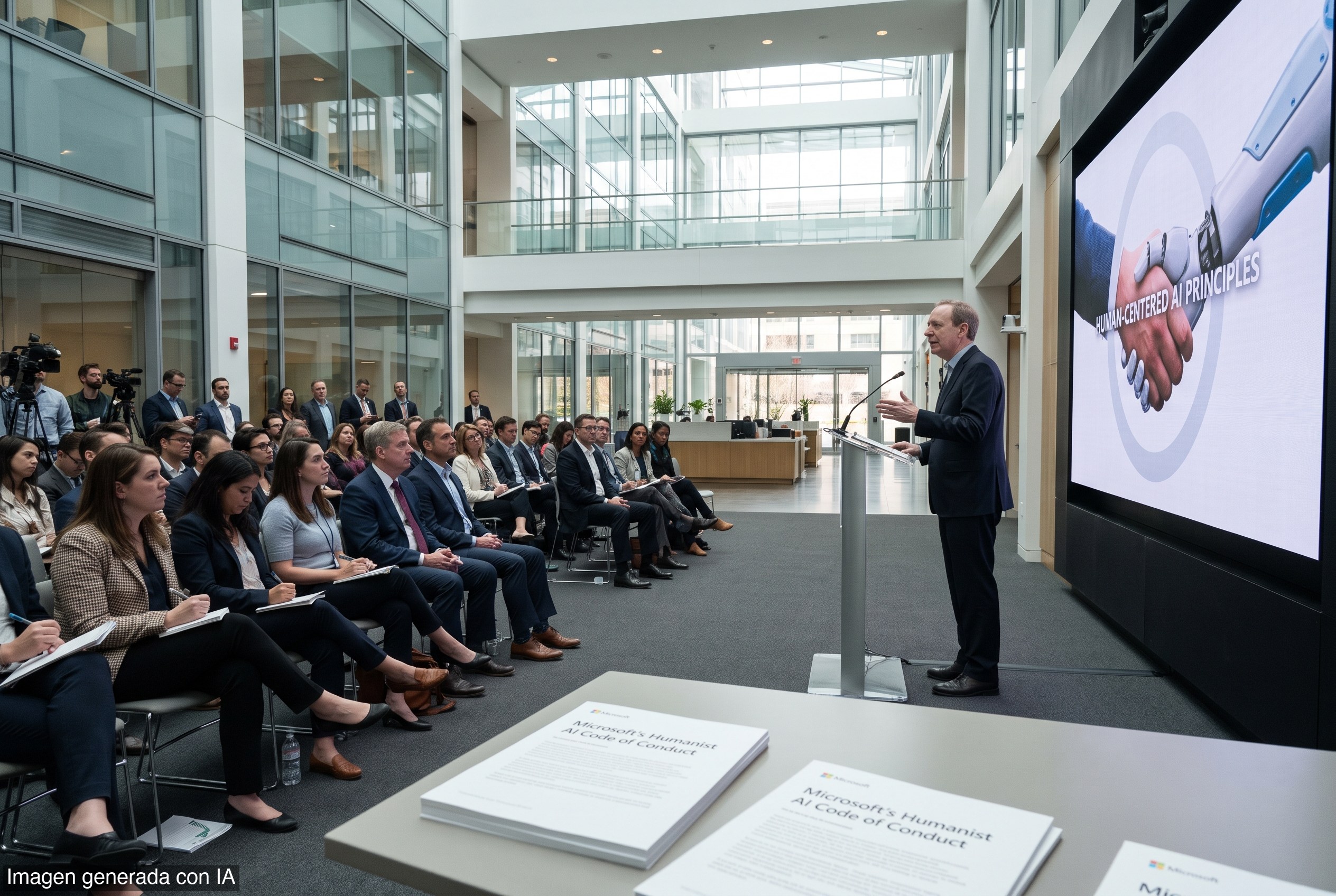
Microsoft is putting a public boundary around how it wants its AI models to behave.
The company has published a 37-page 'humanist AI code of conduct' and says its models must stay under human control. Microsoft sums up the approach in five words: 'People matter more than AI.'
The code says AI models are not conscious and 'should not be designed to imitate consciousness.' Microsoft also rejects 'the pursuit of legal personhood, or the idea that models might deserve welfare, or be entitled to rights.'
It goes further. Microsoft says its models should remain subordinate to humanity, with 'meaningful human oversight and control.' If following a task would violate the code, the model should fail instead of breaking the rules.
The company also says its AI should not exceed human control and should avoid 'patterns of interaction that cause excessive reliance or emotional dependence.' Microsoft says it is looking to work with partners to improve how it evaluates real-world model performance and the impact of sustained AI use on people and organizations.
The move lands amid a broader safety debate across the AI industry. Anthropic CEO Dario Amodei has called for a coordinated slowdown in AI development, and OpenAI CEO Sam Altman has also backed slowing the pace rather than stopping progress. Microsoft AI CEO Mustafa Suleyman called Anthropic's speculation about model consciousness 'really, really dangerous' earlier this year, according to The Verge.
Microsoft says the code is a first draft for public consultation. It also places its own safety constraints above operator policy and user preferences, and says models should explain limits and unanswered questions when there is uncertainty.
For founders and investors, the message is simple: the frontier labs are admitting that speed has a cost. When the product starts to outrun the ability to monitor it, the bill lands on customers, regulators, and eventually shareholders. Microsoft is choosing to slow the sprint long enough to keep the machine inside the guardrails.
That may look conservative in a race for AI leadership, but it is also the only way a platform business preserves trust. If AI cannot stay useful, controllable, and legible to people, it becomes a liability instead of a moat. The winners will be the companies that can ship capability without surrendering the chain of command.