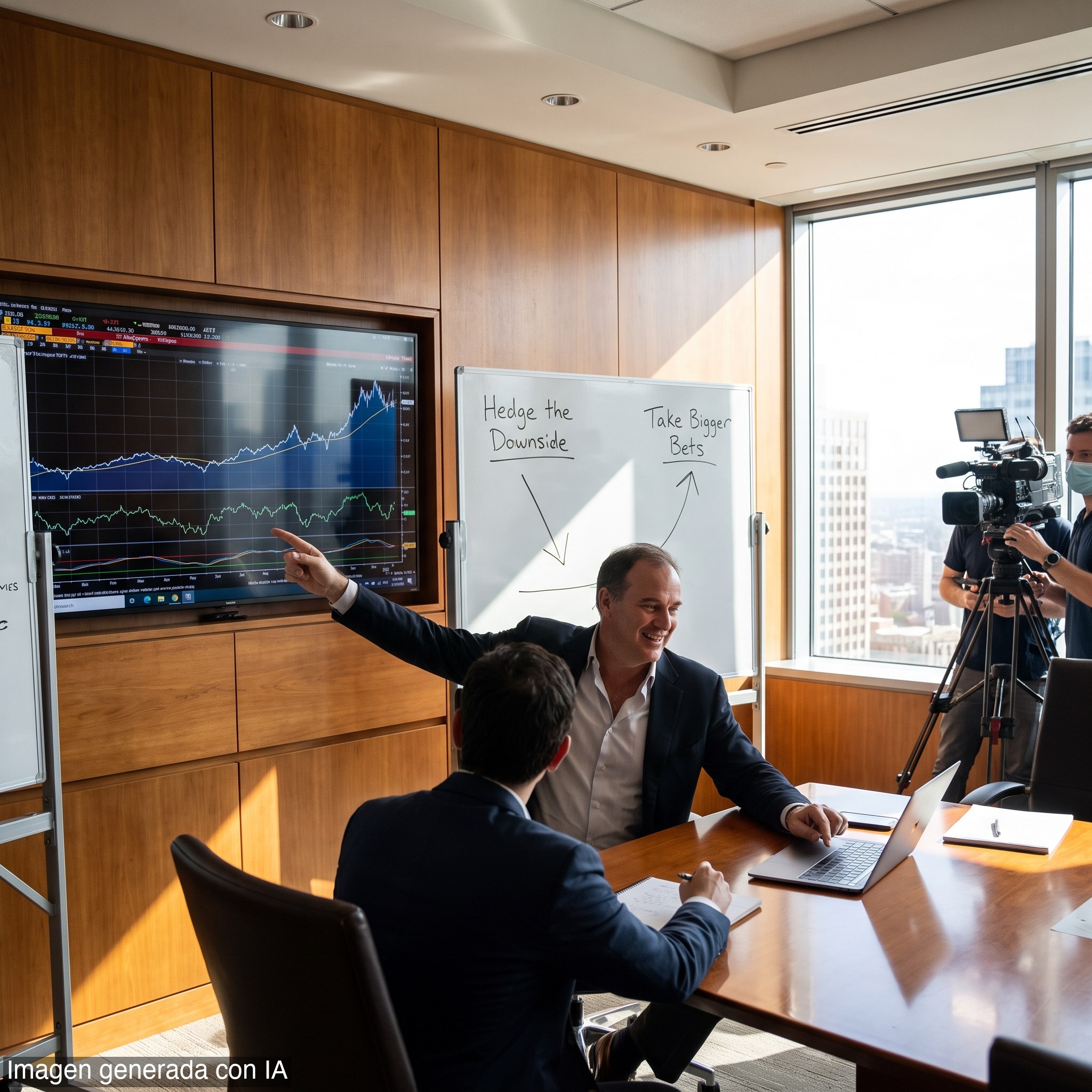
Mark Spitznagel, the head of Universa Investments, built his career around protecting portfolios from rare, extreme events known as 'black swans' or 'tail risks.' But in a conversation with Business Insider in London, he said that living only in defense is not a winning strategy.
'Not taking enough risks can be the biggest mistake someone makes,' Spitznagel said. 'You need to be exposed, you need to bet your beliefs.'
That is the core of his personal and investing advice. Universa sells a tail hedge designed not just to stop clients from blowing up, but to let them be more bullish elsewhere. Spitznagel said the goal is to protect against the disaster that wipes you out, not to obsess over every small loss along the way.
He pushed back on the idea that compounding money should dominate how people think about life. Warren Buffett once said he felt like he was paying $300,000 for a haircut because he believed the money could grow if invested instead of spent. Spitznagel called that mindset a 'curse' if it makes people forget they have to live.
'What’s the point of compounding if you’re not around to see it?' he said.
His advice was to focus on 'mitigating the big losses, not the little ones.' He gave a simple example: a 50% loss on a position requires a 100% gain just to get back to even. In other words, deep drawdowns can trap capital and time.
Spitznagel also championed the 'Kelly criterion,' a mathematical formula used to size bets and avoid catastrophic losses. He said it is useful not only for investing, but for thinking about life more broadly. 'You can’t let your losses take you out of the game,' he said.
On AI, Spitznagel said writing will remain valuable even as tools like ChatGPT spread. He said his firm employs 'some of the brightest mathematicians and programmers' and that they are on the 'bleeding edge' of using AI tools, but he added that AI will 'never replace basic human judgment.'
Asked about the best investment he has ever made, Spitznagel pointed to his goat farm in Northport, Michigan. He said farming is 'better than anything: yachts, planes, sports teams,' because it gives him something tangible to make, along with milk and cheese. He also said it grounds him, connects him to his family, and forces him to think in very long timeframes.
The lesson for founders is straightforward: protect the downside, but do not build a life or a business around fear. The best operators keep enough runway to survive the shock, then keep enough conviction to place the next bet. That is where growth happens.