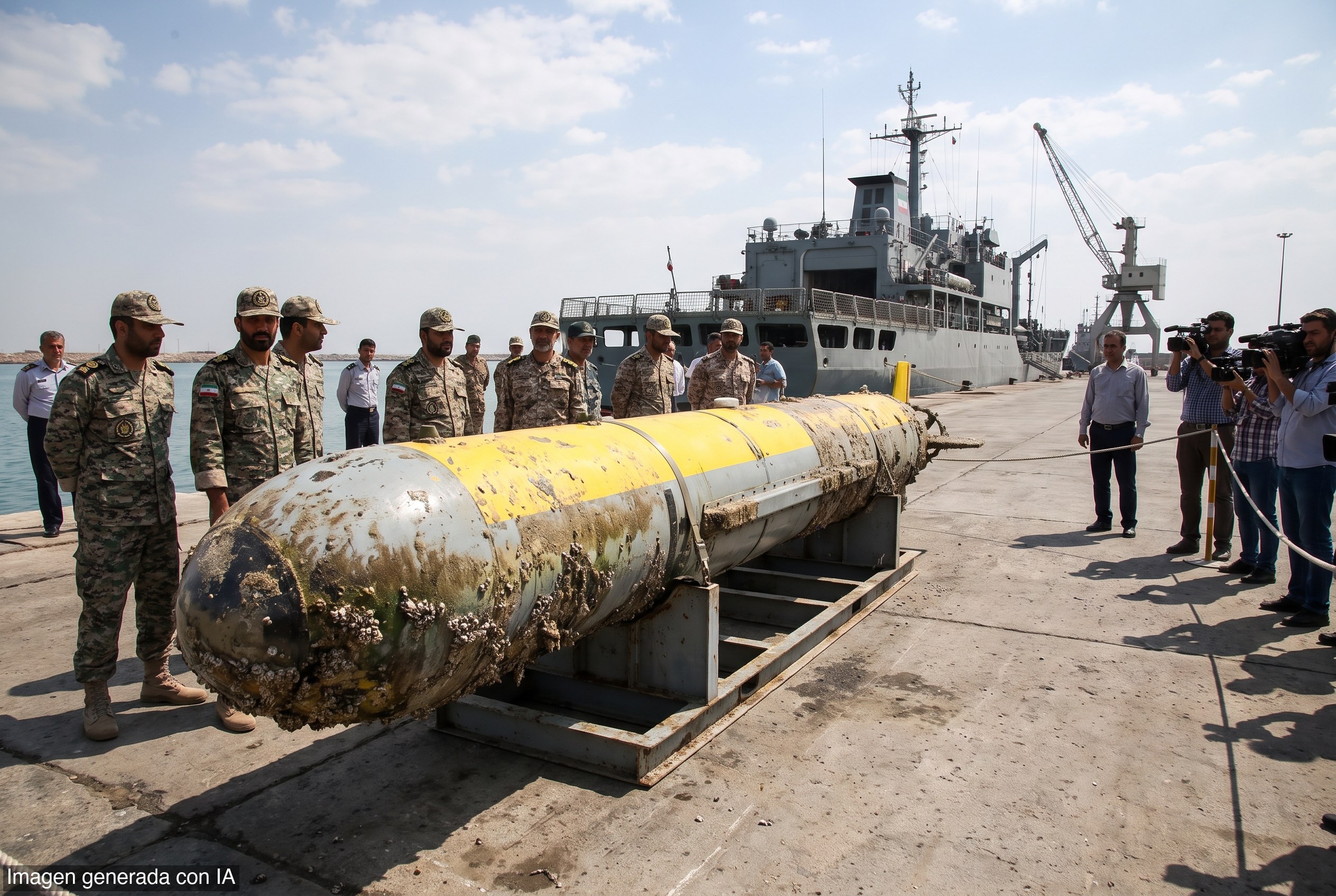
Iran's Revolutionary Guards announced Tuesday they had seized a U.S. uncrewed submarine near the entrance to the Strait of Hormuz, calling it 'one of the most modern, intelligent and unmanned submarines of the terrorist American army' and claiming it was 'equipped with the latest technologies.'
Iranian state media identified the vessel as a Dive-LD, a 19-foot autonomous underwater vehicle built by California defense firm Anduril. According to Anduril's website, the Dive-LD can operate for up to 10 days without returning to base, dive to depths of 6,000 metres, and carry out missions including mine countermeasures, seabed mapping, and intelligence gathering. DefenseScoop reported in 2024 that each unit costs approximately $2.5 million.
The Pentagon told a different story. A spokesperson for US Central Command said the drone had 'malfunctioned more than a day ago' while surveying regional waters. 'The defective drone was an older model that neither collected sensitive data nor carried any classified sonar or radar equipment,' the spokesperson said. The drone was, in the official's words, 'essentially dead in the water for more than a day' before Iran's announcement.
Reuters noted it could not independently verify Iran's claims, and the Pentagon did not directly address them in its statement.
This is not the first time Iran has moved on U.S. naval drones. In September 2022, the Iranian destroyer Jamaran pulled two American drone boats from the Red Sea. The Navy responded by dispatching USS Nitze, USS Delbert D. Black, and an MH-60R Sea Hawk helicopter. Iran eventually released the vessels.
The broader context matters for founders tracking defense tech investment. The U.S. military has been rapidly expanding its uncrewed naval fleet in the region. In April, underwater drones assisted warships in clearing Iranian mines from the Strait of Hormuz. In July, the Navy used Saronic Corsair sea drones to strike an Iranian submarine and ship maintenance facility — and the same platform rescued the crew of a downed U.S. Army AH-64 Apache helicopter.
The editorial read: Tehran's propaganda playbook here is transparent — grab a drifting piece of hardware and declare a strategic victory. The Pentagon's response, whether fully accurate or not, points to the real story: the U.S. is fielding a growing fleet of relatively low-cost autonomous systems precisely because a $2.5 million drone is an acceptable loss compared to a sailor's life or a crewed vessel. That is sound strategic math. The Anduril model — a private defense firm building modular, scalable hardware for the Pentagon — is exactly the kind of free-enterprise innovation that keeps American forces ahead. Iran seizing a broken drone does not change that equation.