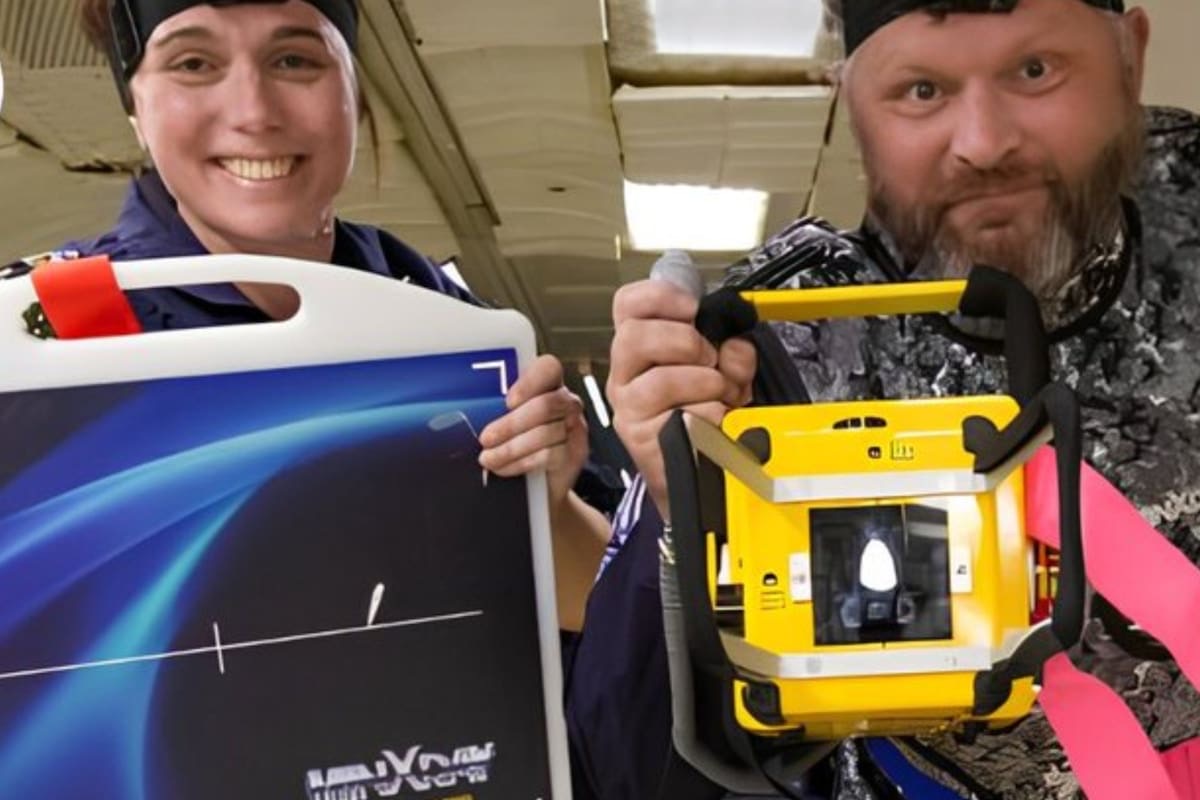
The first medical X-rays ever taken in space didn't require a physician on board. They required a portable commercial device, four hours of training, and a SpaceX Crew Dragon.
That's the headline from the Fram2 mission, which launched March 31, 2025, and orbited Earth for three and a half days. The four-person crew — none with medical backgrounds — used a compact, portable X-ray system to capture diagnostic-quality images of a human hand, abdomen, pelvis, and chest, as well as a smartwatch. Every image was stored digitally, no darkroom required.
The problem they solved was size and power
For decades, space medicine relied almost entirely on ultrasound. It works, but it has a hard constraint: ultrasound needs a physical medium to propagate acoustic waves. X-rays don't. The catch was always hardware — conventional radiological equipment is too bulky, too fragile, too power-hungry, and too sensitive to subject movement to survive a launch and function in microgravity.
Modern compact devices changed that math. Today's portable units draw little power and can even run on solar energy. That's the opening Sheyna Gifford, a physician and assistant professor of aerospace medicine at Mayo Clinic, moved to exploit. She drove the project specifically to test whether an off-the-shelf commercial unit could operate under microgravity conditions.
It could.
The quality bar was met
After the crew returned, three specialists compared the in-orbit images against pre-flight X-rays taken on the ground. Earth-based images were sharper — that's expected. But the panel ruled that the space-taken radiographs carried sufficient diagnostic quality to identify fractures accurately. That's the minimum viable threshold for a mission medical kit.
'We believed a portable commercial system would have a good chance of passing pre-launch tests and being operational in space by crew members with minimal training,' Gifford said. 'By obtaining the first human and equipment X-rays in space, our study demonstrates the viability of in-orbit radiography and expands diagnostic capabilities for crew health and hardware evaluation.'
The crew trained for just four hours before launch.
What this means for founders building in the space economy
This is the commercial-off-the-shelf playbook applied to one of the hardest operating environments on Earth — or above it. A Mayo Clinic researcher didn't wait for a bespoke NASA program. She picked existing hardware, designed a minimal training protocol, ran the experiment, and published results. That's a lean launch cycle measured in months, not decades.
For founders in space-tech, medtech, or remote diagnostics, the signal is clear: the barrier to deploying clinical-grade tools in extreme environments just dropped. Compact, low-power, digitally integrated hardware is the new baseline. The next question isn't whether X-rays work in space. It's who builds the diagnostic stack for the Moon.