Out of over 1 million photos taken by National Geographic photographers in 2026, 25 images were named Pictures of the Year. That is a selection ratio of roughly one in 40,000. Whatever you think of the magazine, that is a serious editorial filter, and it is worth studying if your business depends on standing out.
The cover image is the headline act. Tony Wu photographed a male moray eel releasing the female's jaw during spawning in the waters of Kagoshima, Japan. Wu and his team captured the first-ever images of moray eels reproducing in the wild. Spawning lasts less than two seconds, so it took hundreds of hours to catch the eels in the act. Here's the playbook: the payoff was a single frame, but the investment was hundreds of hours of waiting for a window that might never open.
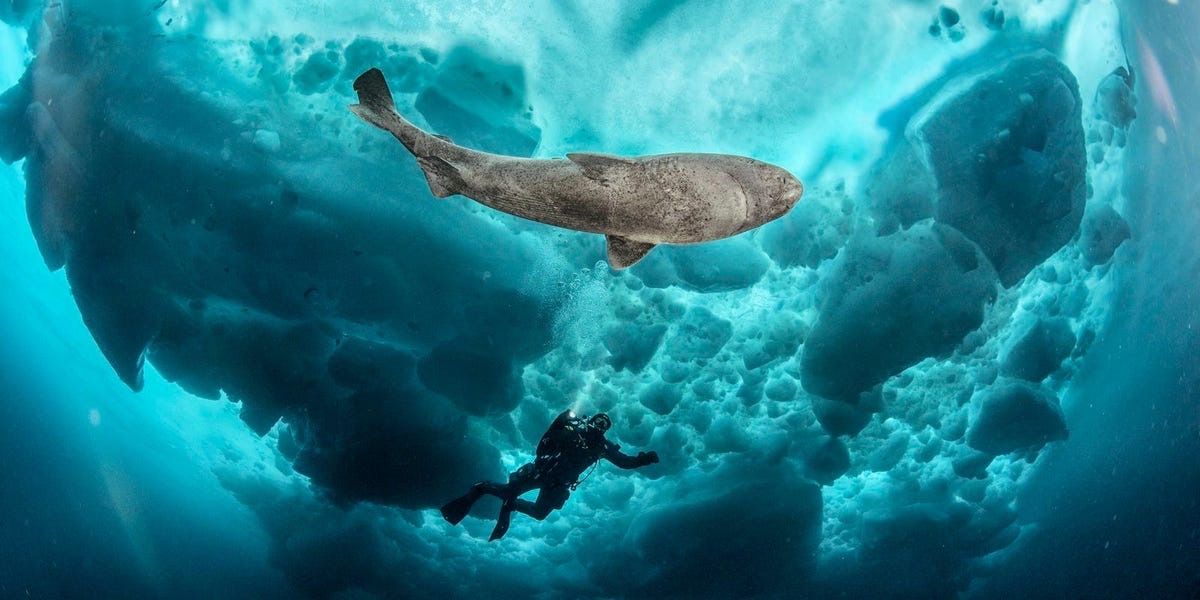
Other selections follow the same logic. Greenland sharks can live up to 500 years, and Kiliii Yüyan estimated that the shark photographed beneath more than 3 feet of ice was born sometime around the Civil War. Yüyan shot it while diver Philipp Oppermann swam nearby off the coast of East Greenland. A rare subject, a hostile environment, and a patient crew produced the image.
Not every winning shot required a remote expedition. Prolonged drought left the Suwannee River less murky than usual, giving photographer Gulley a clear shot. Matada used a fisheye lens attached to a telescoping pole to photograph monkeys who appeared curious about their reflections. The tool was simple. The angle was deliberate.
Amateurs made the list too. Jensen, a self-taught amateur underwater photographer, worked for months to capture a banded jawfish with its mouth wide open, then submitted the photo to National Geographic's #NatGeoYourShot challenge on Instagram. National Geographic senior managing photo editor Anne Farrar said the image shows 'how a species cares for their young, something humans can all relate to.' Founders should note the distribution lesson: a community challenge brought an outside voice into a legacy institution.
Nathan Lump, editor-in-chief of National Geographic, framed the collection as 'a testament to the boundless curiosity and relentless persistence of our photographers.' He also said the work of documenting what's real is 'more valuable than ever in a time when fakes are everywhere.' That line matters for any company selling trust. When content can be generated at near-zero cost, verifiable, first-hand proof becomes the scarce asset.
The practical takeaway is not about cameras. Pace, a photographer who dove with researchers studying how warming waters are affecting krill and whales, shows the model: pair your work with a team that has a real question to answer. Credibility is built by showing up, repeatedly, for the hard version of the job.
So here is the math. Hundreds of hours of effort produced one image that will outlive its news cycle. If your product or your marketing cannot survive a fake-detector, invest in the expensive, unglamorous proof first. Start smaller than you think, document everything, and let the work carry the claim.