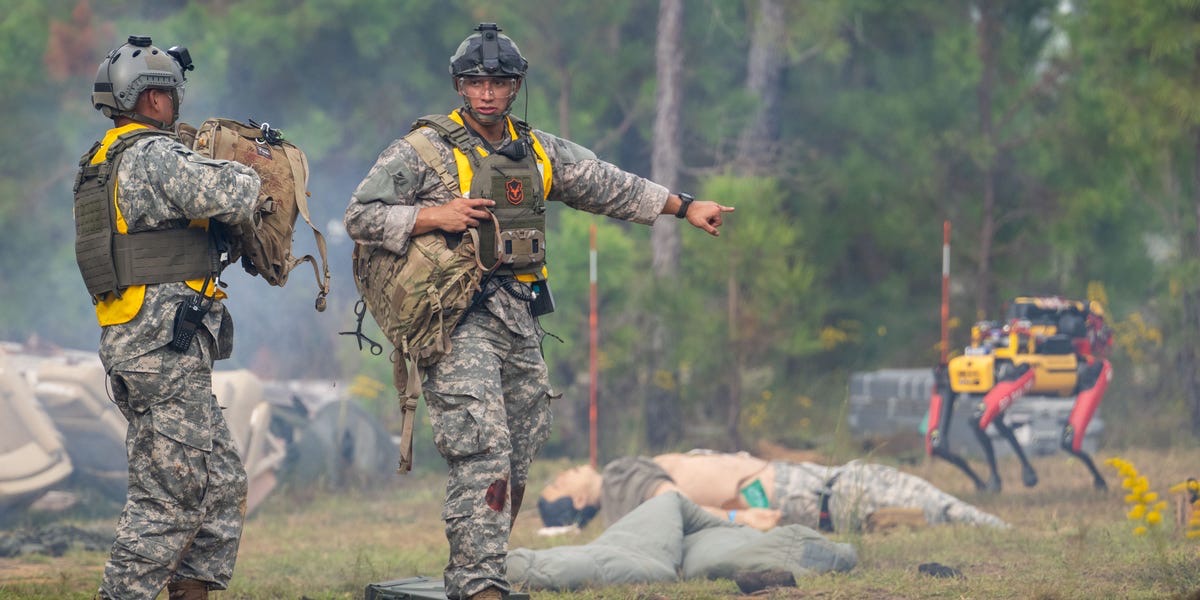
Earlier this month, drones and ground robots searched simulated disaster zones in a competition testing whether machines could help military medics quickly find casualties and identify which ones needed lifesaving care first.
The event was part of the Defense Advanced Research Projects Agency's 'Triage Challenge.' DARPA is the Pentagon's research arm, tasked with finding potential answers to hard military problems. The agency ran the contest to test whether companies and universities could produce tech that is a viable solution for medics on future battlefields filled with enemy drones and AI.
The test took place at the Disaster City facility in College Station, Texas, built to replicate disasters for emergency response teams. Medics and robots faced scenarios such as responding to tornado destruction and a nighttime attack on a military outpost. Ground robots and drones had 15 minutes to find actors and mannequins representing wounded troops and civilians. In a separate test, they were given the casualties' locations and had five minutes to assess how urgently each needed help. The machines also had to identify injuries, check whether casualties responded, and decide who needed to be evacuated first, all without touching patients.
Jeremy Pamplin, the event's program manager and a retired Army physician, told Business Insider in September that rapid triage focuses on severe bleeding and breathing problems. 'Teams have to get out there, recognize these problems really fast and say, yep, that's somebody you got to go see right now,' he said. He argued that robots and drones could help medics find 'needles in the haystack' and 'save the most lives they possibly can.'
The push has a clear motive. Military officials have warned that the US military is unlikely to control the air in future conflicts, which could create major casualty evacuation challenges the military has not faced in decades. That prospect has led medical units to train for treating frontline casualties for days, or even weeks, before they might reach advanced care. A separate element of the event tested whether algorithms could predict what treatment patients would need hours later.
In a major war, medics may have to focus scarce resources on casualties they can save, an ethical dilemma most US military medical providers have little experience confronting. Pamplin hopes technology can help them decide with better information: robots locate and assess casualties while predictive tools anticipate each patient's needs and how long they can wait. He said that kind of help could save more lives and also relieve 'the burden of doubt from our young medics and war fighters.'
For founders, the signal is hard to miss. The Pentagon is paying to turn a battlefield problem into a competition, and the companies that show working hardware and software under pressure are the ones positioned to win contracts. The math is simple: a defense buyer with a clear problem, a public test and a deadline is a buyer you can plan around. Start with the hardest version of the problem, prove it in a messy environment like Disaster City, and then build the sales story around the outcome the buyer already named: finding the right patient fast.