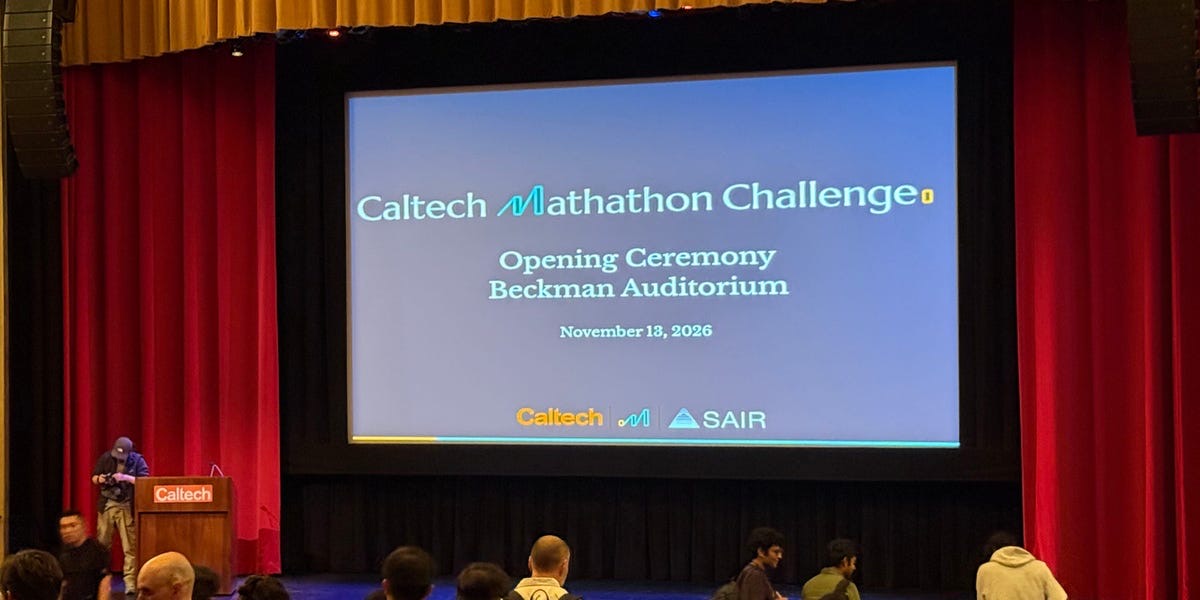
There was a lot riding on one meeting. Caltech's 'mathathon,' a multi-day event in which math enthusiasts planned to prompt chatbots to crack some of the world's hardest unsolved problems, was in peril. Hundreds of mathematical luminaries and graduate students were calling for its cancellation because, they said, it would promote AI 'slop.'
During a video call in early September, the event's undergraduate organizers reached a compromise with their critics. They would rework the competition's parameters, and in return they would get support from the wider math community. Mayla Ward, a Ph.D. student at Caltech who had initially called for the event's cancellation before becoming involved in its organization, described the result as feeling 'like a miracle.'
Here's the playbook they used.
First, they dropped the most ambitious target. In the original design, the organizers had copied the big AI companies, which have focused on the most famous unsolved problems and published lengthy, dense proofs that leave human mathematicians to sort out what they mean. On the call, the organizers agreed to take so-called 'open problems' off the table. Participants would instead look for alternative ways to solve older problems.
Second, they changed how success was measured. The organizers added incentives for teams that could clearly explain their results, which cut through the pile of AI-generated output.
Third, they changed who funded them. Anthropic had sponsored the event with $1 million in tokens, and organizers negotiated to end that sponsorship. OpenAI, also an original sponsor, pulled out after people began calling for the event's cancellation.
The math is simple. A competition that depends on one vendor's goodwill is one controversy away from losing its funding. Diversifying your backers and writing clear conditions into your sponsor agreements protects the event, and the people running it.
The underlying conflict is one many founders will recognize. The field's divisions ran through close collaborations. Caltech mathematics professor Sergei Gukov said the battle lines fell between close friends and research partners, some of whom stopped working together. 'Everything was so cohesive and united, and suddenly it's not,' he said.
The organizers' stated goal offers a useful frame. 'One of the big things us as mathematicians care about was mathematicians being in control of the research process,' said Caiman Moreno-Earle, a sophomore organizer. 'This means taking ownership of the models themselves.' Translate that to your own operation: if the tools you depend on set the agenda, you have a dependency, not a strategy. Decide where the humans stay in charge before a vendor decides for you.
The mathathon also shows what a compromise can look like in practice. Participants still used AI heavily. Nearly every team ran a mix of frontier models in the background while they worked. The change was not about rejecting the technology. It was about setting boundaries on how it is used and who decides.
Whether the event lives up to its organizers' aspirations is still an open question. A truce is a start, not a finish line. Still, a team that rewrote its scope, rebuilt its incentives, and renegotiated its sponsors kept its project alive when it looked finished. Founders facing a similar standoff should start by asking the same three questions: What are we trying to prove? What do our critics need to see? And which of our partners can we least afford to lose?