The math community has a problem with the biggest AI companies, and some of its members have decided to stop waiting for them to fix it.
Sergei Gukov, a Caltech professor, said he could see the writing on the wall. So when OpenAI in October solved hundreds of famously thorny math questions that had stumped the field's best and brightest for years, he was not surprised. His own AI models had solved a few of them first, he said. "The more we work with the systems, the more we understand them," Gukov told Business Insider. "As a result, the better we can control them."
Gukov runs a lab where he and a handful of students design and build their own open-source AI models from scratch, engineered specifically to solve math problems. The approach is turning heads at a moment when antipathy toward major AI companies is high. According to Business Insider, the giants have rapidly published solutions without running them past academic experts.
The criticism is sharp. Mathematicians have torn into OpenAI's approach in Substack essays and lecture halls across the country. Their charge is that the companies, OpenAI chief among them, are exploiting the field to drum up hype ahead of an IPO. Many say the solutions OpenAI proposed are slop, meaningless unless a human researcher spends weeks deciphering how they were reached.
That is where the ownership question comes in. If mathematicians build the models themselves, the AI-generated solutions return to their hands. Tasmin Chu, a Ph.D. math student at Caltech who runs a popular anti-AI Substack, described mathematician-created AI systems as an effort to "own the means of production." "It's complex," she told Business Insider. "I guess it depends on how it really plays out."
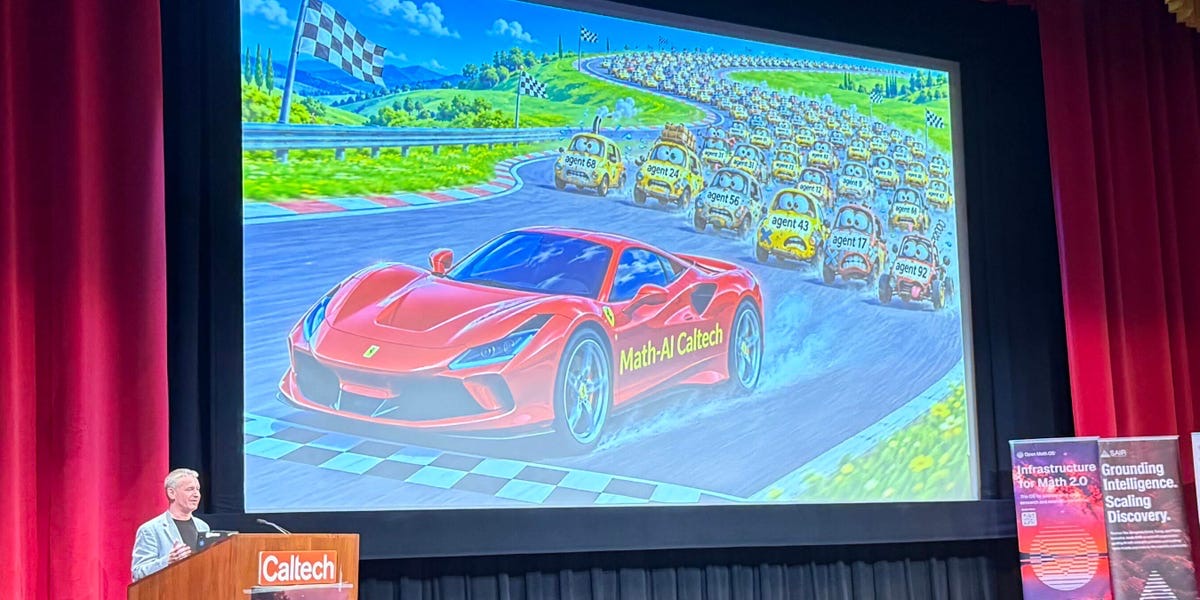
Gukov's models have real limits. He likens them to Ferraris: fast and well built, but largely out of reach for most people. Most of his models can solve only one specific math problem. Ask one to branch into a different area and it sputters. Anthropic models, by comparison, can handle math prompts across a variety of disciplines. Gukov said a more generalized model is in the works but not yet ready.
The episode has split the field. On one side is a group opposed to AI in their work in any form; Chu leans that way. "I'm personally invested in it remaining viable to do mathematics without AI at all," she said. On the other are students going all in on AI, either because they think it will save the field or because they doubt the field is worth saving.
Terence Tao, a UCLA mathematician, has repeatedly argued that mathematicians should build their own AI systems. At Caltech he demonstrated a platform created by a nonprofit he founded. The Open Math OS provides access to open-source frontier AI models, cloud computing and collaborative tools. Crucially, it lets mathematicians control how their data is used, an issue that became urgent after two mathematicians accused OpenAI of using their chat logs to help solve the Navier-Stokes problem.
The math here is simple. Control of the tool means control of the output, the data and the credit. Researchers who own their stack do not have to accept a vendor's timeline, a vendor's press release or a vendor's terms of service. In a market that rewards speed and hype, that independence is worth more than any single breakthrough.
What this means for the rest of us is a principle worth remembering. Private property in intellectual work has always depended on who controls the means of creation. Mathematicians who insist on that control are defending something the free market should protect: the right of creators to own what they build and decide how it is used. Gukov, who was born in Moscow and immigrated to the United States to study math, sees the moment less as a crisis than as a chance to grow. "This AI research aspect is super exciting," he said. "You feel like Columbus exploring new territory."