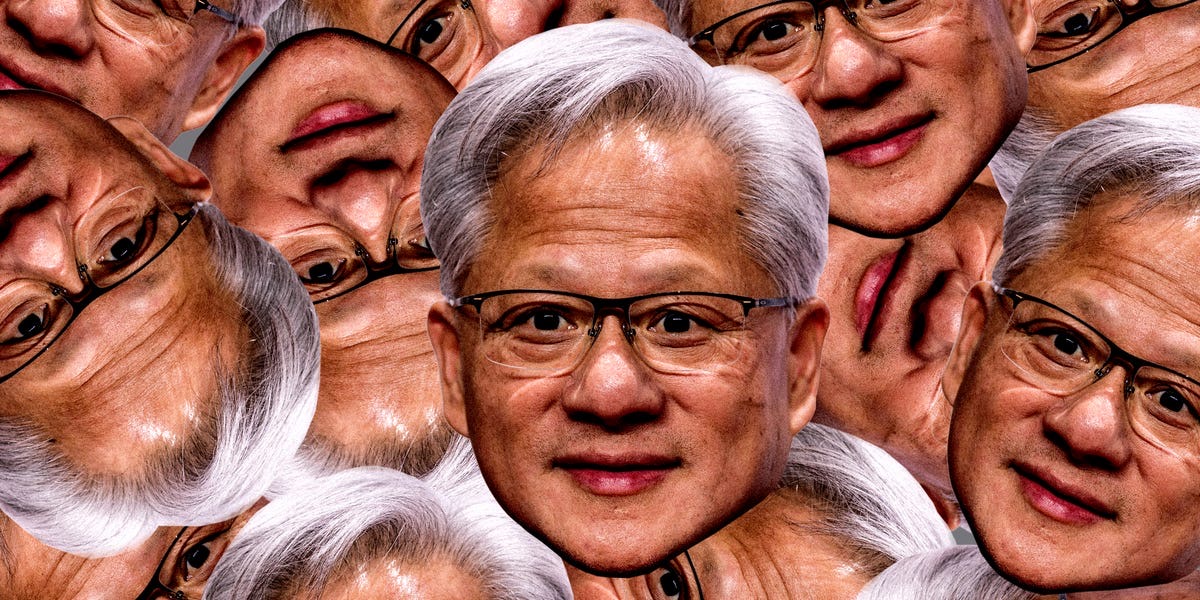
When Nvidia announced on November 12 that its CEO was stepping down, the company's stock went into freefall, erasing about $1 trillion from the market. The moment Jensen Huang returned, the stock soared 30%, nearly recovering its pre-ouster level. According to the market, the presence of one man was worth a trillion dollars to the future of the world's second most valuable company.
Huang ran Nvidia with an unusual degree of control. He had 60 people reporting directly to him rather than trusting a handful of executives to run their own divisions. His 40,000 employees wrote out their weekly priorities, and he read and answered many of those emails himself. 'It's really important that I understand what everybody's doing,' he once explained.
That is exactly the kind of micromanagement management textbooks warn against. Textbooks say to build a company that can outlast you. Huang has openly rejected succession planning, saying that when he dies on the job, 'they'll just have to reshape the company for the next CEO.'
Silicon Valley calls this style 'founder mode,' a term Paul Graham of Y Combinator popularized in 2024, crediting it to a talk by Airbnb's Brian Chesky. Graham contrasts it with 'manager mode,' the delegation approach Chesky tried before ending up with what Graham called 'disastrous' results. Huang has embraced the label himself.
The argument for founder mode has always been that white-collar work needed too many layers for a CEO to see everything. Business Insider's Aki Ito writes that AI is changing that math. Fewer employees means fewer people to supervise, and AI can take over coordination, monitoring and answering questions. Huang once read a hundred employee emails each morning to catch early warning signs; now, he could have agents read every one.
The efficiency gain comes with a cost to accountability. Many startup reorg memos promise to empower rank-and-file workers, but flattened organizations have historically concentrated power at the top. As one researcher concluded, 'CEOs flatten to achieve more control.'
The result, Ito contends, is a future with many more CEOs like Huang, whose influence runs so deep that removing them would cripple the company. Huang himself has been accused of serious personal misconduct, including affairs with a suspected Chinese spy and allegedly with an employee, and of misleading his deputies and board about them. Reports also described him threatening to pee on an employee's brain. He kept his job.
Founders cheered his reinstatement. Elon Musk wrote, 'The mistake has been corrected.' Sam Altman posted, 'Jensen!' Travis Kalanick, ousted from Uber in 2017, posted one word: 'Thanksgiving.'
For shareholders and boards, this is the real lesson. Governance exists to protect the company from any single person, and when a company's value rests on one executive, that protection weakens. Ito's warning is that AI will make such dependence easier to build and harder to undo. The principle at stake is accountability: no executive, however indispensable, should be beyond the reach of the owners who put up the capital.
For founders, the playbook is double-edged. Staying close to the work can be a real advantage. But a company that cannot survive its CEO's departure is not a strong company. It is a single point of failure. Build the bench before you need it.


