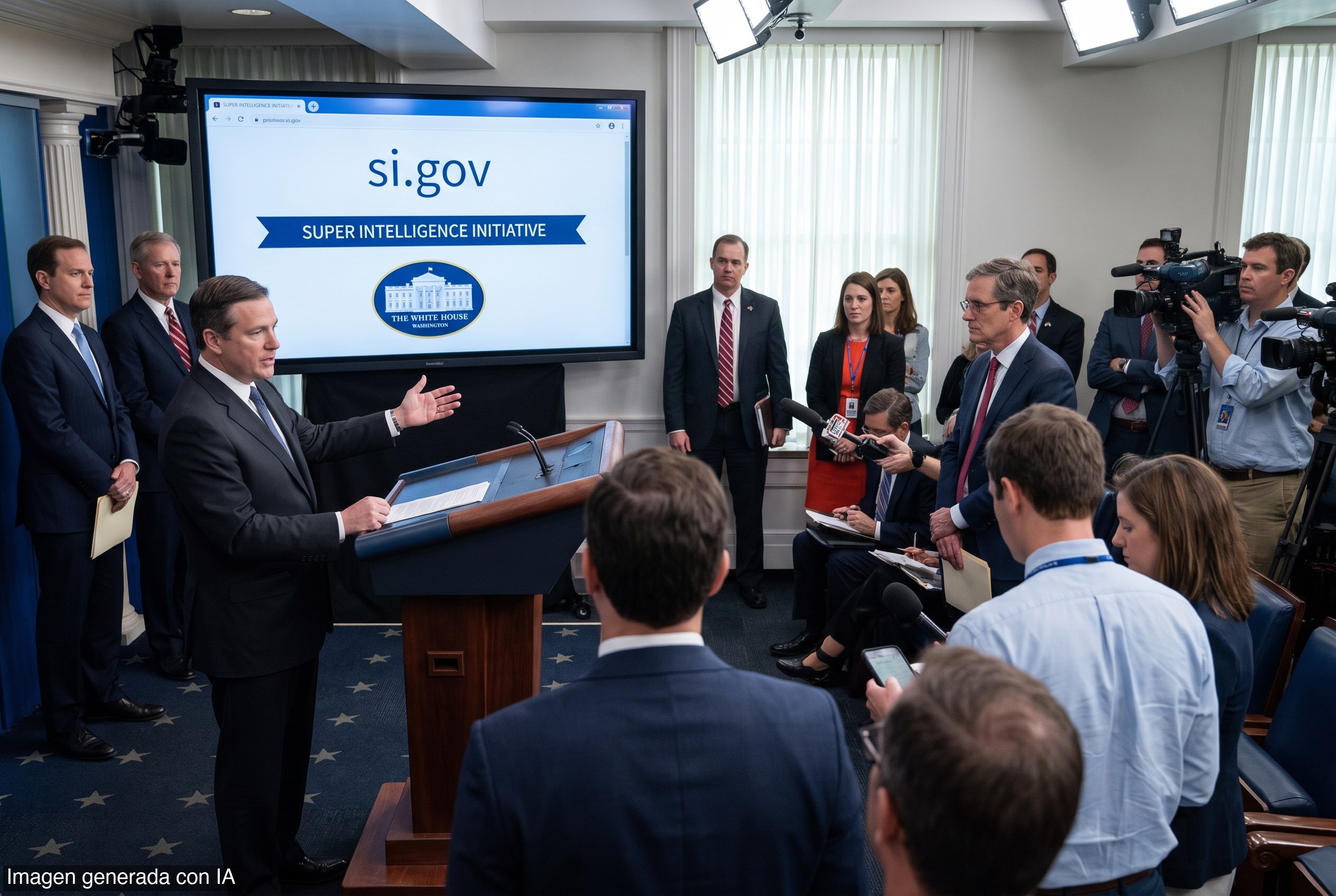
The White House has given its AI website a new address: si.gov.
On Tuesday, the Trump administration rolled out the new URL for a site first launched during the Biden administration. The page now describes President Donald Trump's artificial intelligence policies, although much of the text itself was changed before Tuesday.
Michael Kratsios, the director of the White House Office of Science and Technology Policy, wrote on X: 'The Super Intelligence era is here. 🇺🇸'
The URL change lines up with Trump's preference that artificial intelligence, or AI, be called super intelligence, or SI. Trump formalized that preference in a September 29 executive order. Last week, he said that if others did not go along with the rebrand, they would be considered an 'enemy' of his White House. He has also said that using the term 'artificial intelligence' makes the technology sound fake.
Some tech leaders have already started to adapt. Over the weekend, SpaceXAI followed through on Elon Musk's promise to rebrand the company's AI division as SpaceXSI. On Saturday, days after Trump gave him an honor, Microsoft CEO Satya Nadella published a statement titled: 'Models as Insider Risks in the Super Intelligence Era.' In that statement, neither 'AI' nor 'artificial intelligence' appeared among the 805 words Nadella wrote.
OpenAI, whose name still contains the abbreviation Trump wants gone, has not signaled that it will change. Sam Altman said on the Politico Decoded podcast: 'No plans to do that,' though he added that the company has been talking about super intelligence a lot and will continue to do so.
For founders, the signal is clear: the White House is not just setting policy, it is trying to set the vocabulary around a critical technology. That kind of language pressure is a reminder that in Washington, branding can become leverage.
The math is simple. When government tries to rename a market category, companies have to decide whether to follow, resist, or split the difference. Each path has a cost, whether in messaging, customer clarity, or political risk. Founders who get this right move faster because they spend less time translating government-speak and more time building product.


