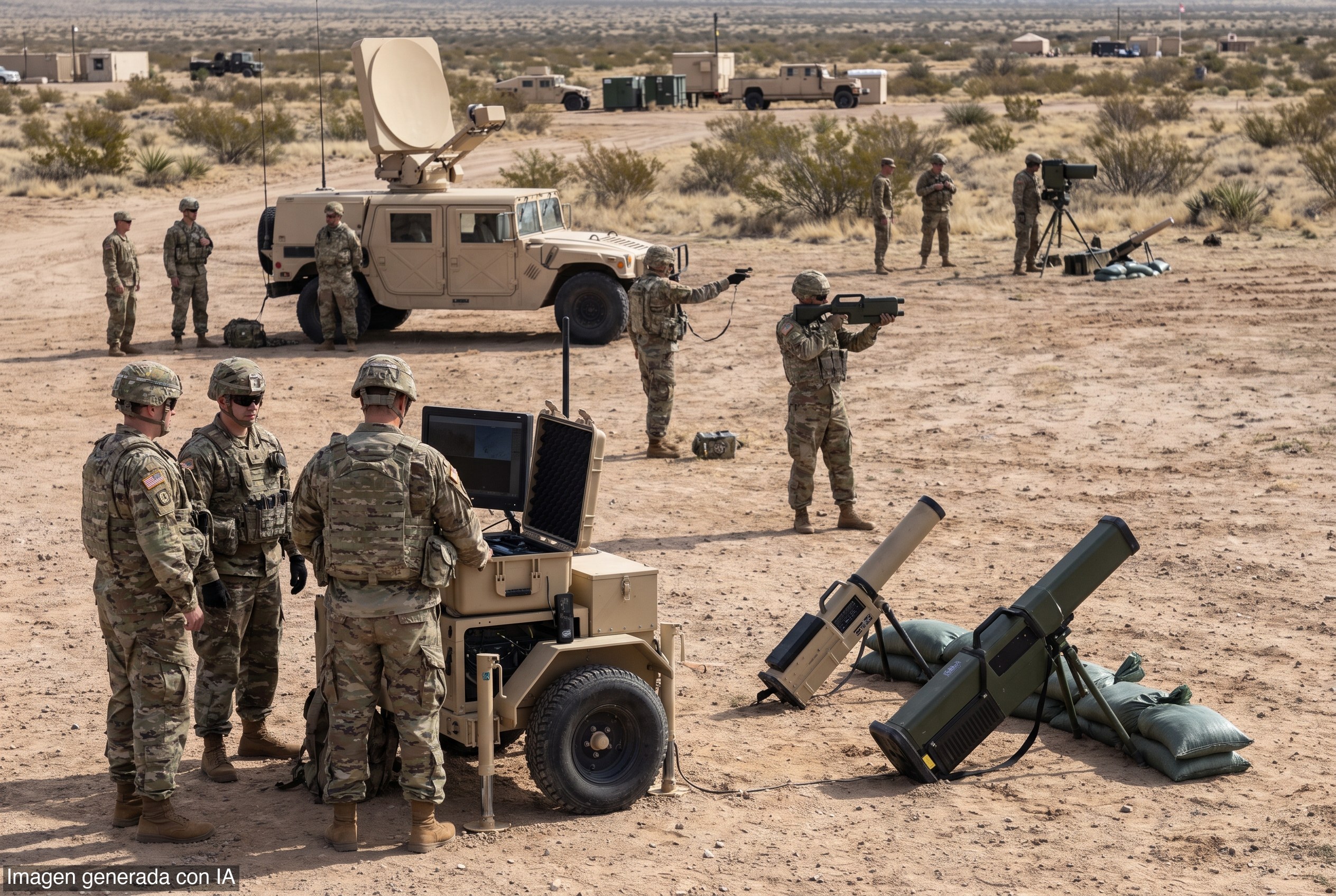
The US military's counter-drone task force is preparing to spend billions on technology designed to defeat small uncrewed aerial systems.
On Tuesday, the Joint Interagency Task Force 401, or JIATF-401, announced enterprise contracts for counter-drone and counter-uncrewed aerial system technologies with a combined ceiling of nearly $7 billion.
Brent Ingraham, assistant secretary of the Army for acquisitions, logistics, and technology, said there is 'not one answer to the drone threat.' He said the military did not build around one solution.
The contracts cover a range of capabilities, including sensors and other non-kinetic options for detecting and disabling drones, as well as kinetic weapons for shooting them down. Officials said the goal is to give agencies more options rather than rely on a specific company or system.
Brig. Gen. Matthew Ross, director of JIATF-401, said the contracts will help ensure these capabilities are available to formations and widen access to systems that may have been seen as specific to the Department of Defense.
JIATF-401 replaced the Pentagon's previous counter-drone force and covers the military as well as federal, state, and local agencies. The task force also stood up a drone marketplace where units and agencies can buy systems, and Australia recently became the first ally to successfully procure technology from that marketplace.
The urgency has been driven by conflicts and attacks. Officials have pointed to the war in Ukraine, as well as hostile drones that killed six US service members in Kuwait in March and three soldiers in Jordan in 2024. An investigation into the Jordan attack found that the military was insufficiently prepared for the threat.
Military officials say they see no silver bullet for defeating drones across the larger force. Ross said units have very different needs, citing 11th Airborne in Alaska and 1st Armored Division as examples. Officials also say layered defense is essential, with systems that can detect, disable, and destroy threats at different ranges.
For taxpayers and defense buyers, the message is simple: the Pentagon is moving toward a broad procurement strategy because the drone problem is not a single-product market. That favors vendors that can prove flexibility, speed, and integration across multiple environments.
It also shows how quickly a battlefield problem can turn into a budgeting problem. If drone warfare is spreading, the winners will be the companies that can scale into the military's layered defense playbook, not the ones pitching one magic fix.


