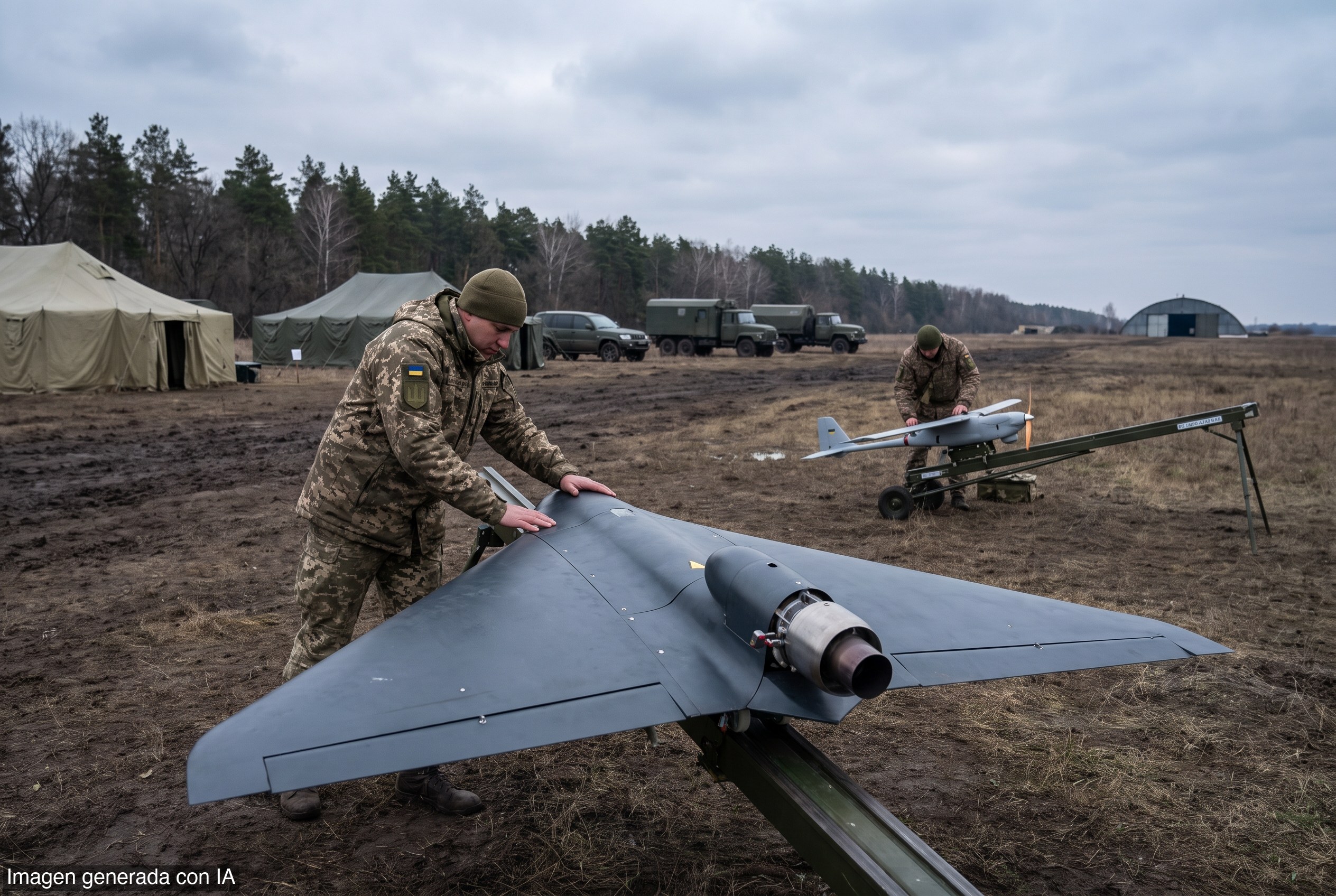
Ukraine has revealed a new interceptor drone built to take down Russia's latest jet-powered drones, and it looks loosely like the Shahed-style systems Moscow uses in the war.
Volodymyr Zelenskyy posted footage on Saturday and said the interceptor was 'successfully deployed' in an operation by the Security Service of Ukraine, or SBU. The video shows a delta-wing drone launched from a rail catapult and flying over open fields. Its chassis appears to have an exhaust outlet, which suggests a turbojet engine.
That design is a clear departure from the bullet-shaped quadcopters that have dominated Ukrainian interceptor development so far. Ukraine is now leaning toward faster, more specialized air defenses as Russia pushes harder with jet-powered drones.
The SBU identified the target as a Geran-5, one of Russia's most advanced attack drones. Ukrainian intelligence said it can fly at speeds of up to 373 mph and carry a 200-pound explosive warhead. On Sunday, the SBU posted another clip saying the interceptor destroyed a second Geran-5.
Zelenskyy said the new interceptor is meant to defend against 'jet-powered Shaheds.' The Geran-5 is not modeled after the Shahed, the Iranian delta-wing drone. It is instead thought to be Russia's version of the Karrar attack drone, but 'Shahed' has become a broader label in Ukraine for Russian long-range loitering munitions based on Iranian designs.
Ukraine has long treated these drones as a major threat. Kyiv says they have bombarded cities and killed hundreds of civilians, and that it needs an affordable, mass-producible way to counter them. That pressure helped drive the rise of interceptor drones in the first place.
Those early interceptors were small quadcopters modified to reach speeds of up to 175 mph. But Russia's growing use of faster jet-powered drones has forced Kyiv to look for other answers.
In August, Zelenskyy said authorities were working with four companies designing interceptor drones to counter jet-powered Gerans. That same month, Ukraine's defense ministry unveiled the Alexa Spatium, a turbojet, winged interceptor drone. The local manufacturer Wild Hornets also said on Saturday that its Sting S interceptor, deployed by the 1020th Anti-Aircraft Missile Regiment, had successfully destroyed a Geran-5.
The math is simple: when the threat gets faster, the defense has to get faster too. For Ukraine, that means building cheaper interceptors that can be produced at scale, not one-off systems that burn runway without changing the equation.
Founders and defense makers should watch the same playbook here. Speed, cost, and manufacturability matter more than elegant design. In war, as in startups, the better product is the one you can ship repeatedly before the competitor changes the market again.


