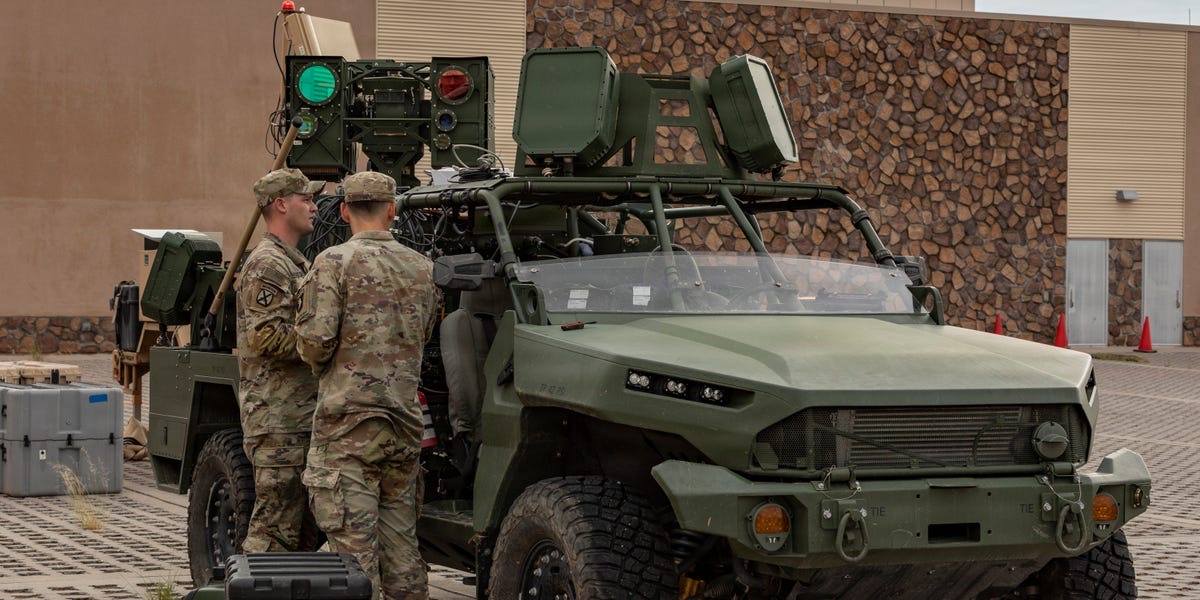
The Pentagon wants to buy more directed-energy weapons to counter the growing drone threat, and it is making its vendors prove the hardware works before a dollar changes hands. On Monday, the Department of Defense announced that seven high-energy laser systems will take part in a live-fire shoot-off next month.
The lineup includes Allen Control Systems' BULLFROG HEL, Aurelius Systems' ARCHIMEDES, AeroVironment's LOCUST X1, Kord Technologies' FIREFLY, Lockheed Martin's Crossbow, Thor Dynamics' LASER ARMOR HEL, and Yrikka's TALOS drone-based HEL. The event is overseen by the US Army-led Joint Interagency Task Force 401, or JIATF-401, which was stood up last year to help the military and federal partners acquire and test counter-drone technology.
Before the live fire, the companies must validate their safety certifications and command-and-control elements. Then they will bring their systems to Dugway Proving Ground in Utah in mid-December. The Pentagon said the evaluations will put the weapons through live-fire vignettes against uncrewed aerial targets and measure how each system identifies, tracks, and destroys targets both above and below the horizon.
The procurement logic is the part founders should watch. Army Brig. Gen. Matthew Ross, director of JIATF 401, said in a DoD press release that the goal is to structure the shoot-off so that systems that perform successfully can immediately result in a purchase order. The aim is to start building production lines and get the systems into the field quickly. For a defense startup, that is a rare thing: a government buyer that tests first and promises a contract on the spot.
The border is the proving ground. Directed-energy weapons are already seeing operational use at the US southern border, where the Army has employed them against drug cartel-linked drones. US military leaders have described the border as a sandbox, a testbed for counter-drone systems. Officials say the lasers are intuitive to operate, can be mounted on different vehicles, and raise fewer personal protective equipment concerns than some competing systems. The Department of Defense envisions these lasers working alongside other counter-drone platforms as a layered defense.
What this means for the market is straightforward. The Pentagon is buying a capability category, not a single vendor's gadget, and it is doing so with a short, measurable test rather than a years-long evaluation cycle. Companies that can certify safety, integrate command-and-control, and hit targets reliably will compete for real orders. Those that cannot will learn that in public, in Utah, in December.
For taxpayers, the case rests on cost. Lasers are pitched as a low-cost answer to drones that can be cheap to launch but expensive to stop with conventional munitions. Whether that holds up will depend on the test results, and the shoot-off is designed to answer that question before the money is committed. Spending that is tied to performance, rather than to promises, is the kind of discipline that protects the public purse and rewards the companies that build the best hardware.


