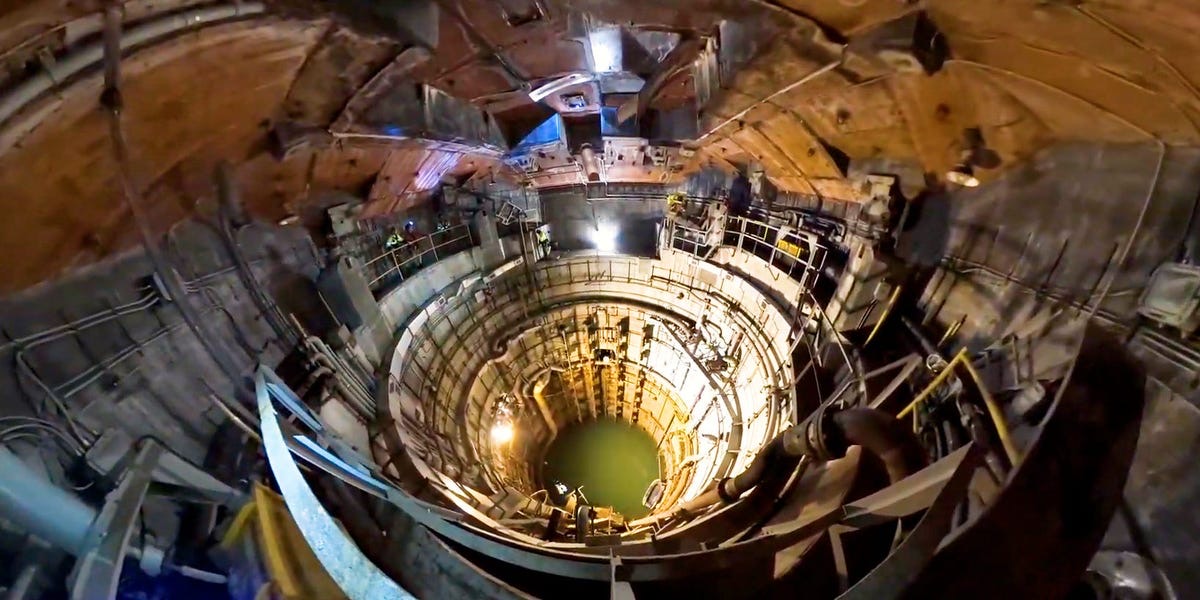
A decommissioned nuclear missile silo near Denver, built to launch three 4.5-megaton missiles, is being turned into an AI data center. The owner is Nik Halik, an Australian venture capitalist who bought the site from the US government in 2021 for more than $10 million. For the past five years he has overseen its renovation, and he plans to house the facility's AI servers there.
The appeal is the infrastructure itself. The Titan I silos were designed to run without the electrical grid. According to the National Park Service, the missiles were 98 feet tall and could deliver a nuclear warhead over 6,000 miles, and the silos carried enough diesel to fuel around 2,000 houses for roughly two weeks. Halik told Business Insider that just one of the three diesel tanks holds about 50,000 gallons. The silo descends 165 feet below the surface, and its walls were built with multiple layers of steel-reinforced concrete that could withstand roughly 15,000 pounds of pressure per square inch.
For a founder, that is a rare combination: a physically secure building, independent power and a site that was never meant to be easy to reach. Halik has pointed to recent tech outages, which have led some people to stock up on generators and emergency kits, as a reason the off-grid design matters. Hardened real estate like this is not cheap to acquire, but it was priced by the government as surplus, and the government has sold most of these facilities to public and private owners over the years.
The costs are the part the pitch deck leaves out. Halik said the basement level is contaminated with cyanide, lead paint, mercury and asbestos. He has also described crawling through a rusty pipe that carried a live wire, a hazard he said could have electrocuted him instantly. Four years of renovation, by his account, has been done by Halik and a team working on a top-secret site, and he has documented the work on YouTube under the channel Nuclear Bunker Living.
The lesson for founders is a familiar one. Start with a clear budget for remediation before you fall for the architecture, because the surprises in a legacy building are rarely cosmetic. Verify power, cooling and access before you commit capital. And remember that an unusual asset is only an advantage if the unit economics work once the renovation is finished.
The market is not waiting for a perfect answer. AI workloads need large amounts of power, and any operator who can secure cheap land, existing grid or off-grid capacity and physical protection has a real edge. Whether a Cold War silo beats a conventional campus depends on the math, not the mystique. Run the numbers on remediation, energy and time to power before you decide the bunker is the smart play.


