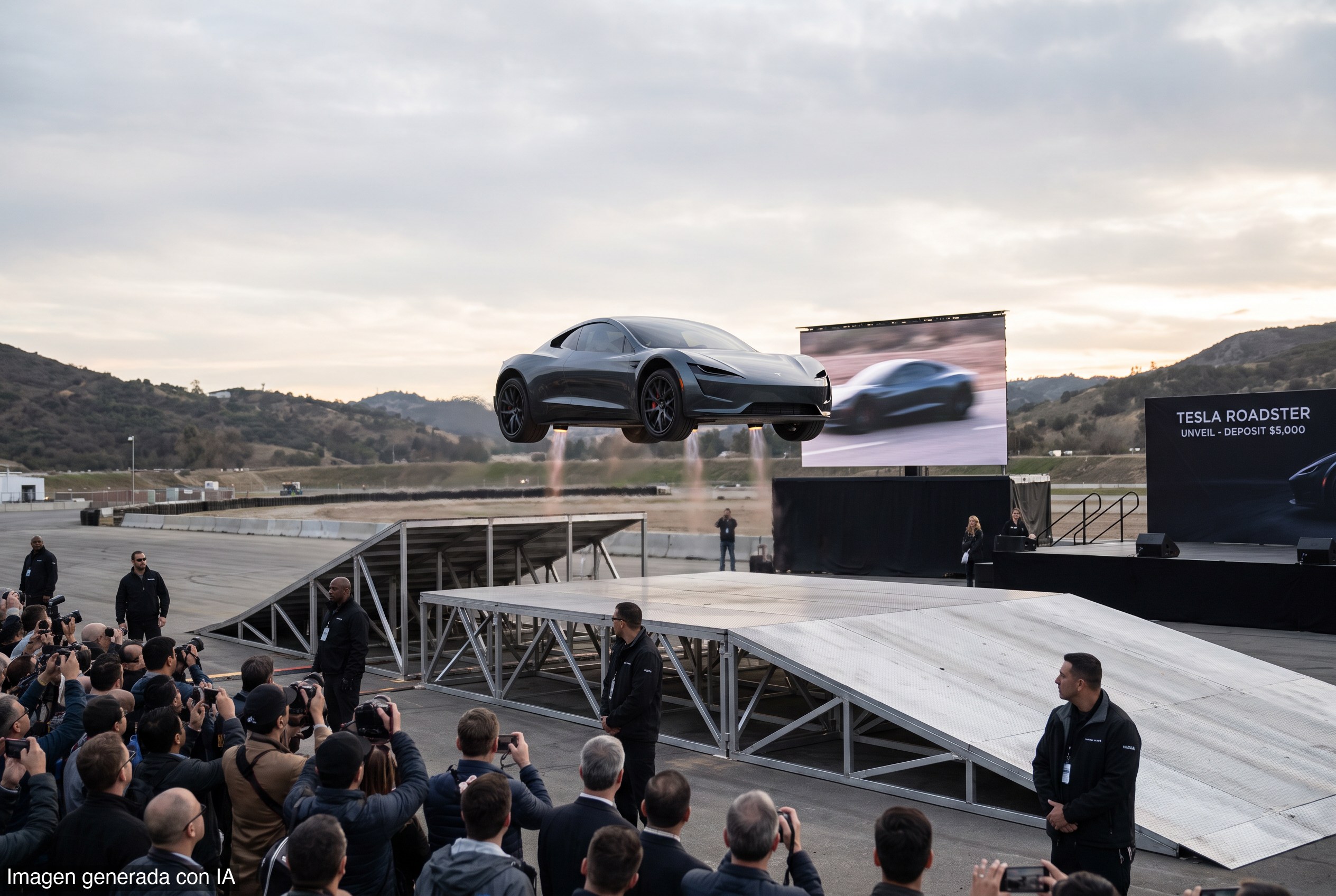
Tesla finally showed off its next-generation Roadster at a livestreamed event Thursday night, and the reveal was as unconventional as the car itself. In the demo, the vehicle climbed a curved ramp, went upside down, then flew off the ramp and landed safely on the ground with the help of thrusters attached to the bottom.
Elon Musk said, 'Well, it worked,' after the landing. Lars Moravy, Tesla's VP of vehicle engineering, added, 'Flying cars are real.' Musk said the car uses an 'advanced ultra-high pressure air tank' to lift itself, and that it has 'altitude control thrusters and main thrusters in the rear,' so it can 'basically fly like a rocket, and it could do rolls.'
Tesla also showed a recorded demo of the Roadster hitting 60 mph in under one second, marking 0.81 seconds. On X, Tesla said the car is a two-seater with about 300 miles of range and a top speed over 230 mph. Some configurations appear to depend on whether the Roadster is equipped with 'rocket' thrusters. If it is 'air ready' and has the rocket, Tesla said the car seats only one.
There are still practical questions. The Roadster's door latches appear to be mechanical, unlike typical Tesla cars, which are known for electronic door latches. The car also appears to lack side-view mirrors, raising the question of how it would be street-legal under federal standards. When asked whether it is street legal, Musk said, 'Depends on your street.' He added, 'It'll be a viable car.'
Tesla's website lists three configurations: performance, thrust, and rocket. The performance trim requires an immediate $5,000 deposit, with another $45,000 due in 10 days. The thrust version requires a $250,000 deposit, and the rocket trim appears to be available only by invitation.
Musk also said the Roadster will be the only Tesla vehicle meant to be driven manually, and that it is not 'necessarily a safety-optimized car.' That matters because this is not a mass-market EV story. It is a halo-car story about engineering spectacle, premium pricing, and whether Tesla can turn a decade of hype into an actual product.
For founders, the lesson is simple: the demo can open the door, but the product still has to close the sale. Tesla has built excitement around velocity, range, and the promise of something that looks like science fiction. Now it has to prove the car can satisfy customers, regulators, and the market at the same time.


