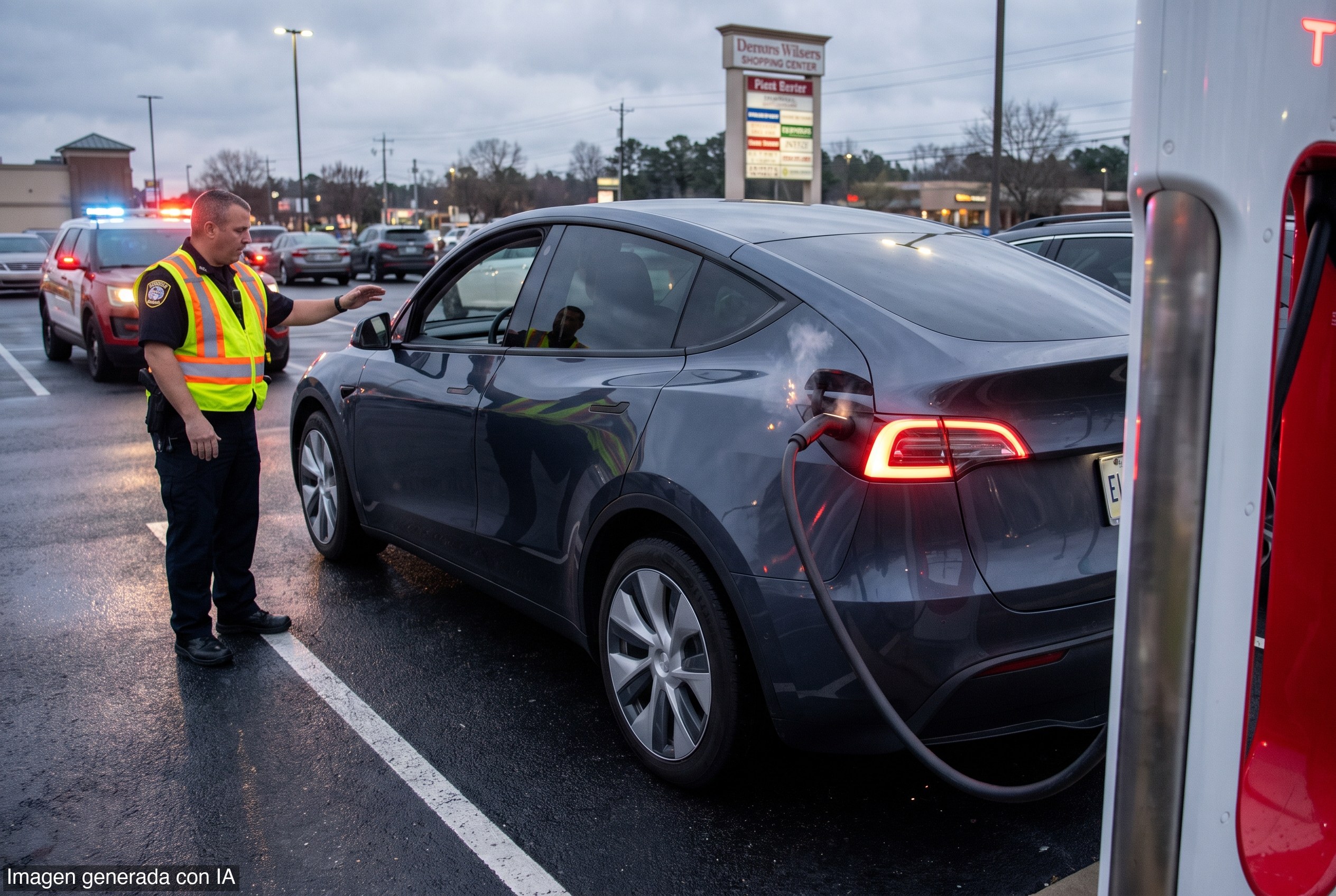
Tesla has rolled out an over-the-air software update called 'Emergency Drive Away' that lets a vehicle shift into drive while connected to a Supercharging station.
Normally, a Tesla will not shift out of park if a cable is detected. With the new update, a driver can press an 'Activate' button after shifting into drive, and the car will break away from the charging handle.
Tesla said in an X post that the feature is for emergencies only. The company added: 'Use of this feature will damage your vehicle and the Supercharger,' and warned that 'Deliberate misuse will invoke additional penalties.' Tesla did not say what those penalties are.
The update comes two months after a shooting near an In-N-Out in Twin Falls, Idaho, left three people dead. One of the victims, Dale Schultz, was inside a Tesla with his wife at a charging station at the time of the shooting, NBC-affiliate KTVB reported.
Max de Zegher, Tesla's senior director of charging in North America, said in an X post that it is a feature 'we hope you never need.' He said Tesla selects Supercharger locations 'with safety in mind' and relocates sites deemed unsafe. 'Our goal is that you always feel safe getting out to unplug,' he wrote. 'We went back and forth on this for years, but believe offering it is the right call. Don't abuse it, so we don't have to restrict it.'
For Tesla owners, the playbook is straightforward: the company is adding an emergency escape hatch, but it is also making clear that the workaround is not free. It can damage taxpayer-free? No — it can damage the car and the charging network itself, which means the cost of a bad situation is pushed back onto the owner and the infrastructure.
The bigger takeaway is about safety and incentives. Tesla is trying to reduce friction in a crisis without normalizing misuse. Founders who build hardware or mobility products will recognize the tradeoff: if you give customers a powerful exception, you have to narrow the use case, or the exception becomes the rule.


