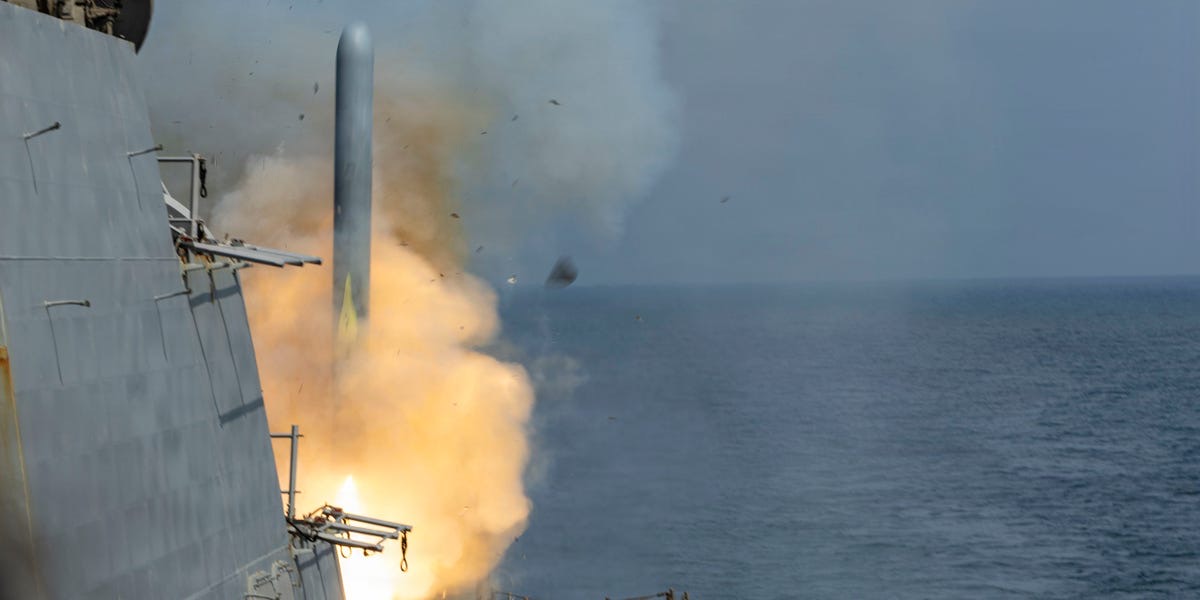
The U.S. Navy fired expired munitions during its war with Iran after changing their condition codes, the service's top civilian official told lawmakers this week.
Acting Navy Secretary Hung Cao made the disclosure at his Senate confirmation hearing on Tuesday, as senators pressed the Pentagon over how heavily it has spent costly precision weapons during Operation Epic Fury. "A lot of the munitions we used in Epic Fury, we were able to recode those," Cao said. "They were Code Echo, Code Foxtrot, which means they're expired."
According to a Defense Logistics Agency manual, codes Echo and Foxtrot describe materiel that is currently unserviceable but could undergo limited restoration or repair. In other words, the weapons were not simply in usable condition on paper. They were relabeled so they could be sent downrange.
Cao, a retired Navy captain and former explosive ordnance disposal officer, defended the practice by comparing it to stretching a household budget. "I came from a poor family," he said. "Things like bread, doesn't expire. You just rub some water on it and microwave for 15 seconds, and it's good to go."
The analogy is folksy, but the stakes are not. Cao did not identify which munitions were recoded or how many were fired. Many of the precision weapons the United States used in the Iran war cost millions of dollars each, which is precisely why the ability to restore and use older stock looks attractive to Pentagon planners in a pinch.
The disclosure came while Cao was responding to Sen. Deb Fischer, a Nebraska Republican, who asked whether the Navy is striking the right balance between expensive precision weapons and cheaper munitions that can be produced in large numbers. Cao said the Navy has increased Tomahawk cruise missile production from roughly 125 a year during his military career to more than 60 a month now.
That production figure is the number to watch. It tells founders and taxpayers alike that the defense industrial base is being asked to scale fast, and that scaling is expensive. It also explains why officials are reaching for workarounds.
Those workarounds carry a cost. A Pentagon Inspector General report released in September, citing the Office of the Under Secretary for Acquisition and Sustainment, found that munitions expenditures during the war had resulted in "strategic inventory shortfalls and revealed industrial base bottlenecks for munitions resupply."
This is a story about the discipline of the balance sheet. When a government buys weapons at millions of dollars apiece, every shortcut in inventory management is a bet with public money. Relabeling expired stock may keep ships firing, but it also means the books no longer reflect the true condition of the arsenal. Taxpayers deserve to know how much of the stockpile is real, how much was recoded, and what it will cost to replace what was spent.
Free enterprise has a simple lesson here. Accurate inventory is the foundation of any serious operation, and a company that hides its expired stock eventually pays for it. The Navy's own numbers should be just as transparent.


