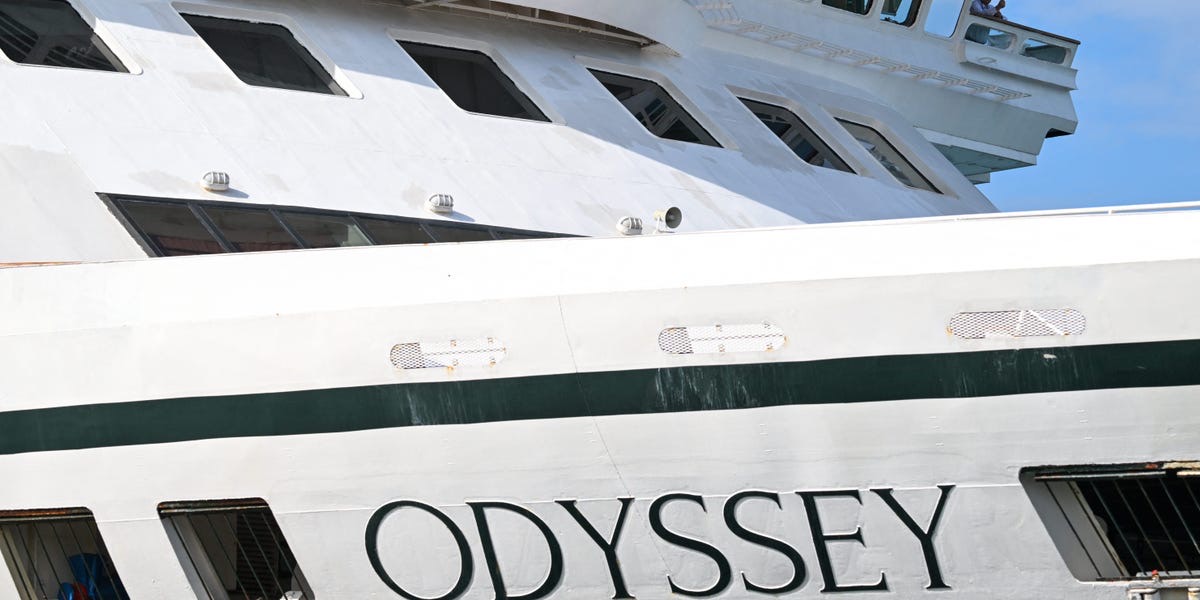
The residents of Villa Vie's Odyssey left more than three weeks ago. Dozens of crew members did not. As of this week, the ship remains anchored near Singapore, and the people running it are still arguing over who is responsible for the people aboard.
The shutdown came on October 27, when residents were given a few hours' notice to disembark in Cambodia. The company had suspended operations of the never-ending cruise, which sold cabins for between $119,999 and $439,999 with the promise of living out the rest of one's days at sea. According to the reporting, Villa Vie blamed months of cash-flow trouble on rising fuel prices, which led to deteriorating services, shifting itineraries, and requests that residents put in additional funds.
Villa Vie cofounder Mikael Petterson confirmed to Business Insider that between 63 and 67 crew members remain aboard. The Odyssey was placed under arrest under a court order. In a November 8 statement, the Maritime and Port Authority of Singapore said the crew were reported to be well and that their welfare was being managed by the vessel's creditors.
Two crew members described a different picture. One said the atmosphere at anchorage had been 'quite difficult,' and the other put it more bluntly: 'Life is hell on board.' They reported cabins without air conditioning in temperatures above 90 degrees, frequent internet outages that made it hard to reach their families, suspended laundry service and a closed crew bar. 'We feel like everybody forgot about us,' the second crew member said.
The responsibility chain is tangled. Petterson said the Singapore sheriff must approve any move from anchorage to a berth before crew can disembark, since the vessel is under arrest. He said Columbia Cruise Services, the vessel's manager, is responsible for operating the ship and for welfare. He said NRP Maritime Asset Management, which controls the ship as administrator of Oceanus Capital's loan, is responsible for putting money toward improving conditions. Oceanus Capital's mortgage claims against Villa Vie led to the arrest. Columbia's chief operating officer, Julia Siebert, declined to comment, and Singaporean authorities did not immediately respond to a request for comment.
Nicolai Heidenreich, managing partner of NRP Maritime Asset Management, told Business Insider he does not 'dispute' the reports of internet and air conditioning outages or reduced services, but rejected the crew's description of the overall experience. He said crew had now been paid for September and October, acknowledging that Villa Vie had previously fallen behind on salaries, which prompted some residents to organize fundraisers for the crew.
The crew hope to disembark by the end of the week, though their expected dates have repeatedly slipped.
What this episode shows is how a lifestyle product built on private capital can collapse into a dispute between creditors, operators and administrators, with the workers at the bottom waiting on court-approved permissions. Residents bought cabins as a private contract for the good life at sea, and when the contract failed, they could at least go ashore and try to salvage their retirement plans. The crew had no such option. Their wages depended on a company that had already fallen behind, and their exit depended on a lien.
For founders, the lesson is about structure. Cash-flow stress is survivable when obligations are clear and the people who carry the risk are the people who chose it. When the risk is pushed onto staff and on-board employees who cannot leave, the moral and legal bill comes due in public. Build reserves for your people, not just your investors.


