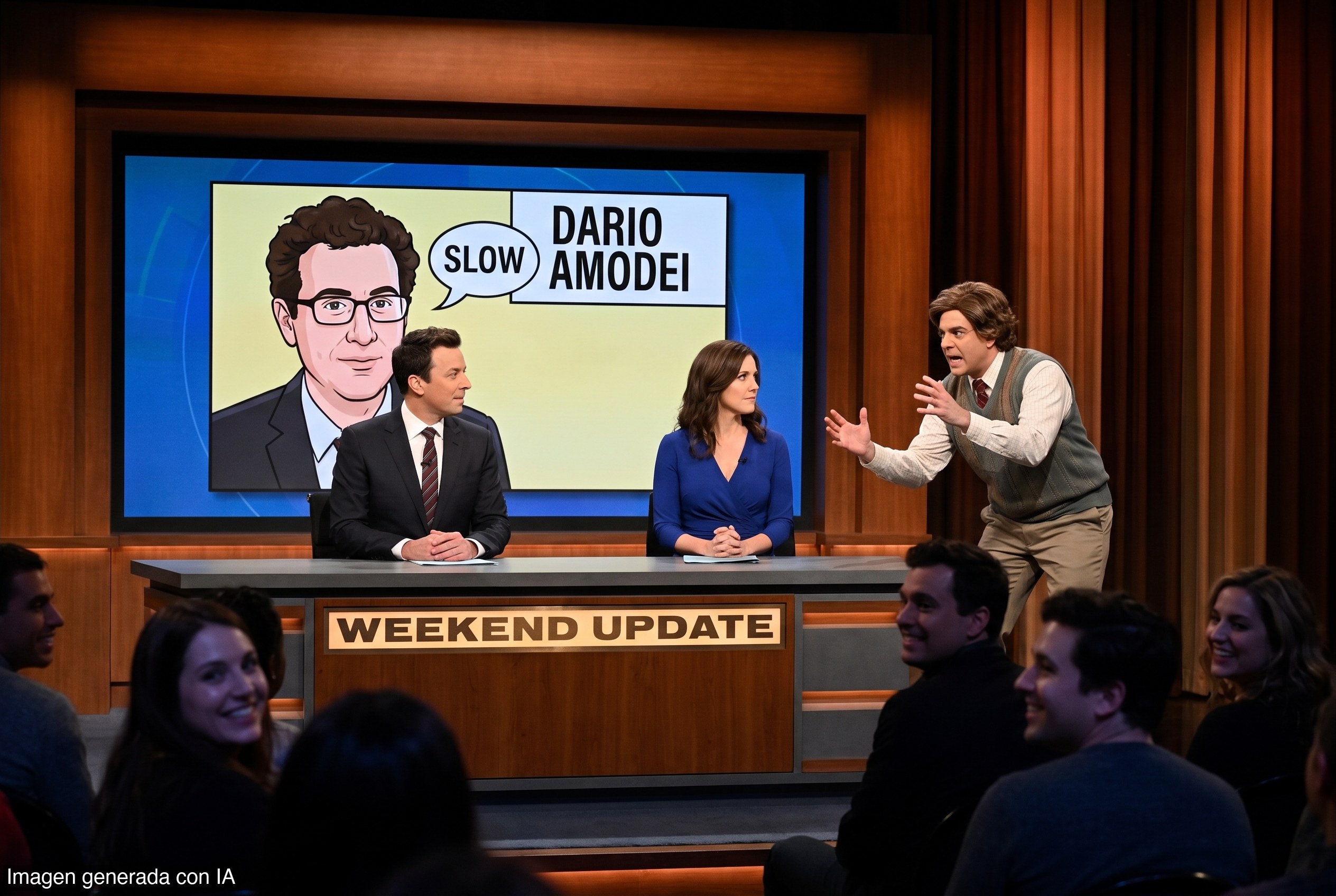
'Saturday Night Live' took aim at Anthropic CEO Dario Amodei over the weekend, turning his warnings about AI risk into a comedy bit.
Jane Wickline portrayed Amodei in her first season as a repertory player, playing him as a bumbling megalomaniac struggling to explain why his own technology would not end the world. During the segment, the character was split into two personalities: one media-trained and one far less polished.
The sketch leaned on Amodei’s recent public push for caution. Earlier this month, he published a grave essay on his personal website saying AI models were quickly getting out of control. He argued for a coordinated slowdown among frontier AI companies and for government regulation.
That warning landed in the middle of an already heated debate. A few days earlier, former Anthropic researcher Jacob Coxon quit the company and went on a media tour warning that AI labs were 'gambling with our lives.' President Donald Trump also mocked Amodei in a Truth Social post, accusing him of 'pretending to be a 'perfect little angel.''
Trump has signaled strong disinterest in regulating AI, though he did pledge last week to create an 'AI Force' that would 'watch over' AI companies.
In recent weeks, Amodei has been promoting Anthropic breakthroughs in medical research and protein structure, and he has stopped making dire predictions about an AI doomsday. Even so, the AI safety message has not persuaded a plurality in Washington or Silicon Valley that development should be paused or slowed.
Wickline’s punch line was blunt: 'AI is the devil and I its maker!' And the reaction from the tech world showed the divide remains wide. Yann LeCun, Meta’s former chief AI scientist and a longtime critic of AI doomerism, replied to a clip of the impression on X with laughing emojis.
For founders, the bigger story is not the sketch itself. It is the policy gap it exposes. If the people building frontier AI cannot get a clear hearing on safety, and the White House is not eager to regulate, the market will keep moving ahead without a stable rulebook.
That is good news for speed, but risky for accountability. When regulation trails innovation, the burden shifts to companies, investors, and customers to live with the consequences. Founders who want a durable AI business need to plan for that uncertainty now, not after the next public scare.


