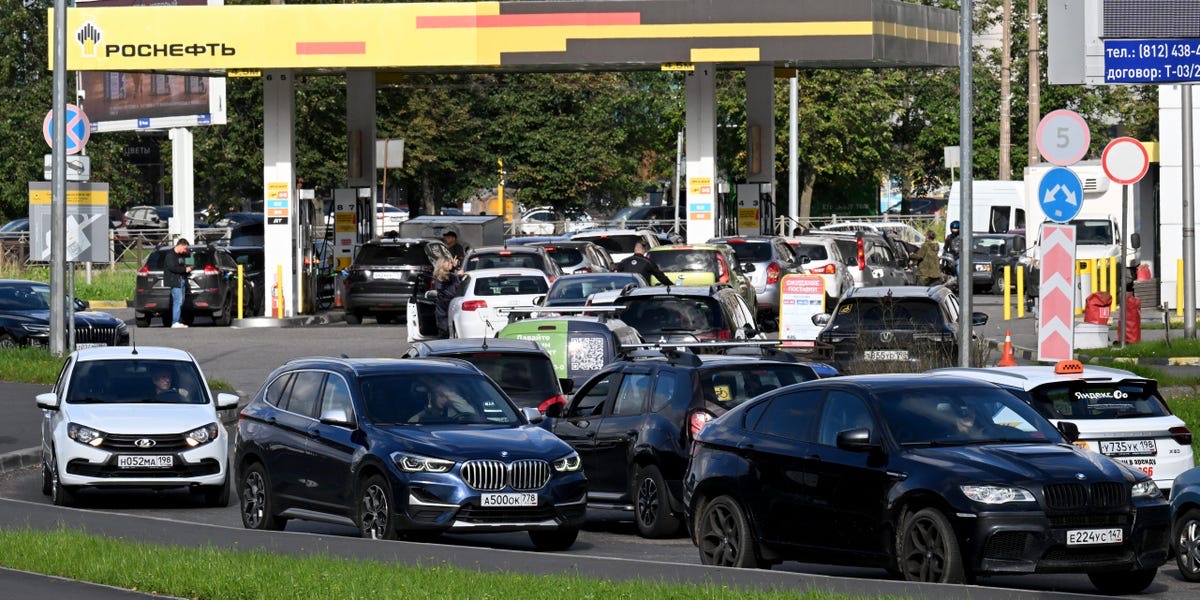
Russia, the world's second-biggest energy exporter, is now buying large volumes of petrol from overseas. The reason is simple: Ukraine's long-range strikes on refineries have made it hard for Moscow to turn its own crude into fuel for domestic gas stations. Kyiv claimed this week to have knocked out about 55% of total refinery capacity so far.
The clearest sign of the strain came from a Russian government meeting on Tuesday. According to the readout, Alexander Novak, a deputy prime minister overseeing energy, told his subordinates to prioritize expanding petrol imports and 'securing additional volumes of out-of-class fuel.'
That second instruction is telling. Russia's gas stations have traditionally maintained a K5 quality standard for about 10 years. Fuel below that rating was typically reserved for exports outside Russia's Eurasian trade bloc, as well as for niche uses such as the military, state reserves, or oilfields. Lowering the bar for what reaches ordinary drivers is a sign of how far supply has fallen.
The pain is already visible at the pump. Local officials and media in at least six Russian regions reported gasoline rationing earlier this month, typically capping customers at 30 liters, or about 7.93 gallons, a day. Reuters reported in August that similar restrictions had appeared in Moscow areas, with long queues outside some stations.
The import numbers are striking. From 2023 to 2025, Russia's monthly fuel imports roughly peaked at 5,000 metric tons of petrol products and additives. The Center for Research on Energy and Clean Air, a Helsinki-based non-profit, says Russia brought in more than 416,000 metric tons of such goods by sea in August, and another 234,000 metric tons in September. London-based shipping analytics firm Vortexa put August imports at about 470,000 metric tons. Ukraine's military intelligence agency, GUR, said Kyiv's attacks forced Russia to import about 989,000 metric tons of fuel and high-octane additives by sea between July 18 and October 23. Most of the seaborne cargoes came from Morocco, India, and Turkey.
Russia is also importing by rail from countries such as Belarus and Kazakhstan, though those flows are not tracked as closely. Reuters reported in July that Russia had imported about 453,000 metric tons over land in the first six months of 2026, roughly a 20-fold increase year-on-year. The last time Russia shipped in fuel at similar levels was in 2014, when it imported 1.6 million metric tons of motor gasoline amid a domestic supply squeeze.
Novak said in October that Russia was importing about 10% of its gasoline, though he did not give specific trade figures. 'We'll be importing at least until the end of the year,' he told state media, adding that reserves depleted during the summer shortages also had to be topped up.
For readers who watch energy markets, the signal is clear. Russia still exports millions of tons of crude and diesel, but a country that cannot refine its own oil and must buy back petrol has lost a basic piece of economic self-sufficiency. Every ton imported is paid for in hard currency, and every rationed pump is a cost passed to ordinary consumers.
That is the editorial takeaway. A state that spent years promising energy sovereignty now depends on foreign refiners and foreign shipping to keep cars moving. Free markets solve this kind of problem by letting supply respond to demand, while central planning pushes the cost onto drivers and taxpayers. Russia's rationing and quality downgrades show what happens when the state controls the refineries, the rules, and the consequences all at once.


