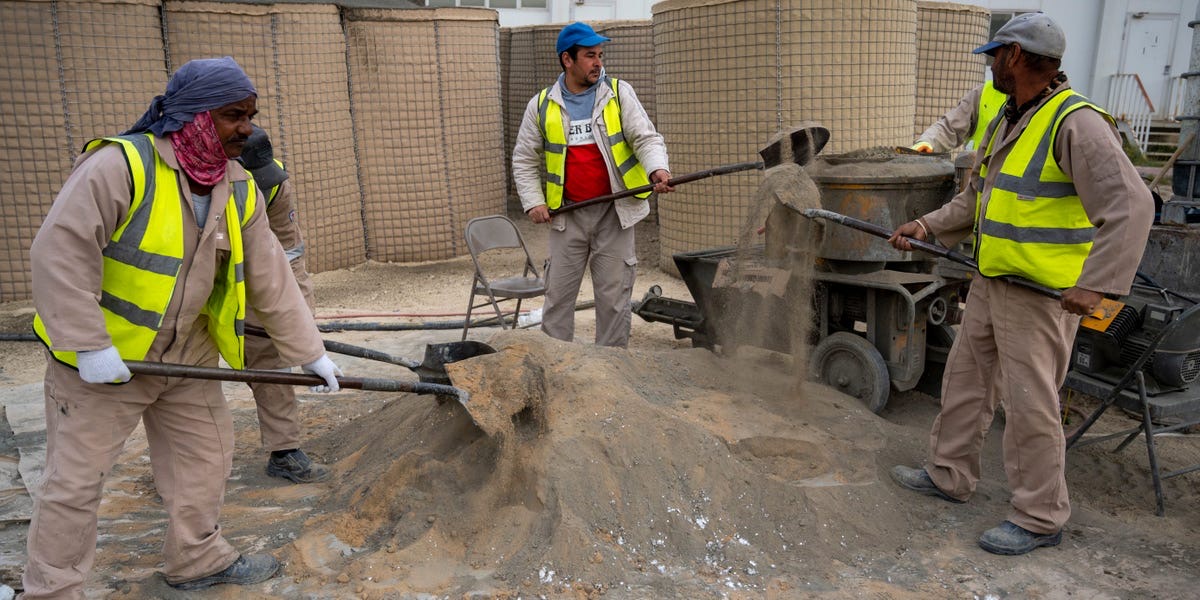
The US Army posted an urgent request last week seeking contractors to quickly build concrete bunkers to replace shipping-container shelters at military installations across the Middle East. The notice called for 17 reinforced-concrete bunkers installed at five sites in Israel, Saudi Arabia and Lebanon.
The Army said the bunkers would offer better protection against indirect fire, as well as missiles and drones, as US forces face continued dangers in the region. According to the notice, American troops had been using 'non-standard containerized shelters' while under the threat of drone and missile strikes. The service described the requirement as an 'urgent, high-priority' need to replace those shelters, and it gave contractors just 45 days to finish the work.
The posting has since been in flux. The Army initially attached documents detailing each project and its tight timeline, then removed them, and the listing has oscillated between canceled and inactive. Col. Adam Hallmark, a spokesperson for US Army Central, told Business Insider the change was a routine administrative update, noting that the project predates recent overseas operations. He added that 'these force protection requirements remain entirely valid as we continue to support and safeguard our personnel across the area of responsibility.'
The request follows Iranian missile and drone attacks that put US personnel at sustained risk during the military's war against Iran. Earlier this year, those attacks severely damaged base infrastructure and equipment, and six service members died in an attack on a US base in Kuwait. Concerns about the protection of US forces have been around since the start of the war, centered on trailers and other unhardened facilities that became common during the post-9/11 wars. Those structures were often surrounded by thick concrete barriers built to stop ground threats such as gunfire and improvised explosive devices, not aerial attacks.
The design described in the notice is built for speed. Each bunker would consist of three prefabricated reinforced-concrete sections, with steel protective doors and heavy concrete barriers shielding the entrances. Sandbags would reinforce the exterior walls and add at least 18 inches of protection above the roof.
The math here is a lesson in cost. Every bunker is taxpayer money spent on a structure that exists because the earlier shelter choices fell short. Procurement on a 45-day clock tends to be expensive, and the Army has not publicly detailed the price of the project. Free-market readers should ask the questions the notice leaves open: what each bunker costs, who builds it, and whether competitive bidding is still in play under this kind of urgency.
The Army's posture is clear, even if the paperwork is not. Protecting soldiers is a legitimate and serious obligation, and no one serious disputes it. But the episode shows how a shelter strategy built for ground threats had to be rebuilt after the threat changed, and how the administrative state moves when the bill comes due in the middle of a war. The principle at stake is accountability for the money spent and for the planning that left troops in unhardened structures in the first place.


