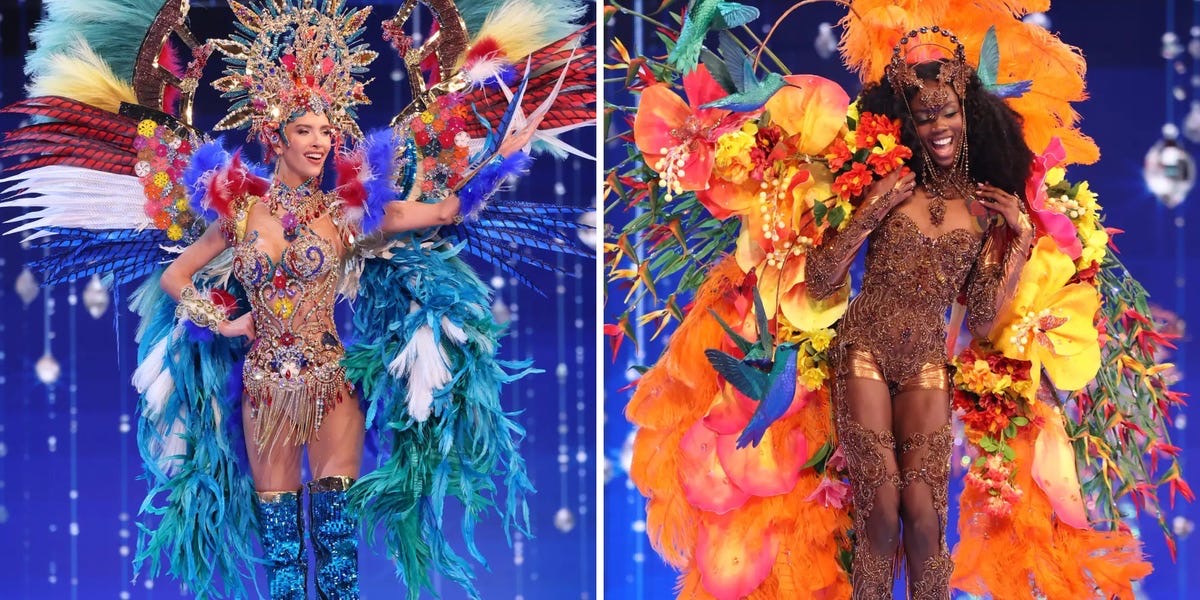
The Miss Universe pageant closes on Tuesday, with one woman set to take the crown at the 75th annual event in Puerto Rico. Before that, the 116 contestants walked the stage for the national costume contest on Saturday, using bold outfits to pitch their countries to a global audience.
The range was wide. Elizabeth Johnson of Aruba fluttered in the bright green, yellow, and blue feathers of the prikichi, also known as the brown-throated parakeet, a bird she said she learned about from her father and from hikes through Arikok National Park. Samira Khan Mahi of Bangladesh used a towering backpiece to tell the story of motherhood, from pregnancy to watching a child graduate. Olga Lombardo of Belgium carried two sparkling swans on her shoulders, a nod to the birds that float down the canals of Bruges.
Caleigh-Rose West of Belize built her look around the Great Blue Hole, a circular sinkhole that is part of the Belize Barrier Reef and stretches more than 1,000 feet across and over 400 feet deep. Marcella Kozinski's all-red costume used PET bottles for its leaves and 3D-printed, hand-painted fruit, a design its creator described as an eye-shaped seed inside a red shell. Juliana Myers of the Cayman Islands wore massive brown-and-yellow wings inspired by the Cayman swallowtail butterfly. At 21, she is one of the youngest full-time real estate agents in the Cayman Islands.
Some costumes carried political weight. Mia Dio's tribute to the Ladies in White, a movement formed in 2003 by the wives and female relatives of 75 dissidents imprisoned in Cuba, featured portraits of all 75 prisoners across her backpiece. Dio said the prisoners were jailed for peacefully exercising their freedom of expression and thought. Dio is a content creator with 5 million followers on TikTok.
For founders, the lesson is simple. Every contestant had roughly the same stage time and the same goal: be remembered. The ones who stood out had a single, concrete story they could explain in one sentence, whether that was a bird, a reef, or a business. Bianty Rojer-Gomperts of Aruba's neighbor in the lineup built her costume around the bright-yellow flowers of the kibrahacha tree, another example of a clear, local symbol doing the selling.
The editorial reading here is that national identity is an asset, and it works best when it is specific. A generic flag does not get remembered. A named bird, a named reef, or a named monument does. Entrepreneurs can apply the same test to their own pitches: if a customer cannot repeat your story after thirty seconds, the costume is too busy and the message is lost. Strip it down to one symbol, make it real, and let the market do the rest.


