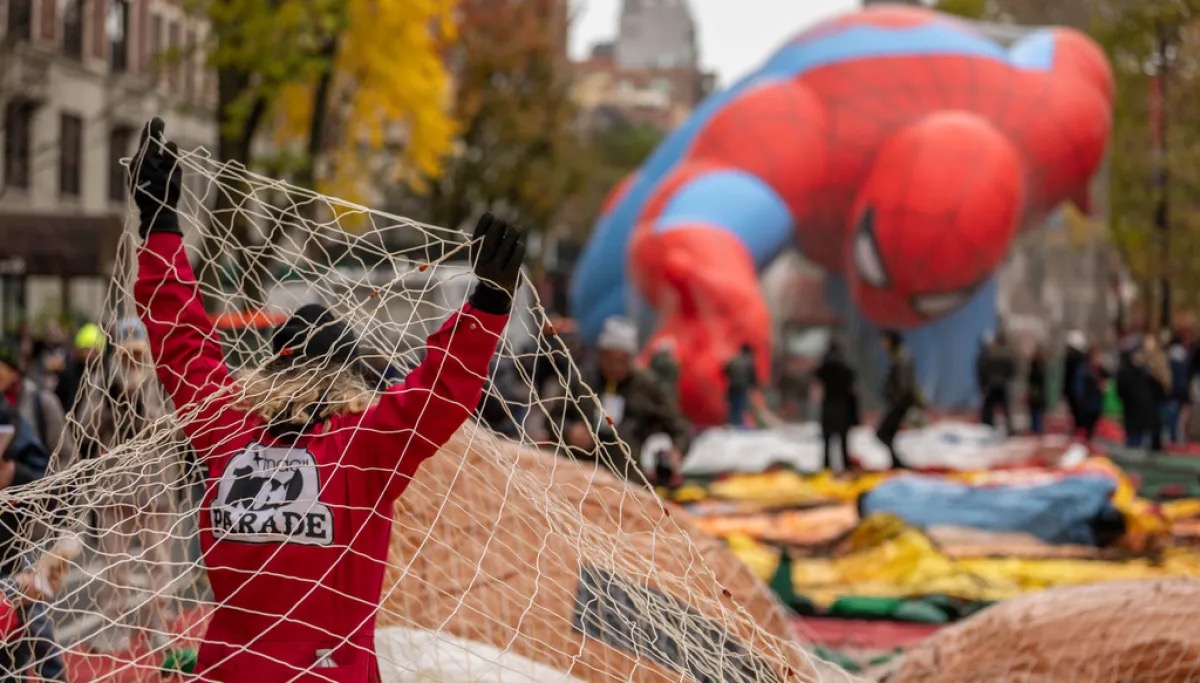
Macy's has pushed its 100th Thanksgiving Day Parade from Thursday to Saturday, November 28, at 8:30 a.m. ET. The company cited severe weather, and the call was not a close one. Heavy rain and thunderstorms were forecast for the New York City area on Thanksgiving, and the wind posed a particular danger to the massive balloons the event is known for. Many of those balloons were already inflated by Wednesday afternoon.
The parade has never been canceled because of weather, though it was suspended from 1942 to 1944 during World War II. The Washington Examiner reported that this is the first time the parade has been postponed due to weather, in what was forecast to be one of the rainiest Thanksgivings in recent memory along the East Coast. A nor'easter, a storm marked by heavy precipitation, gale-force winds and coastal flooding, was expected to move up the Atlantic Coast through the holiday, according to the Weather Prediction Center.
The delay also lands on thousands of volunteers and performers, who now have to rearrange their plans for a Saturday schedule. Macy's said in a statement that 'the safety of our participants and spectators is our top priority,' and that the decision came after close consultation with city and agency partners.
For the network, the disruption has a silver lining. NBC confirmed that it will run commercials from the parade's sponsors twice this week: once when the 2026 parade airs Saturday, and again Thursday, when the network repeats last year's broadcast. According to Guideline, a tracker of ad spending, the cost of a 30-second spot in the parade is up 15% to 20% over last year, when NBC charged between $900,000 and $1 million per unit. That would put a 2026 spot at roughly $1.03 million to $1.2 million. Ad spend on the event is pacing 25% to 30% ahead of last year, and the parade drew more than $88.7 million in advertising last year, according to the company.
NBC's spokesperson said the network is 'committed to ensuring this remains a high-priority opportunity for our clients with both the reach and scale of tomorrow's re-airing and the original live telecast on Saturday.' Geico had planned a two-minute stop-motion spot featuring its Gecko, and Starbucks is promoting a holiday album while sponsoring a TikTok takeover of the parade's livestream.
The Macy's and NBC arrangement has a precedent. After a 35-minute power outage stalled the 2013 Super Bowl between the Baltimore Ravens and the San Francisco 49ers, CBS gave some advertisers an extra run, including Bud Light and Subway.
The editorial takeaway is clear. A private event with a private sponsor base absorbed the weather risk on its own books, and the market responded by making the make-good airtime more valuable, not less. No federal bailout, no emergency appropriation: just contracts, schedules and advertisers who paid for reach. That is how free enterprise is supposed to handle disruption. The volunteers and performers who must now rearrange their weekend bear the real cost, and they did not sign up for a rescheduled holiday, but the system they work within is still voluntary and still accountable to the people who fund it.


