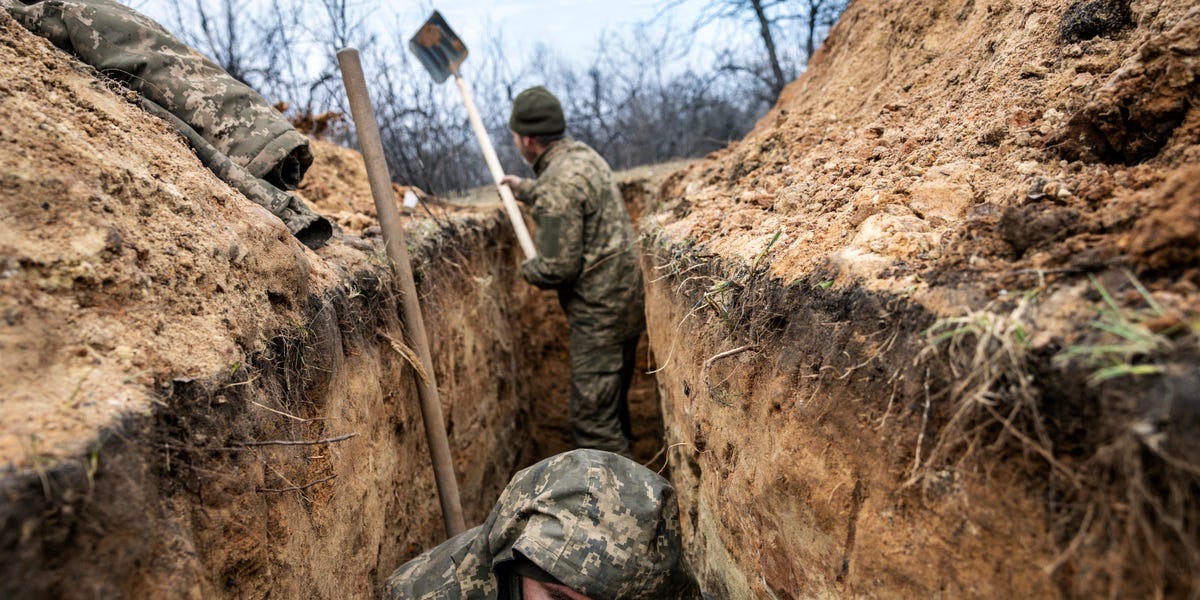
The war in Ukraine has forced the British Army to rethink a skill it had taught the same way for decades: digging a defensive trench. According to Business Insider's reporting, the defensive exercises at the Royal Military Academy Sandhurst had remained largely unchanged for a long time, but the training is now being rebuilt around what is happening on the front lines.
The most visible change is the shape of the trench itself. Brigadier Nick Wight-Boycott, the commander of Sandhurst, said the old straight trenches had a clear weakness. 'If you dropped a grenade in, all the shrapnel just went one way, and everybody who was in the trench would probably get a bit of the fragmentation,' he said. The new L-shaped design gives soldiers a place to hide around the corner, whether from a grenade or from gunfire.
The location has changed as well. Captain Will Kriehn, a British platoon commander, recalled that when he did the exercise in 2022, cadets were 'deployed into an open field' where they dug for days and 'there was no cover.' Now cadets dig under trees, because reconnaissance drones can easily spot exposed positions. Wight-Boycott put it bluntly: 'everything that we've seen in warfare, not just in Ukraine, is that nobody ever digs in an open field.'
Speed is also part of the new curriculum. Rather than spending an entire exercise on one position, cadets now practice digging in, defending, and falling back to repeat the cycle. The aim is to slow an enemy advance and buy time for other forces to counterattack. Wight-Boycott also said cadets are using nets and chicken wire to protect fighting positions from grenades and drones.
The changes are not entirely new. L-shaped and zigzag trenches were used in World War I, and a 2024 US Army Center for Army Lessons Learned report recommended fighting positions 'as deep as possible with a blocked L-shaped entrance.' What Ukraine has done is make those old designs urgent again, and show that modern threats demand them.
For the British Army, the lesson goes beyond ditches. Working with Ukrainian officers has challenged assumptions about what modern trenches look like. Far from clean and surgical, they are likely to be messy, uneven, and full of traps. Kriehn said the goal is to make cadets 'agile leaders, thinking leaders' whose skills carry into any posting.
The editorial takeaway for readers who run organizations is simple. Institutions that refuse to update their training, even on something as old as trench digging, pay for that delay in lives and budgets. Preparing leaders to adapt, rather than to repeat a script, is cheaper than learning the lesson on the battlefield.


