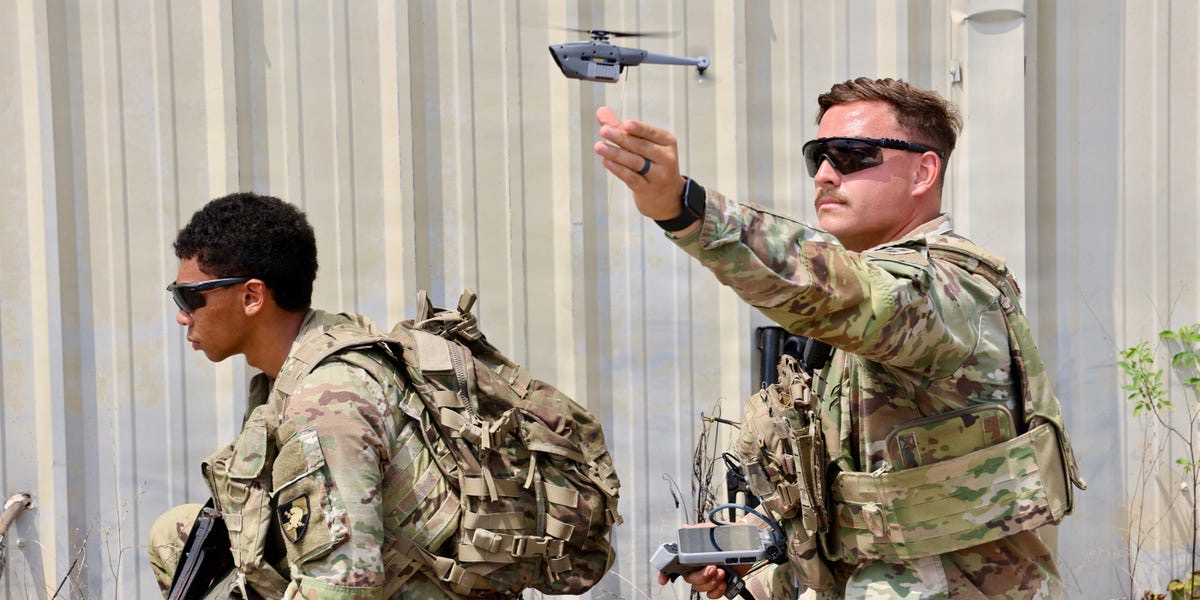
The first time James Andreasen walked into Ukraine's Killhouse, he was stunned by the scale and professionalism of the operation. Andreasen, a senior US Army aviation warrant officer who teaches a drone course at Fort Rucker, Alabama, visited the Killhouse Academy roughly two dozen times between November 2025 and March. Run by Ukraine's elite 3rd Army Corps, the academy trains soldiers, foreign fighters, civilians and defense industry workers to operate small drones. Here's the playbook he took home.
The first lesson is about ownership. Ukrainian trainees are expected to repair and program their own drones, understand the basic systems and swap parts when something breaks. Andreasen said it is 'really important for our guys to understand how these things work,' so they can iterate and adapt. In a war where equipment is consumed fast, the operator who can fix the machine keeps flying.
The second lesson is about realism. Front lines in Ukraine are shaped by electronic warfare designed to disrupt drone signals. The Killhouse leans into that, 'intentionally trying to degrade the signal so that there would be more realistic training environments for their students.' Andreasen contrasted this with the Army's instinct to preserve the signal. US training is built for reliability, safety and control, which saves time and assets but can cost realism.
The third lesson is about cost. Andreasen was struck by how basic the Ukrainian drones were. In his words, 'I was surprised at how bare-bones their drones were.' The hardware came from donations, secondhand purchases, US-funded support or out-of-pocket buys. The American habit, by contrast, is to pursue expensive, exquisite multifunctional systems. For founders, the parallel is hard to miss: a lean stack you can afford to lose and replace often outperforms a gold-plated one that sits in the hangar.
The fourth lesson is about pace. The old US assumption was that flying fast was the skill to master. The Killhouse teaches something different: steady hovering for long periods, flying low, and operating inside buildings and around corners without losing altitude. 'Their drones aren't doing backflips and crazy maneuvering,' Andreasen said. He carried those objectives straight into the Army's Unmanned Advanced Lethality Course, including the altitude at which pilots train and how they strike targets.
The Army is still playing catch-up, Andreasen said. The Ukrainian trainees he watched had a more instinctive grasp of their aircraft, the electromagnetic spectrum and the need to protect drone operators. His biggest concern is throughput: 'we can't get enough of our soldiers through these courses fast enough.'
Still, he credits the institution for listening. When he identified ways to improve the course, the Army was receptive. 'At no time in my 16 years in the Army have I ever seen the US Army move faster than they have done for drones trying to catch up to Ukraine.'
For founders, the takeaway is practical. Build products your team can repair and modify. Stress-test them under the conditions they will actually face. Buy lean and replace fast. And when a frontline operator tells you the old process is wrong, change the process. Speed of adaptation, not the size of the budget, is what closes the gap.


