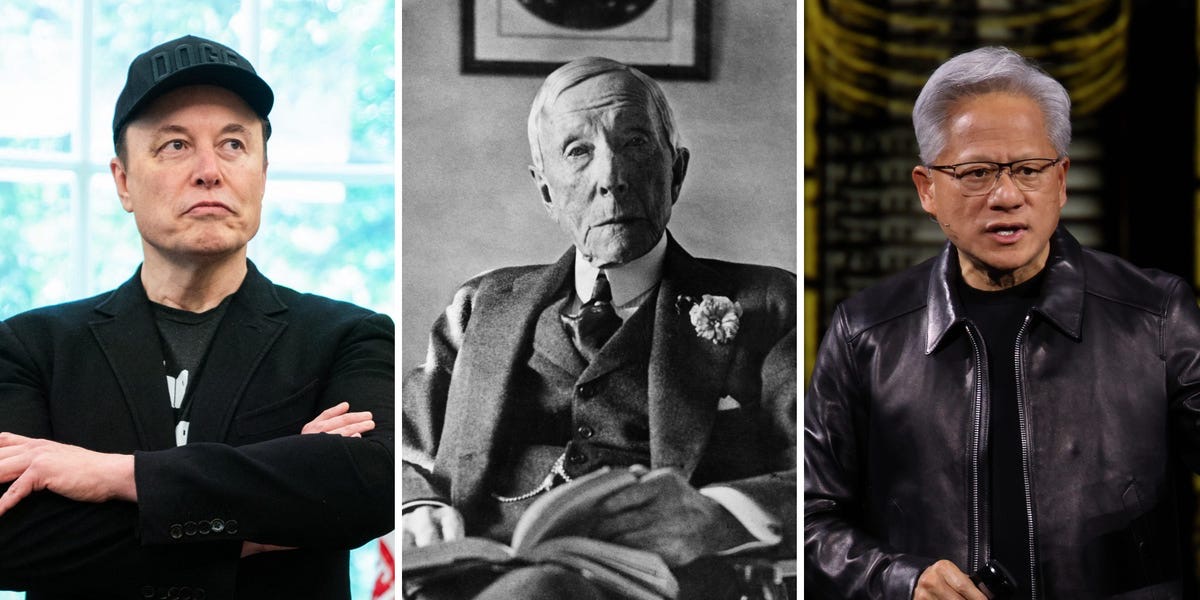
America has never had as many billionaires as it does now, and the number keeps climbing. From multibillion-dollar IPOs to dominance in specialized chips, tech leaders such as Nvidia's Jensen Huang have built fortunes that Business Insider says are destined for the history books.
But how do those fortunes compare with the men who defined the Gilded Age? Business Insider points out that John D. Rockefeller, founder of Standard Oil, is widely considered the wealthiest man in American history. At its peak in 1937, his wealth equaled 1.5% of the country's GDP. Adjusted for inflation, that would be roughly $512.7 billion today.
Elon Musk's current wealth has far surpassed Rockefeller's, according to the same reporting, and tech CEOs like Huang do not fall far behind. The scale of their fortunes is unprecedented by almost any measure.
The comparison depends on method. Business Insider drew on a 2007 Forbes list of history's wealthiest figures, based on estimates by economist Peter Bernstein. That list measured each individual's peak wealth against the country's GDP at the time, converted it to 2006 dollars, and then adjusted it to today's dollars using the US Bureau of Labor Statistics inflation calculator. For living people, the outlet used Forbes' estimated net worths as of November 25, 2026.
That method matters. When the US economy was far smaller, the wealthiest families carried far more weight in it. A fortune equal to a few percent of GDP in the 1890s meant something very different from a fortune of the same nominal size today. Business Insider itself notes that historical estimates 'may not be perfect,' but they offer useful context.
The list spans 28 figures, including bankers like Andrew Mellon, retail pioneers such as Marshall Field and A.T. Stewart, and steel industrialist Andrew Carnegie, whose Carnegie Steel built one of the era's great empires. Among the modern entries are Larry Ellison, cofounder of Oracle; Michael Dell, founder of Dell Technologies; and Mark Zuckerberg, cofounder of Facebook, now Meta.
For founders, the playbook behind these rankings is consistent. Every name on this list built a company that solved a problem at scale, then used that scale to compound returns. Standard Oil dominated refining. Carnegie Steel dominated production. Nvidia's position in specialized chips is a modern version of the same bet: own a critical layer of an expanding market and hold it.
The lesson is not that every founder can match Rockefeller. The math is simple: fortunes this large come from ownership of companies that customers keep choosing, year after year, at margins that let the business reinvest. Founders who understand that move faster, because they know which metric actually drives value: durable revenue, not headlines.
The historical comparison also underlines how much the wealth of the American economy has been concentrated and recycled through private enterprise. Those who built these companies took the risk, and the market rewarded them when it wanted what they were selling. That is the free-enterprise story at its core, and it is worth remembering whenever the size of a fortune draws political fire.


