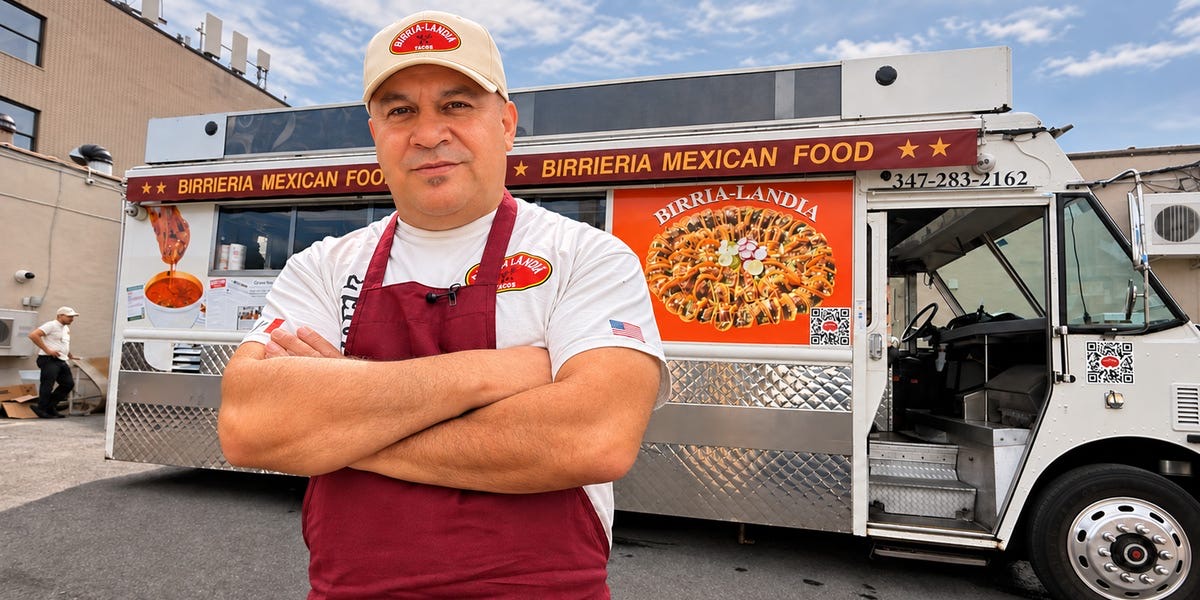
José Moreno started out washing dishes. Today he owns some of the most popular food trucks in New York City. His company, Birria-Landia, has grown from a single vehicle into a business that generated $10.5 million in gross sales in 2025, according to Business Insider.
The origin story is lean by design. The business began in 2019 with a $22,000 taco truck, funded by Moreno and his brother's savings. No outside investors, no loan stack, no venture round. Founders who are bootstrapped from day one know that every dollar has to earn its place, and that is exactly what this story shows.
The operating model is equally concrete. Birria-Landia turns 8,000 pounds of beef a week into birria tacos, served from seven locations across the city. That is a volume number worth studying. Consistent weekly throughput is what turns a food truck from a hobby into a predictable revenue line, and it is why the unit economics matter more than any single busy day.
The brand also earned something money cannot buy: two stars from The New York Times. Critical validation drives foot traffic, and foot traffic drives the pipeline of repeat customers that keeps margins healthy. For a food business, reviews are a distribution channel.
The next move is the one that tests every operator: expansion into brick-and-mortar restaurants. A truck is cheap to start and easy to move. A fixed restaurant brings rent, a larger headcount and a longer runway requirement. Moving from mobile units to permanent sites changes the cost structure entirely, and the founders who make that jump successfully are the ones who model fixed costs before they sign a lease.
Here's the playbook. Start with a unit you can afford to lose. Measure weekly volume against cost. Let customer demand, not ambition, set the pace of expansion. Moreno's path shows that a modest starting budget can scale into a seven-location business when the product is consistent and the numbers are watched closely.
The math is simple: a $22,000 investment that has grown into $10.5 million in annual gross sales is a powerful reminder that small, disciplined starts can outpace fancier launches. Founders who get the basics right move faster, and they keep control of the business while they grow it.


