Scale.
The Latest
NBC Pulls Anti-Israel Ad From 'SNL' Special After Backlash Over $400 of 'Taxpayer Money'•Jensen Huang's Nvidia Comeback Could Usher in an 'Age of Resentment,' Warns Economist Steve Hanke•The Army Has Received Just 180 of Nearly 12,000 Abrams Rounds Due by Summer, and Taxpayers Are Still Paying•Why One Parent Swapped Christmas Gifts for Family Trips, and What It Actually Costs•Musk's Free SpaceX Shares for Every Child: A Gift Worth Watching, and a Reminder That Stakes Beat Subsidies•I Spent a Day Riding, Eating and Cleaning With Robots. Here's the Free-Market Scorecard.•A Budget Traveler's Honest Take on ASKY Airlines: Cheaper Than You Think, Less Consistent Than You'd Like•A Texas Relocation Broker Is Heading to Florida, and Her Clients Say the Tax Math Is Next•Booking Your First Cruise? Here Are the 7 Costs and Surprises Founders Should Plan For•Shake Shack's Holiday Shakes Ranked: The Christmas Cookie Is Sweet, the Hazelnut Chocolate Is Worth Watching•NBC Pulls Anti-Israel Ad From 'SNL' Special After Backlash Over $400 of 'Taxpayer Money'•Jensen Huang's Nvidia Comeback Could Usher in an 'Age of Resentment,' Warns Economist Steve Hanke•The Army Has Received Just 180 of Nearly 12,000 Abrams Rounds Due by Summer, and Taxpayers Are Still Paying•Why One Parent Swapped Christmas Gifts for Family Trips, and What It Actually Costs•Musk's Free SpaceX Shares for Every Child: A Gift Worth Watching, and a Reminder That Stakes Beat Subsidies•I Spent a Day Riding, Eating and Cleaning With Robots. Here's the Free-Market Scorecard.•A Budget Traveler's Honest Take on ASKY Airlines: Cheaper Than You Think, Less Consistent Than You'd Like•A Texas Relocation Broker Is Heading to Florida, and Her Clients Say the Tax Math Is Next•Booking Your First Cruise? Here Are the 7 Costs and Surprises Founders Should Plan For•Shake Shack's Holiday Shakes Ranked: The Christmas Cookie Is Sweet, the Hazelnut Chocolate Is Worth Watching•
Scale.
Sections
The outlet
Innovate

Google’s space data-center test targets a cheaper power source for AI

Google is launching its first Suncatcher satellite next week to test whether AI chips can survive in orbit and tap stronger solar power than Earth can offer. The experiment is small, but it could shape how founders think about the next wave of compute infrastructure.
SEP 26, 2026
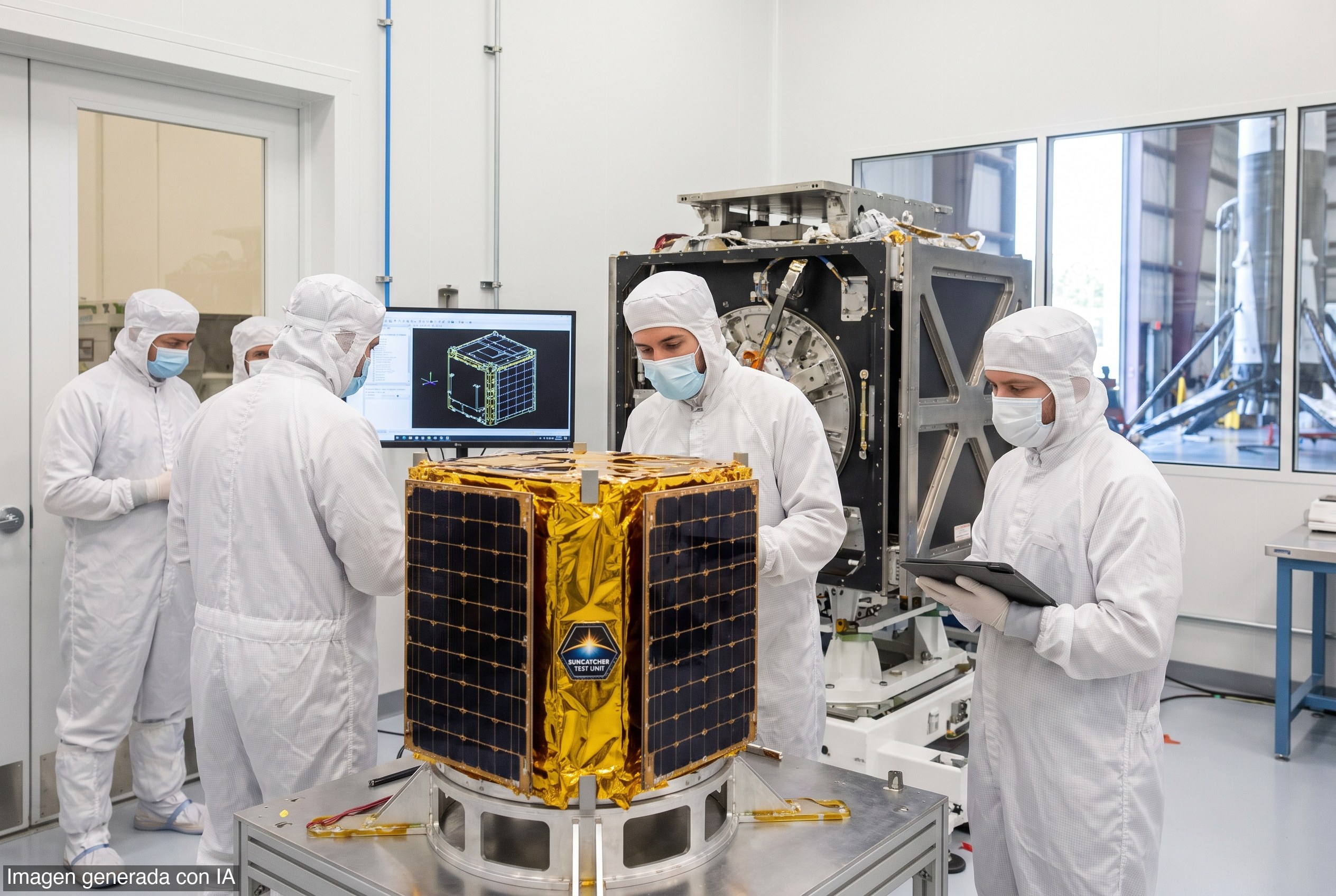
Photo: Imagen generada con IA

Google is taking the first step toward Project Suncatcher, its effort to design orbital AI data centers.

The company will launch a prototype satellite next week, with the mission set for October 1 aboard SpaceX’s Transporter-18 rideshare, according to Reuters and Ars Technica. The satellite, called MVP, is about the size of a refrigerator and carries four of Google’s custom TPU AI accelerators.

Google is not trying to build a full orbital data center yet. The satellite is a test platform designed to see whether its chips can survive launch forces, extreme temperatures, and radiation. Google will also examine a cooling system built with heat pipes, radiators, and thermal interface material, since airflow cooling does not work in a vacuum.

The appeal is straightforward: power. Google says solar panels in low Earth orbit can collect up to eight times more energy than panels on the ground. Ars Technica reported that MVP’s solar panels supply only about one kilowatt of power, enough to run a microwave or a hair dryer. That is still enough to test whether space can become a more favorable place for energy-hungry AI hardware.

Google wants to run Gemini models on the TPUs during testing, but not continuously. The cooling system can only work in short bursts of about 15 minutes before the TPUs need to shut down so the radiators can catch up.

The satellite comes from Planet Labs, not from a new spacecraft built entirely by Google. The company had initially planned two custom satellites in 2027, but it accelerated the schedule by integrating its chips into a satellite Planet Labs had already built for an early test.

Google says the mission will help it learn what works and what does not before future launches. It still plans two more satellites in 2027 to test laser links between orbiting computing clusters. Ars Technica said Google expects it will be years before Suncatcher moves from 'project' to 'product'.

For founders watching AI infrastructure, the signal is clear: compute is becoming a power and logistics story, not just a software one. If orbit can deliver cheaper energy and fewer local objections, the winners will be the companies that solve heat, launch risk, and bandwidth before everyone else.

But this is still a moonshot, not a business model. The math is simple: if the hardware cannot stay cool, survive launch, and scale without expensive dedicated launches, the administrative-state-style promise of 'infinite compute' stays a pitch, not a product. For now, Google is buying time and data, not revenue.

JC
June Calloway
Innovate Columnist

June Calloway covers innovation and trends — the new ideas, categories and consumer shifts that decide who's ahead next year.

More from Innovate

Ben Stiller's 10 Best and 10 Worst Movies, Ranked by the Critics Who Score Them
Ariana Grande's Image Problem Is Costing Her More Than Headlines. Here's How PR Pros Say to Fix It.
AI Safety Researchers Are Betting Their Retirement Plans on Their Fears, and the Numbers Are Striking