Waymo's robotaxi business is now more than half a million fully autonomous rides a week, and it has begun expanding beyond US roads. But the company's story is also a story about cars, and the vehicle choices tell founders a lot about how to build hard hardware on a budget.
It didn't start with a purpose-built robotaxi. The earliest roots trace to a 2004 Volkswagen Touareg R5 TDI, a diesel SUV that Volkswagen supplied as the base vehicle for a Stanford University team. The team bolted on five lasers, one camera, two radars, a GPS, and a six-processor Intel computer. The car was nicknamed Stanley, and it won the first-place, million-dollar prize in the Defense Advanced Research Projects Agency (DARPA) Grand Challenge in 2005 by autonomously traversing 132 miles of Mojave Desert terrain.
The lesson here is borrowing. The team didn't manufacture a vehicle. It retrofitted one that already existed, which let it focus its limited resources on the software and sensors that actually mattered.
The next phase followed the same logic. A Carnegie Mellon University team won the 2007 urban challenge with a Chevrolet Tahoe named Boss, fitted with 13 lidars, five radars, and two cameras. Then Google's self-driving project built its real-world test fleet around a far more ordinary car: the Toyota Prius. According to the reporting, a Discovery Channel project helped set that path, and a Prius became the first Google vehicle to receive an autonomous-vehicle testing license in Nevada, which at the time was the first state to create such a licensing regime.
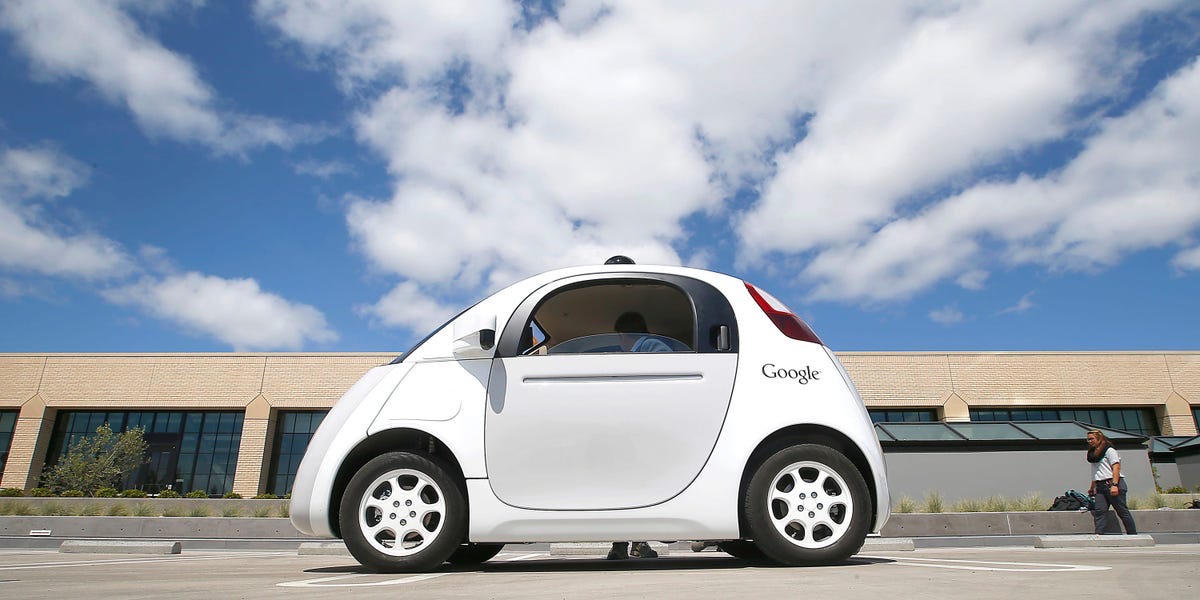
Then came the experiment that tells founders the most. Google built the Firefly, a car designed from scratch for autonomy, with no steering wheel, accelerator, or brake pedal. It was never meant for sale. Waymo said the exercise is what let it solve early problems such as sensor placement, computer integration, and the controls passengers need in a car that drives itself. The dome on the Firefly's roof is the ancestor of the lidar hat on today's vehicles.
The commercial turn came with partnerships. In 2016, the project announced a deal with Fiat Chrysler Automobiles, which later became Stellantis, to bring Chrysler minivans into the fleet. The company was also spun out of Google and rebranded as Waymo that same year. The Chrysler carried Waymo through its first early-rider program in Phoenix in 2017 and its first paid, fully driverless service to the public three years later. Waymo retired the minivan in May 2023 after a seven-year run.
The Jaguar I-PACE, an all-electric SUV, is what turned Waymo into a multi-city business. Waymo introduced the white Jaguars in 2018, and they became a fixture of its service.
The pattern is clear. Waymo has repeatedly used partners to get platforms at lower cost and faster, instead of building everything itself. As the company expands, it has tapped companies abroad, including China's Zeekr and South Korea's Hyundai, to bring newer vehicle platforms into the fleet at lower costs.
The math is simple. Hardware is expensive, and a fleet is only as good as its unit economics. Founders who work out which parts of their product are differentiators and which are commodities can move faster. Waymo built its edge on sensors, software, and operations, and it rented the rest. Start with the platform that already exists, prove the core value on it, and only then decide what to build yourself.


