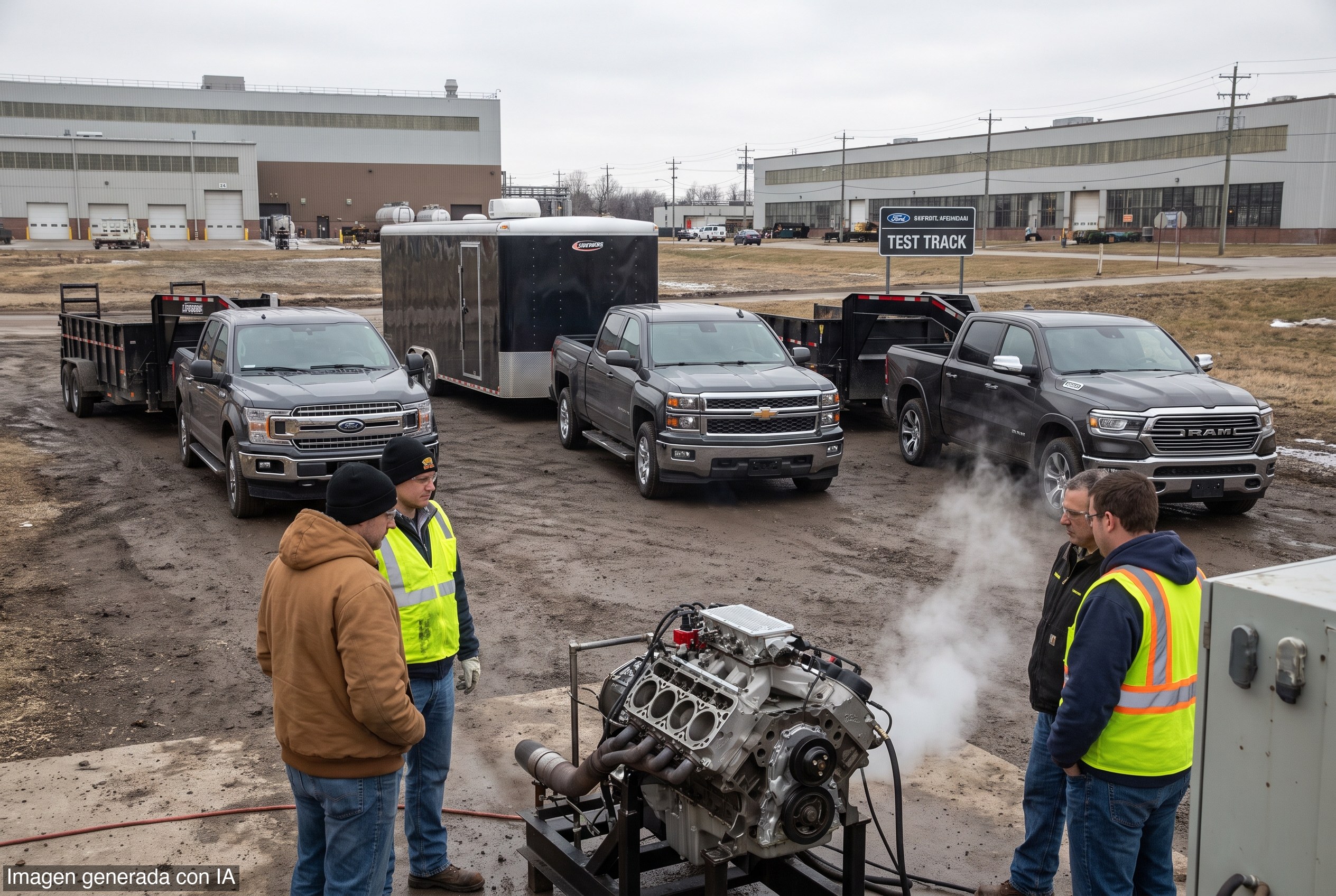
US automakers are putting real money back into V8 engines just as federal policy turns less hostile to gasoline power.
General Motors announced two new V8s for the 2027 Chevrolet Silverado and GMC Sierra. The company said it invested roughly $830 million in US propulsion plants. Ram brought back its Hemi V8 in August after discontinuing it just last year, and this month it relaunched the TRX, a V8-powered sport-oriented pickup. General Motors also said it restarted V8 engine production for trucks at its Western New York propulsion plant last May after stopping electric-vehicle battery production there, a shift that required an $888 million investment.
Ford is making its own V8 wager. Its updated 2027 F-150 still offers the 5.0-liter V8, even as a turbocharged V6 replaces the outgoing four-cylinder as the base engine. Ford has also said it plans to add a new, faster trim to its V8-powered Mustang Dark Horse lineup, called the SC.
The timing matters because Washington has relaxed emissions rules, eliminated companywide fuel-efficiency fines, and ended the federal EV tax credit. Automakers are responding to that shift by leaning into trucks and performance cars that use more fuel but still sell.
The demand data helps explain why. According to Cox Automotive, US consumers spent about $15 billion on full-size pickup trucks in December alone. Dave Mann, president of motor oil company Performance Oil Technology, said, 'What customers actually want is more horsepower and more torque.'
At the same time, hybrids are gaining ground. JD Power told Business Insider that hybrids represented 15.9% of all vehicle sales in July, up 2.5% compared with the same month in 2025. Kevin Roberts, director of market intelligence at CarGurus, said, 'Consumers wanted these cars,' but regulations had made them a difficult economic choice before the rules changed.
The math is simple: Detroit still makes its best profit on big trucks, and the V8 remains tied to that business model. If buyers keep paying for towing, hauling, and high performance, automakers will keep funding the engines that deliver them.
But the comeback also shows how much policy shapes product strategy. When regulators make gasoline power more expensive to build and sell, companies move away from it. When those pressures ease, capital flows back fast. For founders and investors, the lesson is familiar: margins follow incentives, and incentives follow the rules.


