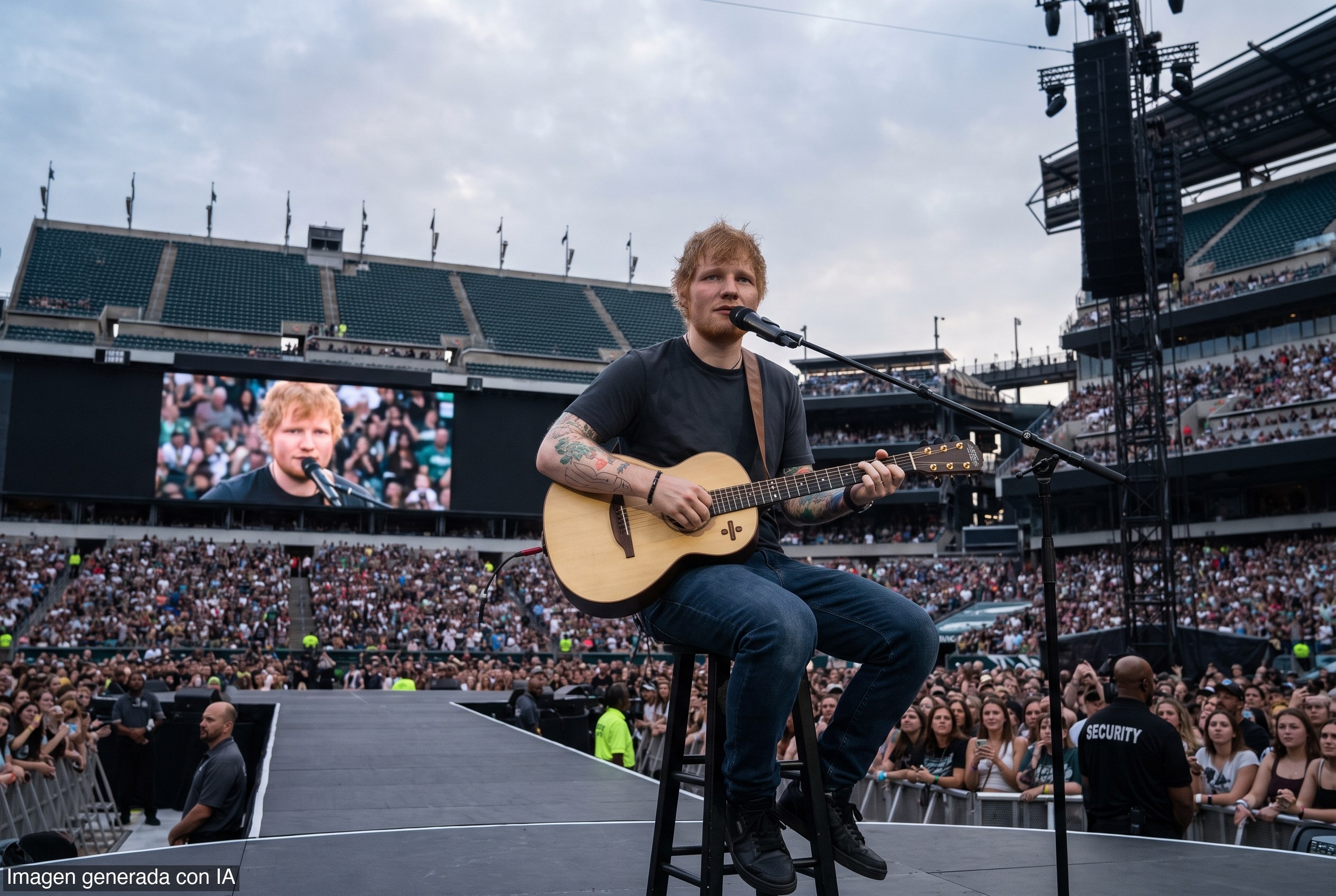
Ed Sheeran opened the Philadelphia stop of his Loop Tour with an apology-style speech after a week of backlash over Macklemore’s removal from the tour.
Sheeran told the crowd, 'I've had to take and make difficult decisions, and I am making mistakes, and I'm so so sorry,' before he sang a note. He later said, 'Honoring my commitment to my fans is also completely essential to who I am, and that is why I'm here tonight on my own and continuing my current tour.'
The controversy started when Macklemore was removed from Sheeran’s tour after pro-Palestinian comments onstage at MetLife Stadium in New Jersey. According to the report, Robert Kraft, the billionaire owner of the NFL’s New England Patriots, threatened to cancel Sheeran’s Gillette Stadium stop in Foxborough, Massachusetts, if Macklemore remained on the bill. Kraft also encouraged other stadium owners in the US to follow his lead.
The backlash spread fast. Social media users urged boycotts, headlines tracked falling resale prices for future shows, and the rest of Sheeran’s openers dropped out in solidarity with Macklemore and the Palestinian people. Some speculation even suggested Sheeran could cancel the Loop Tour entirely.
He did not.
In Philadelphia, the show went ahead with no opener. Sheeran bumped up his set time and played the hits, including 'Castle on the Hill,' 'Shape of You' and 'Bad Habits.' A small group of pro-Palestinian protesters gathered outside, but the concert still drew fans into the venue.
The financial stakes are hard to miss. Sheeran’s last tour, the Mathematics Tour, grossed over $875 million from 2022 to 2025. The Loop Tour started at the top of this year in Auckland, is scheduled to continue through North America, and is set to wrap in December in Mexico City.
Randy Nichols, who has experience with both digital marketing and live event strategy as an artist manager at Fly South Music Group, said there is no need for Sheeran to step away. 'You're talking about hundreds of millions of dollars earned over the course of an entire tour,' Nichols said. 'You're not going to cancel that tour.'
Tara Goodwin, a crisis communications expert and founder of Goodwin Consulting, said Sheeran’s first Instagram statement was 'impersonal,' 'callous,' and 'incredibly defensive.' But she said his onstage remarks helped restore his standing with the people who matter most to his bottom line: fans who buy tickets and merchandise.
Goodwin said Sheeran’s speech became more specific and more emotional, including a condemnation of the Hamas-led attack on October 7, 2023, which killed about 1,200 people in Israel. He also described the Israeli government’s war in Gaza, which has killed over 73,000 Palestinians and counting, including tens of thousands of children, according to UNICEF, as 'catastrophic, unjustifiable, and disproportionate.'
The lesson is simple for founders and executives who live on recurring demand: public outrage is real, but so is revenue. If the venue is full and the tour is still moving, the cost of stopping is often higher than the cost of absorbing the hit.
That does not mean reputation does not matter. It means the market still rewards continuity when the product is live, the customers show up, and the math on walking away gets ugly fast. In that sense, Sheeran’s Philadelphia stop was less a culture-war statement than a reminder that cash flow has a way of disciplining crisis decisions.


