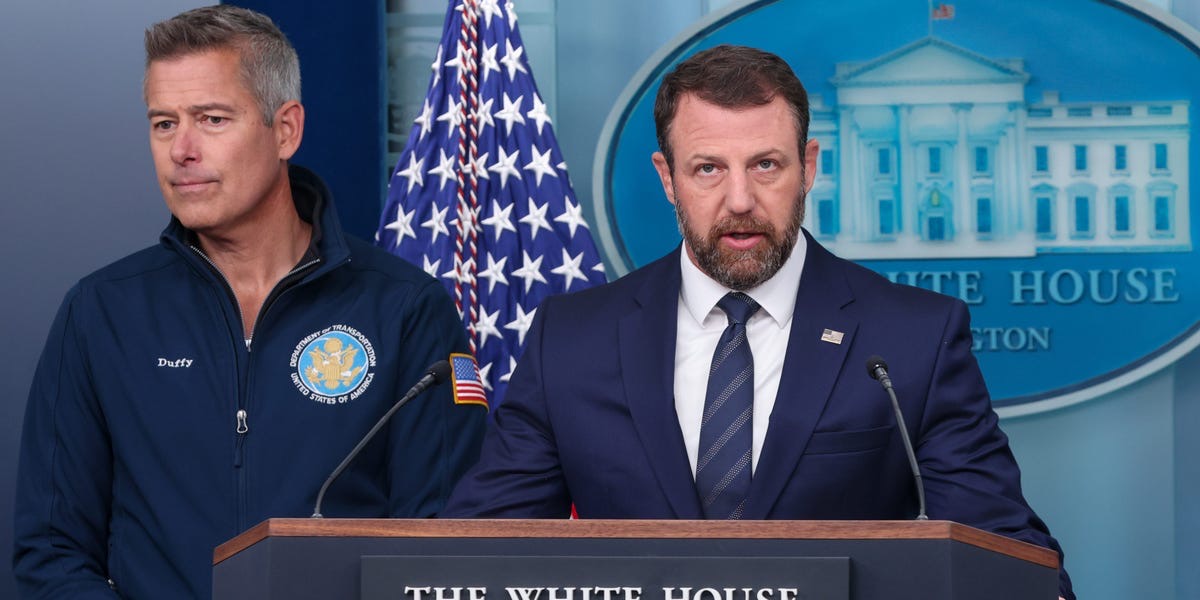
Markwayne Mullin, the head of the Department of Homeland Security, went on Fox News and said new AI software might be behind a run of computer outages. He pointed to a nationwide grounding of air travel last Friday and to other recent high-profile disruptions at JPMorgan, Microsoft and United. His reasoning was a conversation with 'one guy that's very smart with tech,' whom he did not name beyond saying it was not Elon Musk. He said that 'kinda makes sense to me.'
Mullin also admitted he does not really know the cause. He said, 'We used to have backup systems. And the backup systems are overwhelmed by the new systems now.' He told viewers to 'breathe' and said he was '98%' confident the country was not under a cyber attack.
Here's the playbook for reading this moment. The honest answer is that nobody outside the affected organizations has verified the cause yet. Mullin leads a federal agency with more than 200,000 workers and an annual budget above $100 billion, and he was still speculating on national television. That is the first lesson for founders: when your own systems fail, your customers will not accept a guess dressed as an explanation.
The second lesson is about dependency. Our world runs on software, and the commentary around this story points to a fragile stack. The Business Insider piece recalls the 2003 blackout, when a software glitch in Ohio left large parts of the country, including New York City, without power. It also quotes journalist Josh Tyrangiel, who wrote in The Atlantic that we should plan for 'Software Beirut, where nothing is broken all the time, but anything might break at any time.'
The math is simple. Every new system you add to your stack is another point of failure, and backup systems that were never sized for the new load will not save you. If you are bootstrapped, you may not have a dedicated infrastructure team, so the work falls to you. Start smaller than you think: map your critical dependencies, list which ones have no fallback, and test whether your backups still work under current traffic. That exercise costs a few hours, not a hire.
The third lesson is about communication. Outages damage trust in proportion to how much your customers hear that sounds like certainty before the facts are in. Founders who get this right tell customers what they know, what they do not know, and when they will update. That is the discipline a serious operator applies to churn and cash, and it applies here too.
For the broader economy, the question is whether public institutions can explain complex failures quickly and accurately. A free-market reader should care about this directly. When private companies and public agencies depend on the same fragile software, the cost of an unexplained outage lands on the taxpayer, the traveler and the small business that cannot process a payment. Good answers come from technical depth and accountable reporting, not from a secondhand conversation.


