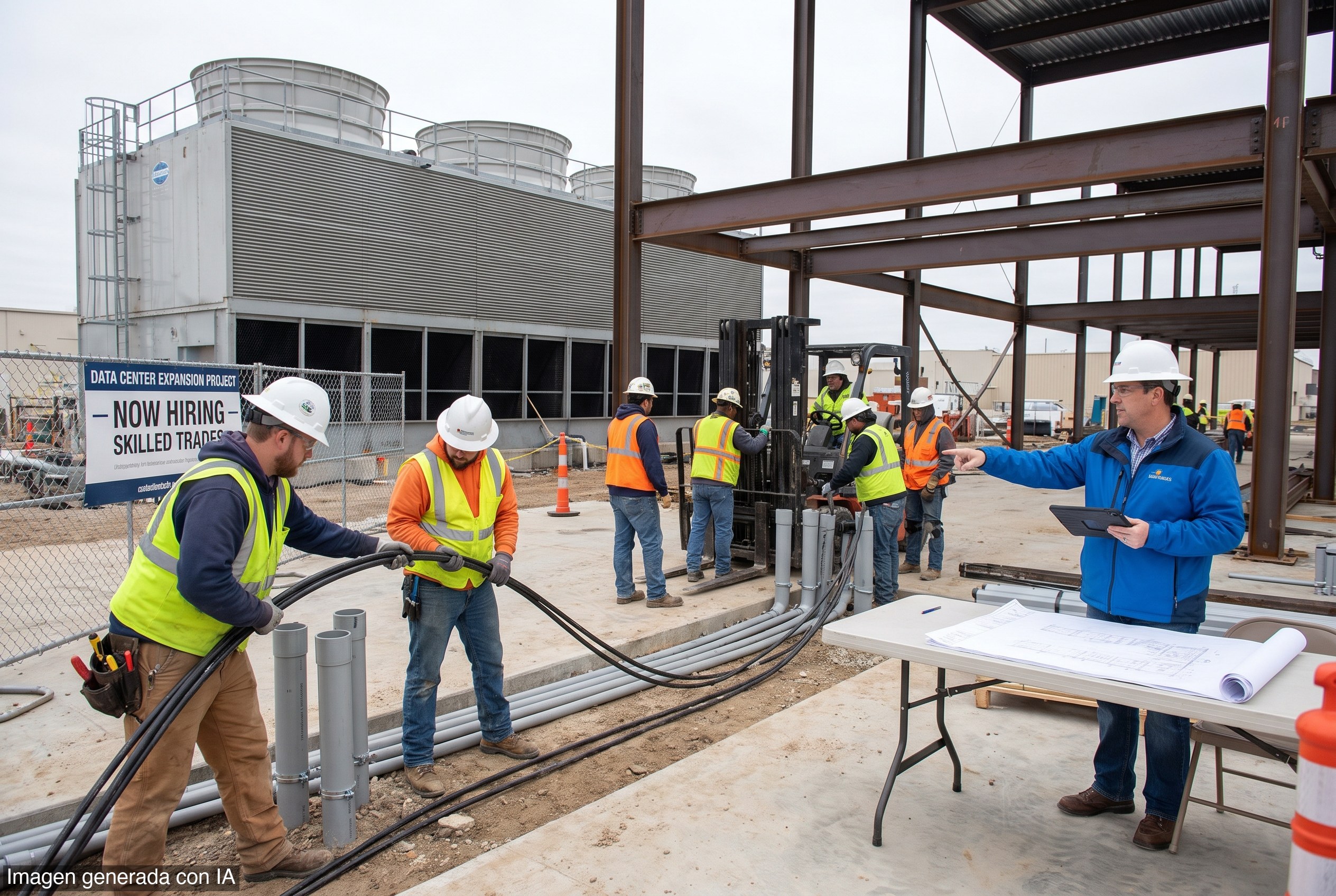
Data center construction is turning into one of the biggest forces in US building, and the labor market is already feeling it.
A Brookings Institution analysis says AI buildouts are on track to become the largest capital expenditure project in US history, outpacing spending on highways and railroads as a share of GDP. That spending is showing up in blue-collar hiring: the number of nonresidential specialty trade contractors, including electricians working on non-residential buildings such as data centers, has grown by 86,000 in the past year.
Zach Fritz, an economist at Associated Builders and Contractors, said 'a very large portion of construction labor demand right now is being driven by increasing data center construction activity.' The American Institute of Architects found that data center construction spending is set to climb more than other kinds of nonresidential building and account for about 8% of nonresidential building spending by 2027.
The short-term math is clear. Year-over-year spending on data centers has grown by just over 57%, while construction spending overall has fallen 3.8% year-over-year as of July, according to the Census Bureau. KPMG calls data centers a 'structural growth driver' for spending. On Indeed, job postings for data center-related roles are up almost 130% from about two years ago, even as overall postings are down compared with the same period.
The demand is spreading across roles. Lightcast found higher posting growth for electrical engineers within utilities, project management specialists, and, inside commercial and institutional building construction, construction managers, project management specialists, cost estimators, and civil engineers. About half of the data-center demand this year came from the IT infrastructure, operations, and support group and the installation and maintenance group.
For now, that means data centers are acting like a workhorse for the construction industry. But the durability of the jobs boom is less certain.
Guy Berger of Burning Glass Institute warned that if the cycle ends sooner than expected, 'we trained a lot of electricians, people like that, to do stuff that is no longer needed.' Fritz said the next few years look stable, but he also pointed to community opposition and technological changes that could slow growth or shrink the footprint of future projects.
Aubrey Woessner of Indeed Hiring Lab said only about two in every 1,000 data center postings are temporary, but she added that 'permanent' is a label the employer chooses and may overstate how durable these roles really are. She also noted that local incentive agreements can require a project to create a set number of permanent positions, giving employers a reason to post jobs that way regardless of how long the work lasts.
For founders, the lesson is simple: when a capital-spending wave is this large, it can create real revenue, real jobs, and real momentum. But if the buildout slows, the same labor and supplier chain can get caught with too much headcount and not enough pipeline. The winners are the businesses that treat this as a cycle to capture carefully, not a guarantee to build around forever.


