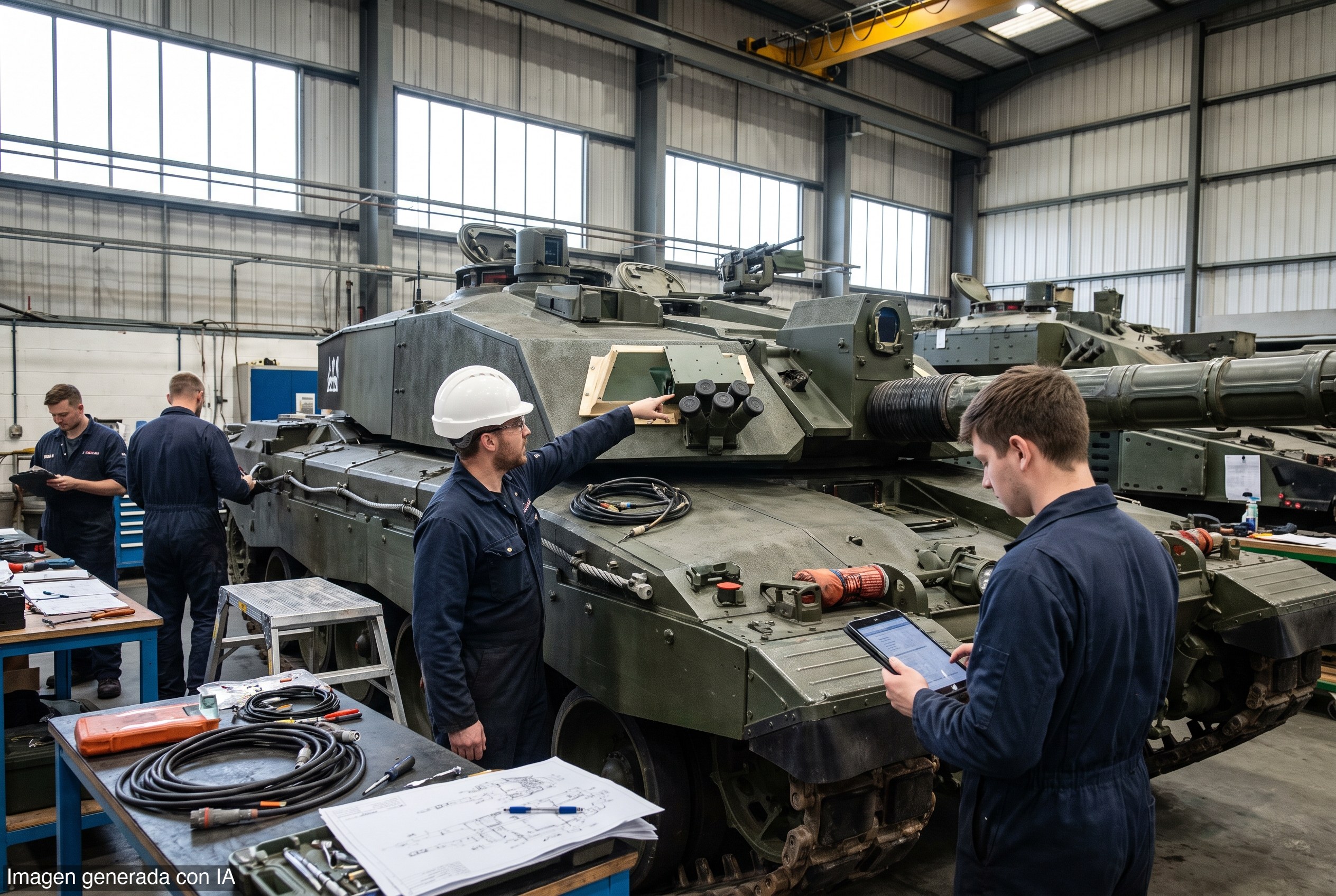
Britain's next-generation Challenger 3 tank is being shaped by the war in Ukraine.
A UK defense ministry spokesperson told Business Insider that the ministry is taking 'a load of data from Ukraine' and feeding it into Challenger 3 development. British Army officers said the military is learning lessons from Ukraine not only for Challenger 3, but for armored vehicles more broadly.
The tank is meant to be a major upgrade over the Challenger 2. The older platform is in service with the British Army and the Ukrainian military. Challenger 3 will include a digital overhaul, new weaponry, and systems meant to make it more compatible with other NATO forces.
Its smart targeting system is built mainly to fight enemy armor, but it can be adapted to detect hostile drones. The tank also carries explosive reactive armor. The ministry spokesperson said the new features are modular, so they can be swapped in and out, and Britain has options for drone-related equipment that can be added as needed.
The shift matters because Ukraine has shown how fast battlefield economics have changed. The spokesperson said the approach behind the '20-40-40' model came directly from Ukraine, where drones worth hundreds of dollars have destroyed armored vehicles that cost millions.
Challenger 3 is also getting a 120mm L55A1 smoothbore main gun that fires NATO-standard ammunition, replacing the Challenger 2's rifled gun that used ammunition unique to Britain. Other upgrades include a redesigned turret, better thermal imaging, enhanced armor, and improvements to the engine and suspension.
There are seven Challenger 3 prototypes, and an eighth is in production. The tanks have already completed their first crewed live-firing trials and are undergoing additional testing before expected delivery next year. That delivery had been pushed back from 2025.
For founders and operators, the playbook is simple: the best systems are no longer the ones that stand still. They are the ones built to absorb new data, swap parts fast, and adapt before the market changes again.
The bigger lesson is about capital discipline and survival. In Ukraine, cheap drones have changed the cost curve. In business, that same logic rewards modular design, faster iteration, and less waste. Founders who get this right move faster, and they waste less runway on products that cannot keep up.


