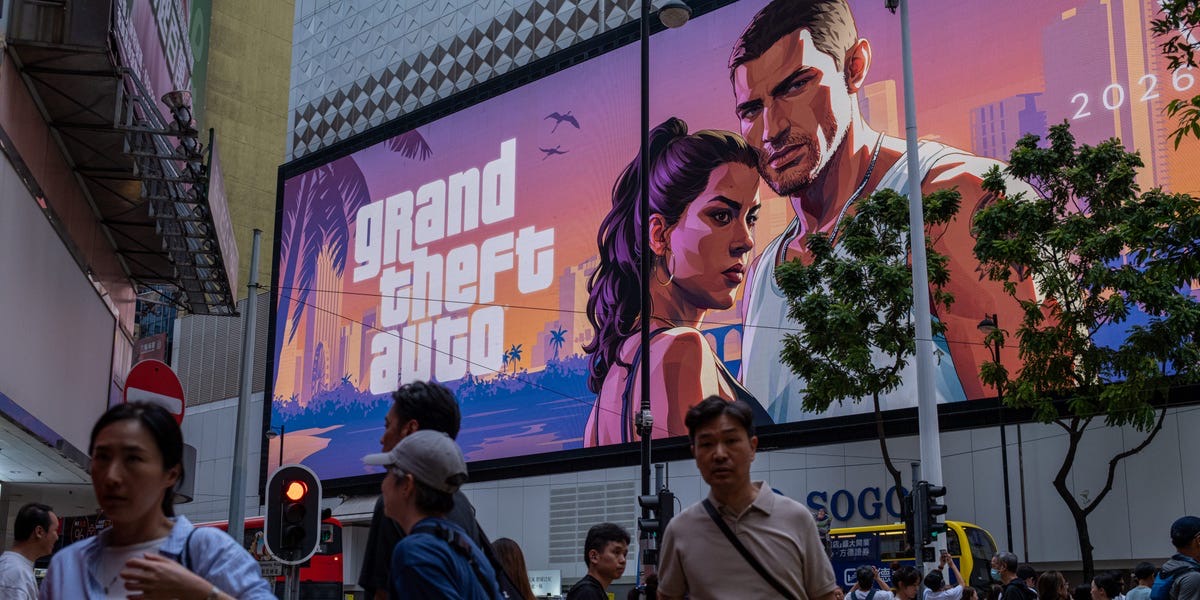
Grand Theft Auto VI launched on a Thursday, and at 2 a.m., Daniel Camilo, a 39-year-old gaming consultant from Portugal who has lived in Shenzhen for 15 years, fired up his PlayStation 5 and got to work. The game is not officially sold in China. Beijing tightly controls national licensing for games and censors titles that promote violence, unlawfulness, nudity, or vulgarity. Rockstar Games isn't running physical ads in mainland China, though it has done so in Hong Kong.
That hasn't stopped millions of gamers. To get most international releases, players in China rely on a gray market, using imported consoles to bypass region locks or modifying their gaming stations. Here's the playbook they follow. Official consoles in China are region-locked, so a buyer has to purchase a PlayStation 5 or Xbox Series X/S from overseas. Retail and online stores do stock foreign consoles, which were unbanned in 2015. Then, to get a Chinese-language version, players buy a digital copy from a Taiwanese or Hong Kong Xbox Live or PlayStation Network store.
The demand is visible. On Weibo, the hashtag for GTA 6 had received 320 million views as of Friday morning local time, according to the site's internal statistics. On Douyin, China's version of TikTok, streams and videos related to the game have garnered 9.97 billion views, per the platform's statistics. Business Insider created a new Douyin account on Thursday and found that 9 of the first 20 streams on its explore page featured gameplay from the title.
The sales math is less dramatic. Zac Ling, project manager at Shanghai-based consultancy Daxue Consulting, estimated that mainland Chinese players should contribute about 3 to 5 million copies to first-week sales. Montgomery Singman, a 40-year gaming development and licensing veteran who spent two decades in China, estimated the game would eventually see at least 10 million copies sold to mainland gamers. Ling gauged there are only about 15 million core console gamers in China, where PC and mobile gaming dominate. Some analyst firms estimate 280 million to 320 million PC gamers in the country.
The pattern matters beyond gaming. When a market is closed by regulation, customers do not disappear. They pay more, wait longer, and route around the rules through import channels, foreign digital stores, and screen-recorded streams. Singman noted the legal ambiguity: 'The game is not sanctioned, but the streamers can screen capture and give comments on their gameplay so they can get traffic.' For a founder, that is a warning about gray-market exposure and a reminder that platform moderation can be stricter than the law requires.
The editorial reading is straightforward. Every licensing gate, every region lock and every censorship rule adds friction, and friction creates a business for intermediaries. Taxpayers and consumers pay for the enforcement, while the people who benefit are the importers and the reseller networks. Rockstar, meanwhile, has not announced a launch date for its PC version, and its publisher, Take-Two Interactive, did not respond to requests for comment.
The principle at stake is simple: when the state decides what a customer may buy, the customer still buys, just through a more expensive and less accountable channel. Founders building for global audiences should price that in.


