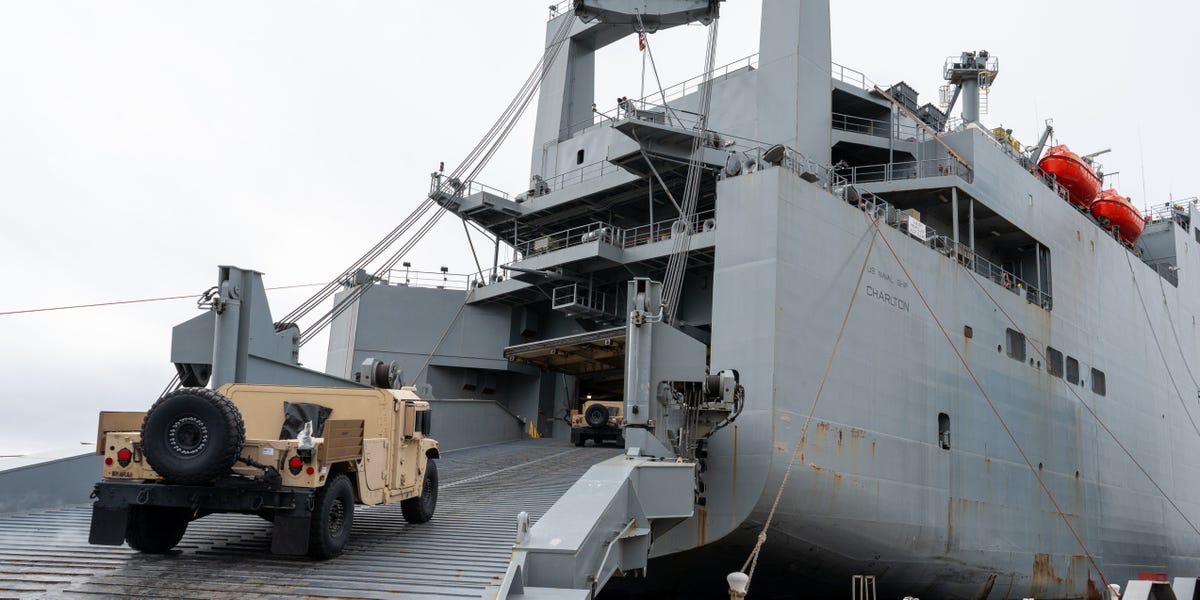
The US Army tested whether it could keep talking to units at American ports after simulated attacks knocked their normal networks offline. The goal was to rehearse how it would send forces overseas if critical infrastructure at home came under fire.
During a recent homeland defense exercise at Fort Eustis, Virginia, the Army's 597th Transportation Brigade used backup communications to connect with units in South Carolina and Texas. The drill simulated physical and cyberattacks that knocked military and commercial networks offline, creating what the Army described, in an official news release, as a 'catastrophic communications blackout' at key deployment hubs.
In that scenario, troops had to restore access to a key system that tracks military cargo moving by air and sea. Losing those connections makes it harder to track equipment, confirm it reaches the right ports and ships, and move forces overseas on schedule. In a conflict, a delay of that kind is not a paperwork problem. It is lost time.
The service said the exercise proved successful. It did not provide deeper details on how much stress was placed on the system or whether any persistent challenges remained, so the public has only the Army's own summary to go on.
The scale of the stakes was laid out by Gen. Randall Reed, head of US Transportation Command, who told lawmakers in March that more than 85% of US combat power resides in the continental United States. In his testimony, Reed wrote that 'a disconnected mobility force threatens the Joint Force's ability to win,' and called for communications that can resist jamming and cyberattacks.
The threat is not limited to military networks. Potential adversaries could also target the civilian infrastructure US forces depend on. Some US military experts have described the current situation as 'the end of strategic sanctuary,' a phrase that captures how the old assumption of safety behind two oceans no longer holds.
The concern is not hypothetical. In February 2024, US cybersecurity and intelligence agencies warned that China-backed Volt Typhoon hackers had compromised critical infrastructure, including transportation and communications networks, and had positioned themselves to cause disruption during a major crisis or conflict. More recently, refrigeration systems in military commissaries have experienced power outages linked to suspected malicious attacks.
For the taxpayer, the question is simple: a defense budget is only as useful as the logistics that carry it to the fight. Money spent on hardened, jam-resistant communications is money spent keeping the force mobile, and that deserves close scrutiny from Congress, which should demand clear metrics on how the system performed under stress, not just a 'successful' label.
The free-market case points the same way. Critical networks run by both the military and the private firms that handle commercial shipping and logistics are only as strong as the competition and accountability that keep them secure. Weak links in that chain are costly, and the public pays for them either way.


