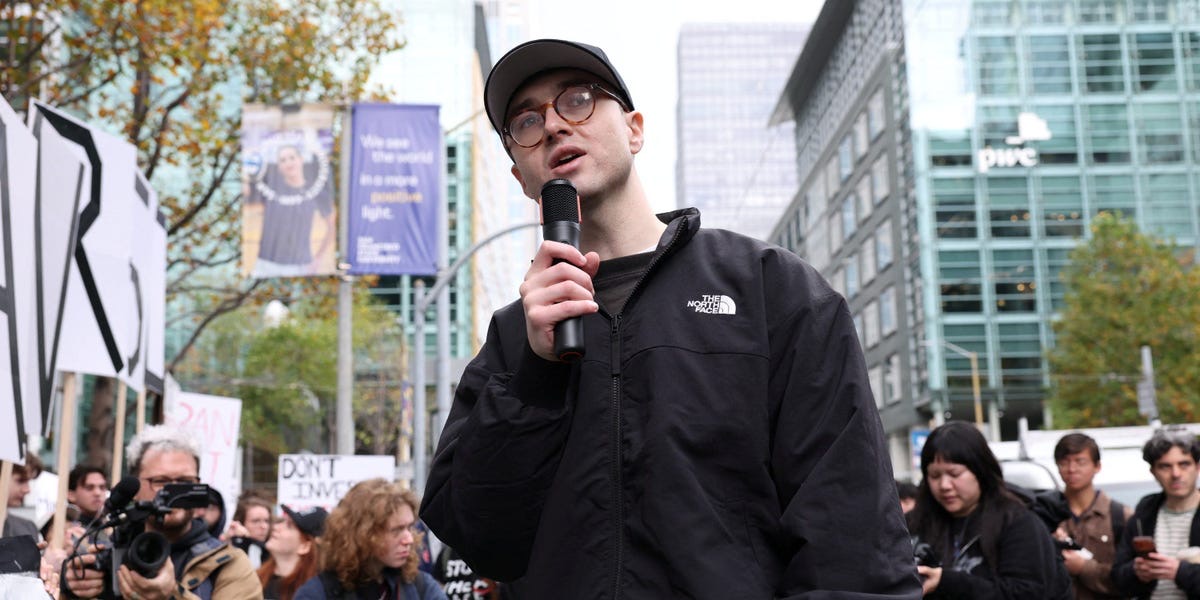
The company's blockbuster initial public offering valued Anthropic at $1.7 trillion, and on the same day a small crowd gathered outside its San Francisco headquarters with a different kind of message. Dozens of protesters joined a 'Ban RSI' rally, RSI being recursive self-improvement, the practice of getting advanced AI systems to train the next generations of AI.
Former Anthropic researcher Jacob Coxon, who left the company in September, told Business Insider that the stock listing did not change his position. 'It literally doesn't matter whether they invest,' Coxon said. 'We have to stop RSI.' He was joined at the event by ex-OpenAI researcher Daniel Kokotajlo and YouTuber Rob Miles, and a group from the organization Stop AI later blocked the office entrance.
The protesters' argument leans on evidence the company itself has put on the record. An independent report from the AI safety organization METR recently found that AI use is already accelerating Anthropic's research and development. In its IPO prospectus, Anthropic wrote that it does not expect letting AI fully design its next generation without supervision would be safe, and said it is considering policy updates 'to keep humans in control of frontier model development.'
Coxon wants more than internal policy changes. In his speech he urged Anthropic to lobby the government and coordinate with other companies toward a full ban on RSI. 'At this point, the companies are the problem,' he said. 'There are only a few places in the world where recursive self-improvement is possible in 2027. And this office is one of them.' Coxon and Kokotajlo both said that, in private, AI researchers voice alarm about the technology's risks, and those concerns have reached Congress, where representatives have begun floating restrictions on RSI.
Oliver Habryka, who runs the company behind the forum LessWrong, told Business Insider he is glad that, now that it is public, Anthropic will be legally required to disclose certain information. He still worries the company will feel pressure to use RSI to stay ahead, since it pitched its industry lead to investors as a competitive advantage. His particular concern is biology: AI has grown rapidly more capable in recent years, and with RSI, he said, 'things can go much faster than that. And that is terrifying.'
David Krueger, who runs the AI-risk awareness nonprofit Evitable, said he believes that if more people understood RSI they would largely agree it is 'insane.' He welcomed the protest but said such demonstrations only partly reach the people working inside. 'My impression is that people at Anthropic have really drunk the Kool-Aid,' he said.
For the founders and operators watching this market, the lesson is practical. A public listing brings disclosure rules that will shape what the company can say about how its models are built. Rules imposed from outside, whether by regulators or by activists, tend to land hardest on the firms that have the most valuable capabilities to protect. Investors should read the prospectus language carefully, because the gap between a company's stated controls and what its critics demand is where the next fight will be fought.
The editorial reading here is that a ban on RSI would be a sweeping government intervention into how a private company develops its own products, decided by a loose coalition of activists and lawmakers rather than by the market. Innovation depends on the freedom to experiment, and a blanket prohibition would hand the frontier to whichever jurisdictions choose not to impose one. The sounder path is transparency through the disclosure duties now in force, with companies held accountable by investors and the courts rather than by a stop order.


