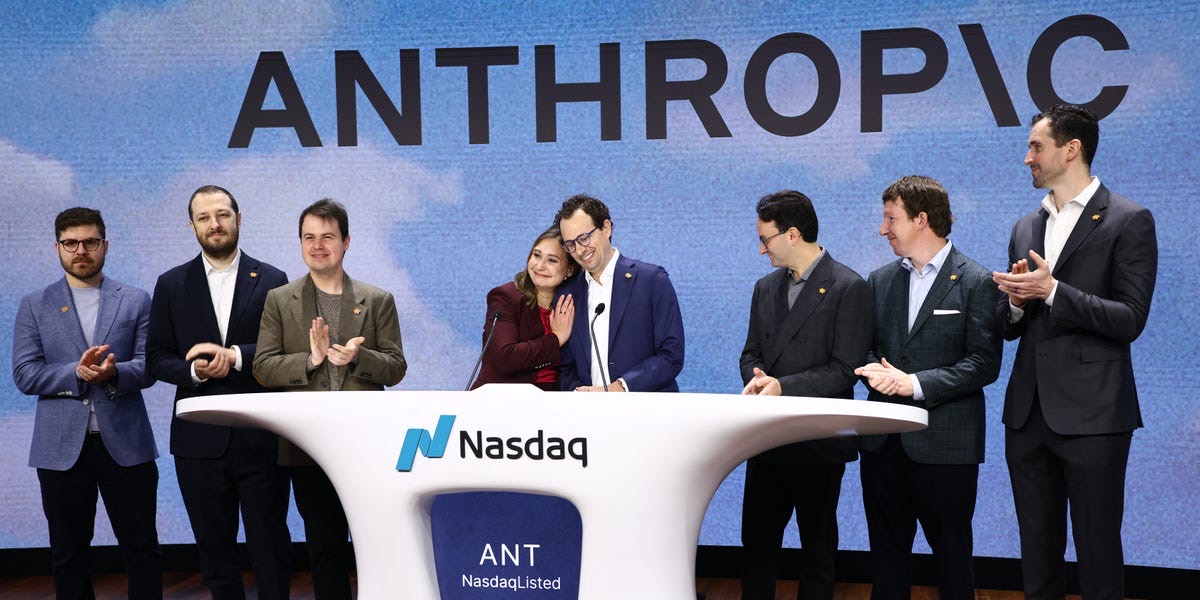
Anthropic's founders have built a safeguard that Nvidia cofounder Jensen Huang did not have. According to Business Insider's Alistair Barr, the AI company's seven cofounders, including CEO Dario Amodei, collectively control 50.1% of shareholder votes through a special Class F share. Under that structure, the voting power stays intact no matter how many ordinary shares Anthropic sells.
A separate, independent trust holds Class T stock, which generally lets it appoint and remove a majority of the board. Anthropic says these protections are necessary because AI is so powerful that its development must be shielded from short-term investor pressure.
There is also a more practical benefit. It is extremely difficult to oust leaders who control their company's voting power.
Barr points to a historical precedent. In 2004, when he covered Google's IPO for MarketWatch, cofounders Larry Page and Sergey Brin insisted their search engine was too important to the world to leave to ordinary shareholder votes, so they issued special voting stock. Other tech founders, including Mark Zuckerberg, followed their lead.
Nvidia took a different path. Huang cofounded the company 33 years ago, when it made video game chips, and special voting stock was rare in tech at the time. Today Nvidia powers the AI revolution, but Huang owns only about 3.5% of its shares, without special voting rights. Barr suspects Huang would do things differently if he could start again.
Here's the playbook. If you are raising capital and want to keep your company's direction in your hands, the cap table is where that decision gets made. Dual-class and special-voting structures let founders absorb new equity rounds without giving up control. The math is simple: the more stock you sell, the more your ownership percentage shrinks unless your voting rights are separated from your economic stake.
That does not come free. Investors price governance risk, and a structure that insulates leadership also limits accountability to shareholders. Founders who adopt these terms should be clear-eyed about the trade-off between protection and oversight.
For founders, the lesson is to decide early who should control the company and write that into the charter before the first major raise, not after. Founders who get this right move faster, because they are not negotiating their own job security every time the company needs capital.


