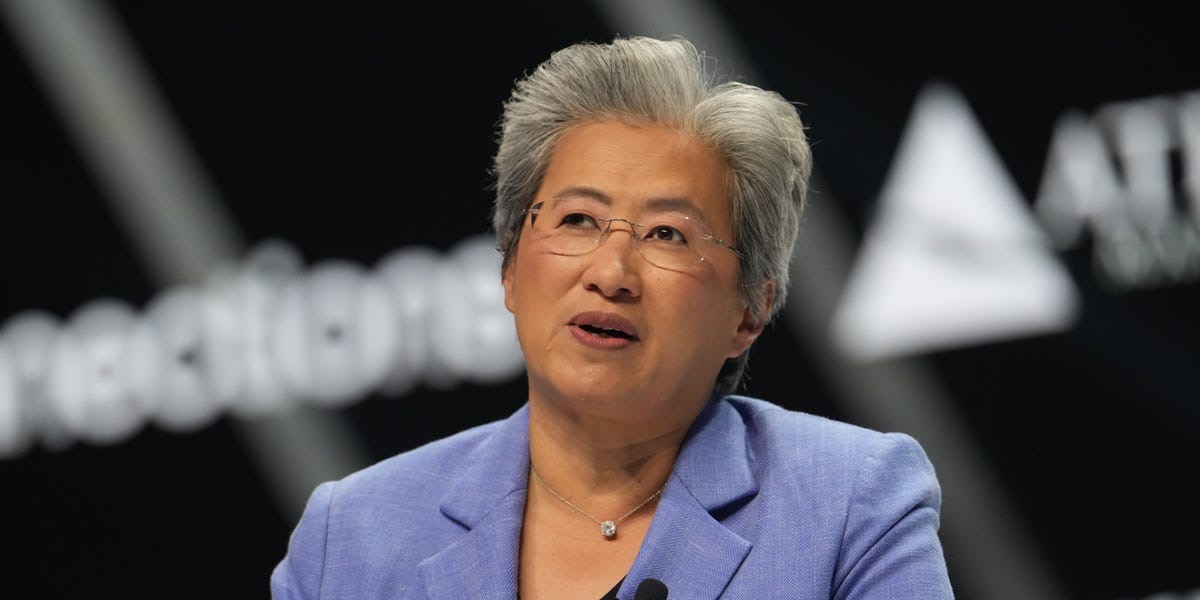
AMD CEO Lisa Su has praised her cousin, former Nvidia CEO Jensen Huang, as a 'tremendous leader for the industry.' But she made clear that her company intends to keep its distance from the turmoil at its largest AI-chip rival.
Speaking with Dominic Rizzo of T. Rowe Price at the TomorrowX Summit in Austin on Wednesday, Su said, 'Nvidia is a phenomenal company.' She added, 'What I try to do from an AMD standpoint and from an industry standpoint is, look, we have to separate a little bit from the noise. The noise will work itself out in time.'
Her comments were her first on the upheaval at Nvidia since Huang's resignation the previous week. Huang left after the board opened an investigation into whether he was 'the target of a foreign intelligence effort,' and he apologized for being unfaithful to his wife. Nvidia's board appointed Colette Kress as interim CEO and has said it has no intention of reinstating Huang.
Media reports have since put Nvidia's business dealings in China under scrutiny, just as the US moves to tighten the flow of AI chips to the country. That scrutiny has spilled over to AMD. On Thursday morning, its shares fell as much as 10% after a short-seller report from Hunterbrook claimed that 'AMD firmware keeps turning up at a blacklisted Chinese company and three companies tied to it.' The shares pared some of those losses. AMD did not immediately respond to a request for comment.
Su did not directly address the allegations involving Huang, his resignation, or whether AMD could benefit from the leadership upheaval at Nvidia. Instead, she said AMD sees a 'tremendous opportunity' to help build the infrastructure for AI and to deliver for customers. She also argued that the tech industry must ensure communities affected by data center development 'feel the goodness of it.'
What this means for founders: when a rival stumbles, the instinct is to pounce. Su's approach is a discipline worth copying. Staying out of a competitor's noise protects your own message, your own customers and your own balance sheet. Her point about the infrastructure buildout is the operational takeaway. Demand for AI capacity is large enough that a company can win by executing on its own roadmap rather than by waiting for the leader to fall.
The editorial reading is this: markets punish companies that get dragged into rival scandals, and they reward those that keep building. A 10% intraday drop on a short-seller claim shows how fragile sentiment is, even for a company with no finding against it. Founders who run lean, with clear customer commitments and transparent China exposure, are the ones best positioned to ride out this kind of volatility. Hype and headlines fade. Disciplined execution compounds.


