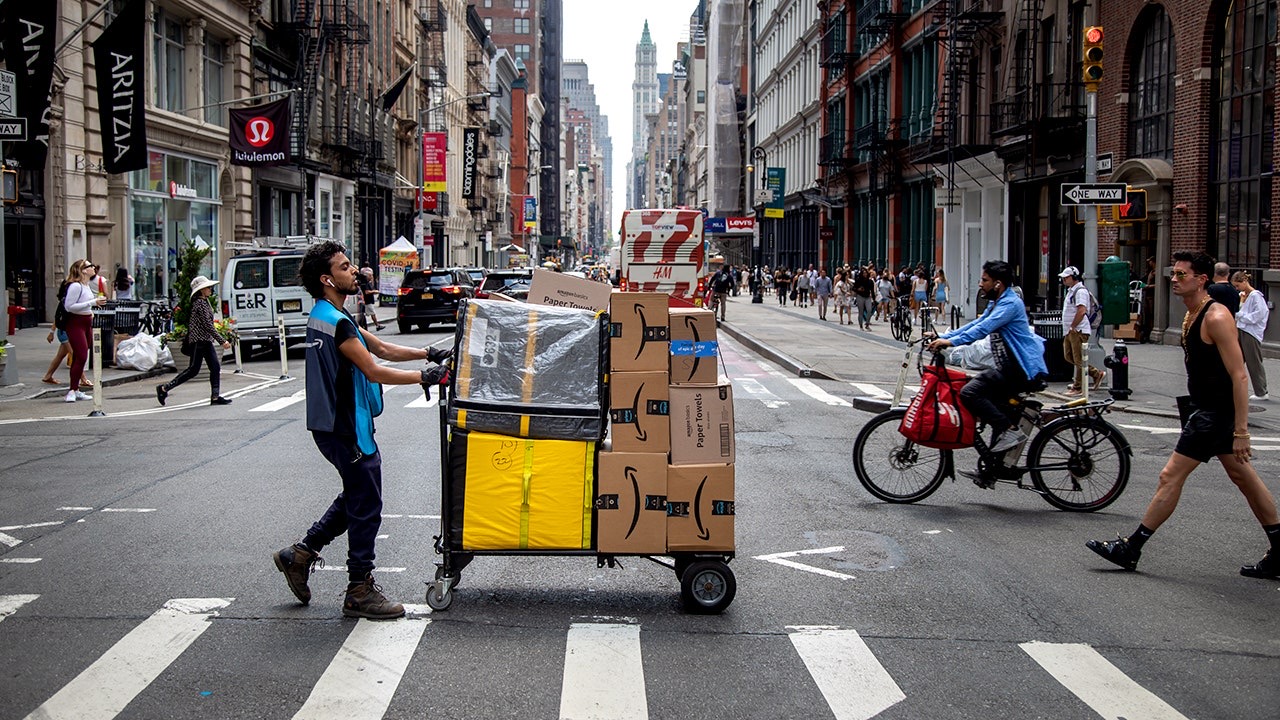
Shoppers in New York City who opened the Amazon app this week may have seen an unusual message: a red banner warning that the City Council "could add up to $5 per order." The retailer is using its own storefront to rally customers against Intro 518, the Delivery Protection Act, and it includes a form that lets them contact their council representatives directly.
The bill would require companies operating last-mile delivery facilities to obtain city licenses and to employ the people who handle and deliver packages, rather than relying on independent contractors. Amazon currently works with more than 40 local delivery businesses that employ more than 5,000 people in the city, according to its testimony to the Council. The company says that if the law passes as written, it would no longer be able to use those partners and would have to consider moving operations outside city limits.
The $5 figure needs careful reading. The bill does not impose any surcharge on customers. Amazon says the number reflects what compliance would cost, but it did not explain how that cost converts to a per-order amount. It also cited a study by the consulting firm AKRF estimating that the law could add $409 to $664 a year to New York City household costs. Those are two different numbers measuring two different things, and the gap between them is worth keeping in mind.
City Council Speaker Julie Menin pushed back sharply. "It defies logic that Amazon, a $3 trillion corporation, would raise New Yorkers' cost of living if it's forced to adhere to basic regulations and worker protections," she said. Mayor Zohran Mamdani and labor groups, including the Teamsters, back the measure, arguing that the subcontractor model lets large companies dodge accountability for how drivers are treated. The city's Department of Consumer and Worker Protection has endorsed the bill while acknowledging concerns about some of its provisions.
For founders, the practical lesson is about exposure. A business that depends on a network of independent contractors can see its cost structure rewritten by a single municipal vote. If you run a logistics operation, a marketplace, or any model that sits on outside contractors, map which of your costs would change under a reclassification mandate before a bill gets to a vote.
The editorial reading is this: a cost imposed on a business is ultimately paid by someone, and in a city of this size that someone is usually the customer, the taxpayer, or both. Mandates that force operators to restructure their workforce reduce the flexibility that lets small delivery firms exist and compete. Whatever one thinks of the labor policy, the principle at stake is clear: the government deciding how a private company must organize its workforce, and the price shoppers pay for that decision.


