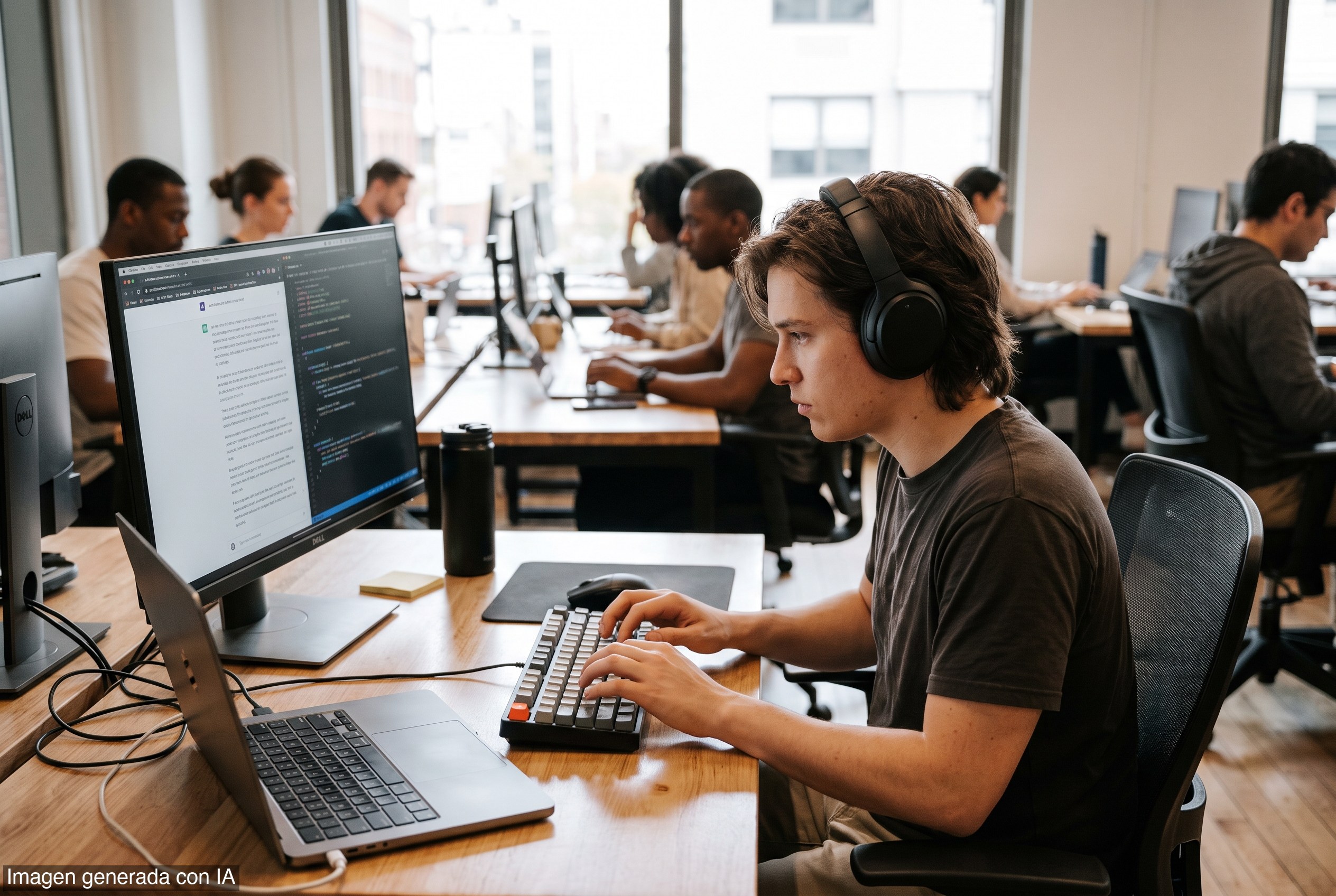
Julia Andrusiak used to type with two fingers in college until one professor kept pausing his lecture because her keyboard noise was so distracting.
That moment pushed her to drill typing harder. She started by typing out books, then moved to touch typing, and now, at 26, she still works on speed and accuracy while using AI in a job focused on helping people use the technology.
Her experience is part of a broader shift among younger workers and students. Some Gen Zers are treating typing as a comeback skill as AI becomes more common in daily work. The logic is simple: AI tools are only as good as the prompts you give them, and vague voice prompts can be too loose to get useful results.
Andrusiak said she likes using AI for writing and research, but worries about relying on it too much. She said one friend told her that you do not need to type a whole page anymore, only short sentences, but she sees that as outsourcing too much cognitive power to technology.
Andrey Gerasimov, a 23-year-old computer science graduate, never took typing classes. He first built the skill for video game chats and eventually reached 170 words per minute. As he sees it, faster typing makes prompting more efficient because you can put your full thoughts down without feeling like it takes forever.
That same pressure is showing up in classrooms. Andreas Francazi, a 36-year-old IT teacher in Vienna, said he has taught typing for a decade to people ages 15 to 30 and has noticed their skills deteriorate. He said many of his newer students did not grow up around physical computers and are much less familiar with keyboards than previous generations.
Francazi also said some students arrive typing quickly with just two fingers, so he is teaching them the basics. He described typing practice as meditative, saying it can calm students down as they focus character by character on the text in front of them.
The demand is reaching products too. Nick Sjolinder, the founder of BYOK, said about 10% of the device's orders come from educators, including elementary schools, middle schools, high schools, homeschools, and universities. He said a recent batch order came from a high school creative writing teacher who wanted to cut down on AI and distractions for students.
Tarun Krishnamurthy, an 18-year-old sophomore at San Diego State University, said his professors speak quickly and move through slideshows fast. Because he began practicing typing in middle school, he can keep up better than some classmates.
For founders, the takeaway is straightforward: in an AI-heavy workflow, speed is not just about convenience. It is part of the productivity stack. If workers cannot get their thoughts into the machine quickly and clearly, typing becomes a bottleneck.
Founders who get this right move faster. The skill may sound basic, but the people who can capture ideas, prompts, and notes without friction will likely have an edge in classrooms and in the labor force. In a world that rewards output, keyboard fluency is becoming a small but real advantage.


