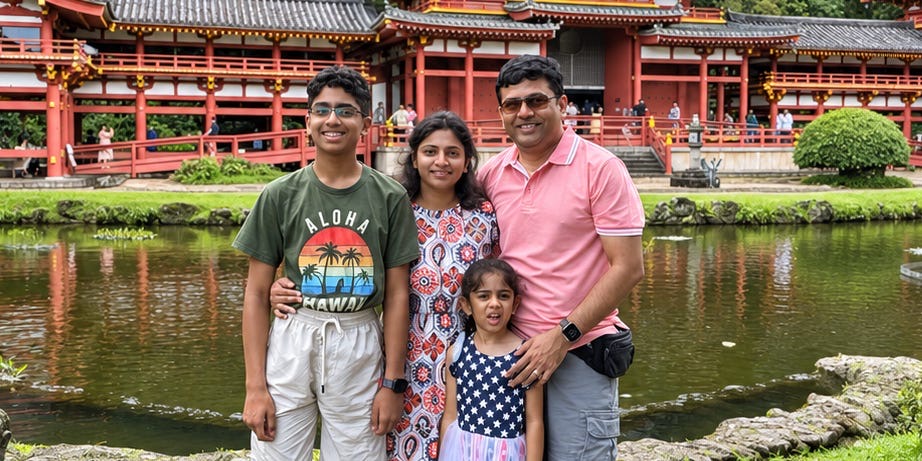
Balaji Gururajan, 44, spent 18 years building a career in the United States. He worked at Microsoft, LinkedIn and Meta, became a US citizen, and raised two children in the San Francisco Bay Area. This June, he and his wife rented out their house, sold their cars and furniture, and moved to Bengaluru, India.
He came to the US on an H-1B visa after working at Wipro and Philips Medical Systems in India. He joined Microsoft a year later. Like many skilled engineers, he took a path that started with a visa and ended in citizenship. The decision to leave was not a rejection of that path.
The reasons were personal. Gururajan said the US culture of independence left his family without the support network he grew up with. His in-laws are in India and cannot easily travel to live with them, and his mother, who had lived with the family for nearly five years, was lonely in California with few people her age. His children had only seen India on short, curated vacations.
The move also involved real trade-offs. His son is 14, and the family weighed the risk of disrupting his high school years, so they moved before that point. They kept their Cupertino house as a fallback in case things went badly. The kids now attend an English-speaking school that follows an international curriculum, and Gururajan said his son has made friends.
The household math has changed too. He said the family lives in a gated community where rent is about $1,050 a month, and a helper who handles household chores daily costs another $260. In the US, he and his wife did everything themselves. Now he has time to take his daughter to the park and help his son with schoolwork.
For founders and operators, the lesson is about planning. Gururajan did not walk away from his career. He is taking a sabbatical after nearly 20 years of nonstop work and is still deciding whether to return to a similar role or build something of his own. He kept a financial safety net, prepared for months, and treated the move as a reversible experiment.
He was also candid about the downsides. Traffic and infrastructure gaps are real, and he acknowledged that his relatives were surprised by the decision. Still, he said what India offers now is impressive once those problems are set aside.
Gururajan and his wife have framed their plan as a home base rather than a permanent answer. If their children settle abroad, the couple expects to split their time between India and wherever the kids live. When that becomes too hard, they will stay in Bengaluru.
The free-market takeaway is that talent is mobile, and the economic case for a country is only one input. Family, cost of living and personal autonomy all count. Founders who plan moves like this as deliberate capital allocation, with a fallback, a timeline and a clear list of priorities, tend to make better decisions than those who drift.


