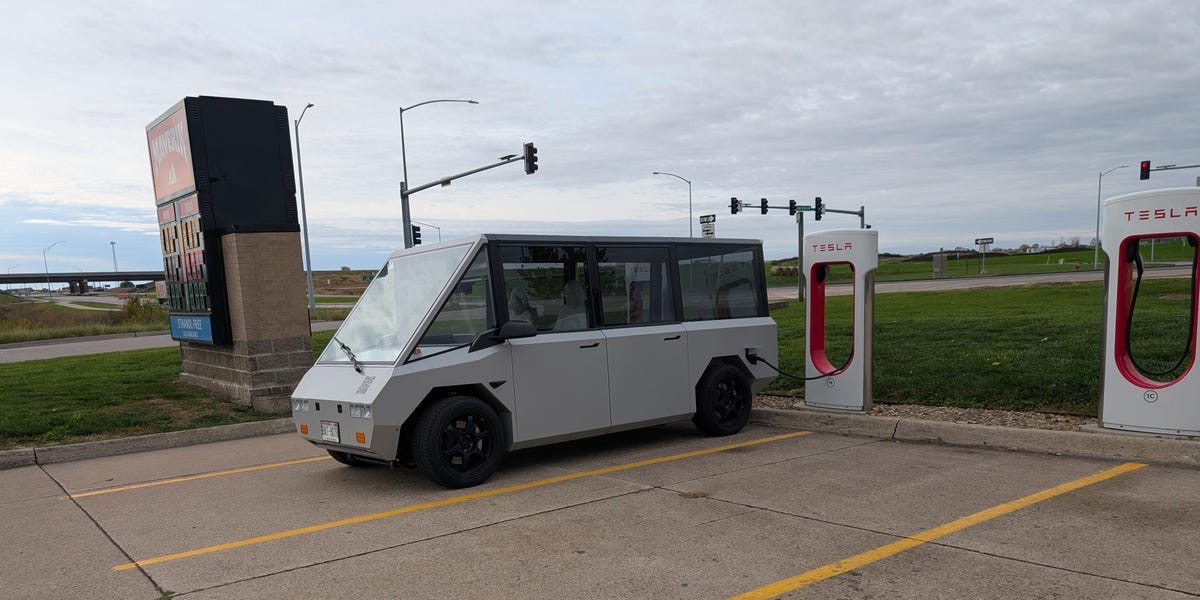
Tesla has never sold a minivan. Geoffrey Hoffman saw that gap and decided he didn't need to start a car company from scratch to fill it.
His six-year-old company, Hoffman EV, is based in Wisconsin. It recently showcased the Badger at the SEMA trade show in Las Vegas. Hoffman describes the vehicle as "dorky-looking," and it is equal parts off-road toy, cargo van, and Tesla recycling project.
"I wanted to create something that had fun elements to it," he said. "I built something that was what I wanted to use for myself."
Here's the playbook. Instead of building its own platform, Hoffman EV reuses the battery, motors, computers, cameras, interior screens, wiring, and seats from older Tesla Model 3s. The company wraps the vehicle in a new aluminum body. That's a very different wager from the hulking, expensive electric trucks that struggled to win American buyers.
The math is simple. Hoffman's current target pricing breaks down to about $10,000 for the chassis, $40,000 for a body kit, and $10,000 for the build itself. Add a roughly $20,000 donor Model 3, and the Badger could cost about $70,000 before taxes.
The model also leans on a dependency founders should notice. The Badger gets access to the Tesla Supercharger network, Tesla's software updates, and Tesla's semi-autonomous driving technology. Tesla has no involvement in the project, and there is no communication between the two companies. Hoffman said Tesla could restrict that access or disable features in the future. For him, that risk is worth taking, because the vehicle lets him build on some of the auto industry's best technology.
Range is the real constraint. Hoffman drove the Badger to Las Vegas and back, but its current highway range is only about 150 miles, a figure he called "probably unacceptable." The next prototype targets 200 miles of highway range, and the team is working on aerodynamics to reduce wind noise and improve efficiency.
On semi-autonomous driving, Hoffman is cautious. The Badger can technically use Tesla's FSD (Supervised) features, but he doesn't recommend it. The van is shorter than the Model 3, which might confuse the technology, he warned.
Hoffman EV is targeting 2027 for reservations and production, and it predicts it can build about 100 units annually. The company is still debating whether to sell fully assembled cars or kits that customers piece together.
Hoffman is also clear about the scale. He knows the company isn't expected to become a mass-volume seller. "I think I have a really good concept here, or at least a lot of smart people have told me so," he said. "It isn't going to fill any gaps in the market at such low quantity or solve our climate crisis, but it should make some people happy."
For founders, the lesson is about discipline. Hoffman didn't spend capital building what already exists. He reused proven components, priced for a narrow buyer, and kept the cost of entry low enough to test demand before scaling. Start smaller than you think, and let your donor parts do the heavy lifting.
The free-market reading is straightforward. Hoffman is taking a risk without a government subsidy, a bailout, or a giant balance sheet behind him. Buyers who want a practical electric van, and who value a custom build over a corporate product, get to choose. That is what competition is supposed to deliver: more options for people with their own money to spend.


